
 Heartthrob or heartache? Sudden attraction or slow connection? With Valentine’s Day approaching, and its card exchanges popular even in some pre-schools, the recent publication of Svetlana Chmakova’s Crush (2018) was aptly timed. This continuation of the author/illustrator’s award-winning Berrybrook Middle School series targets tween readers, the age at which crushes typically first loom large. Today I look at this very enjoyable, satisfying graphic novel and another recent graphic work about first and ongoing loves, M. Dean’s memorable I Am Young (2018). That book will appeal more to teen and older readers, with its look back at how folks frequently used to get and manage crushes, before these days of (often successful) online dating websites.
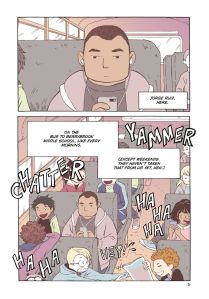
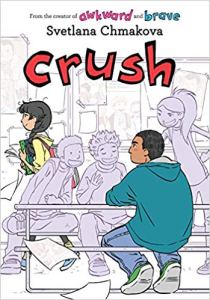 Crush’s central character, 13 year-old Jorge Ruiz, first appeared in Chmalkova’s Brave (2015) and Awkward (2017), reviewed by me here,but Crush works well as a stand-alone-novel, too. I believe that readers who first experience engaging Jorge’s point-of-view here will eagerly seek out those other Berrybrook Middle School works! Chmakova does a great job communicating how Jorge’s big, athletic build—his stereotypical “jock” appearance—does not match his sensitive nature and thoughtful mind. He is one of Berrybrook’s unofficial peacekeepers, watching out for other kids at risk from bullying, and quietly annoyed at how crushes are the hot topic at school.
 Wordless panels and others with word balloons filled only with ellipses show us Jorge’s gradual, then stunned realization that he too now has a crush—on classmate Jazmine Duong. As the novel’s eleven chapters unfold, we see Jorge later daydreaming about Jazmine in even softer pastels and also read his astute, rueful conclusion about his own change-of-heart about crushes: “I guess that’s why you can predict movie plots . . . but can’t predict life.”
Chmakova’s visual style, employing the manga conventions of cheek lines for blushes and wide mouths for other strong emotions, supports Crush’s story lines and character development. Sub plots involving some self-centered and insecure tween characters add dimension to school life here, as does the understated 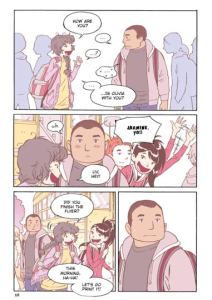 depiction of a hajib-wearing gym coach, a lesbian teacher whose wife accompanies her to school events, and what appears to be a non-binary drama club character, Nic. This rich texture of daily and seasonal school events adds heft and poignancy to the slow development of Jorge and Jazmine’s relationship from friends to “boyfriend” and “girlfriend.”
Even figuring out how to ask for—or give—a phone number for texting is a situation the pair realistically stumbles through. Along the way, Chmakova points out that Jorge admires Jazmine’s spirit and not just her appearance, unlike another shallow character. We see that sincere dating duos, like real friends, steadfastly support one another’s efforts and events. A cheek kiss and a “Hi, Jorge” sweetly conclude this tween-age saga. Chmakova’s fans will further appreciate the author’s “Afterward,” interestingly and entertainingly showing how over months she developed Crush, becoming a mom during this time period, too.
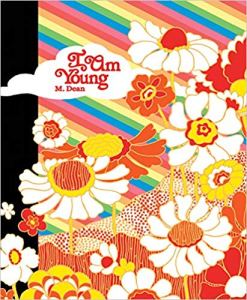 That conjunction between adult life, often linked to parenthood, and its frequently problematic relationship to tween or teen crushes is central to M. Dean’s I Am Young. This visually lush book contains six short stories spotlighting such intense emotional connections, also including a non-romantic one between two female best friends. A widowed father and adult daughter who no longer “connect” figure poignantly in another story. All these distinct stories, some set in the U.S. and others in Great Britain, alternate with episodes in a seventh, prominent framing story—the saga of one couple’s relationship with one another, begun as a sudden crush, when Miriam and George meet as teenagers at a Beatles concert in 1964 Britain. We follow that crush, continued at first through hand-written letters, throughout the pair’s lives, the passage of time signaled by different Beatles album covers as well as Miriam and George’s whitened hair. Regardless of age, Dean’s characters all have the large eyes and simple facial features and bodies of cartoon characters.
 Music is important throughout I Am Young, with Dean altering her color palette and graphic style to match her other characters’ very distinct musical tastes and eras, along with the each story’s plot line. Miriam and George’s Beatlemania is shown in black-and-white, while Lisa’s later psychedelic tripping to the Beach Boys’ Pet Sounds is depicted in deep pink, gold, and green swirls. High school seniors and best friends Kennedy and Rhea, whose growing differences are summed up in their opposing views of pop singer Tom Jones, are shown in somber beiges, maroons, and olive green.
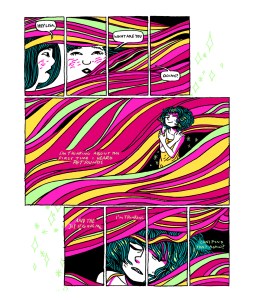 Dean smartly varies the size and shape of panels in these stories, sometimes omitting panel frames all together, to accentuate mood and events. Similarly, she makes some pages very busy or empty, with text sometimes centered or even omitted, in telling ways. When Roberta in “Baby Fat” begins to doubt that she really was ready at 18 to marry Pepe, we see her in the corner of a page, vulnerably small against a large vista. When she unwillingly derives some comfort from returning to her childhood home, Roberta is almost overwhelmed by parental concern along with her own doubts, shown nearly smothered by the busy patterns of a subdued blue quilt.
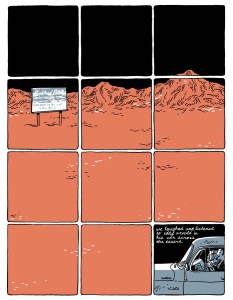 Throughout this visually rich and emotionally wise book, Dean continues to question crushes and how we see others and ourselves. In “Nana,” the central character continues to doubt herself harshly, but she realizes that a shared love of Karen Carpenter’s music is not enough for a former school bully to become a new, close friend. In “Alvin,” the brainy central character has a retro appreciation for Chuck Berry, but that and all the theories he knows about social injustice cannot get him a date for his high school’s “sock hop.” Alvin is left alone, with a migraine headache. M. Dean cumulatively fulfills her goals for this graphic work in each story. In an interview, she said, “I want to tell stories about the foibles of youth, the mistakes and nuances, the people, places, and things that feel important.” Dean added, “I realized a title like I Am Young reveals both naivete and an acknowledgement that everyone grows older and changes.”
Readers who are mature enough to take an objective view of crushes vs. adult  relationships or who enjoy music and art will take particular pleasure in Dean’s storytelling achievements here. I also believe that those of us old enough to remember the Beatles’ 1960s debuts in Britain and the U.S. will find much to be nostalgic about in I Am Young, even as I ruefully wonder if some young readers (or perhaps the tween characters in Crush) might mistake the circular vinyl record and record album covers Dean depicts for CDs! In these days of streaming music, perhaps CDs will soon lose their familiarity as well.
As someone who no longer says, “I am young” but still very much appreciates  exchanging valentines with my white-haired husband, I find the final double spread pages of M. Dean’s novel particularly meaningful. On the left, we see aged Miriam and George, now barely old acquaintances, while on the right we see the couple as they first met, teenagers sitting together, with handwritten greetings to one another at the top and bottom of the page. There is something to be said for memories and being young at heart—and M. Dean captures it here.
 At the start of a new year, in our sometimes Kafkaesque world, it is good to realize that not all tales from the inner city are bad. What exactly do I mean by that remark? I hope you will be amused that it contains the titles of two new graphic story collections I am about to discuss. Today I look at works by master storytellers Peter Kuper and Shaun Tan, whose award-winning achievements I have reviewed before. Some earlier works by both artist/illustrators are discussed
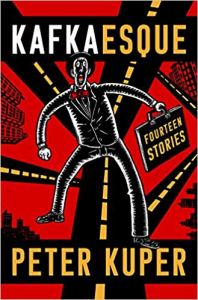 Words, though sparsely used, are integral to Peter Kuper’s Kafkaesque: Fourteen Stories (2018). On the book’s frontispiece, Kuper describes this work as a “conversation with [Franz] Kafka.’’ This Czech author (1883 – 1924) wrote such powerful novels and stories depicting the absurdities of government and cruel circumstances of people’s lives– including The Trial, The Castle, and The Metamorphosis—that his name has become a synonym for nightmarish bureaucracy—“Kafkaesque.”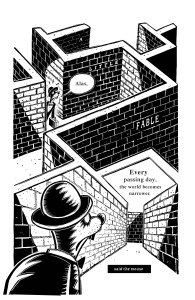
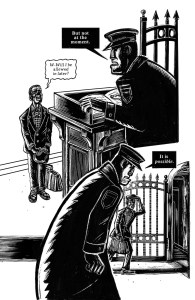 character in “Before the Law,” even as we see him initially questioning the guard who will not let him enter an important government building. Kuper’s making this seemingly powerless figure a Black man adds another layer of meaning to this “conversation with Kafka.” The years-long fictional exchange here, portrayed in a two-page double spread swirl of images, ends ironically, with the guard’s revealing that this entrance was always meant for the now dying, too patient character. He never tried to force his way past the guard. Readers may well wonder about our own life choices and whether or when it is wise to delay action. Like most of the stories in Kafkaeque, these are only five or six pages long.
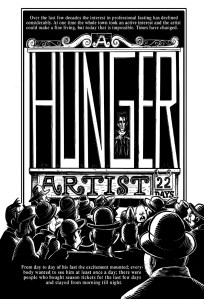 Two of Franz Kafka’s best-known short works, though, receive lengthier interpretations. Kuper devotes 22 pages to “A Hunger Artist” and 45 pages to “In the Penal Colony.” These sobering, thought-provoking stories about what spectacles people watch and what measures our judicial systems consider to be justice raise multifaceted questions. They touch on human nature in general but are also highly relevant to today’s social media-driven world and to current issues in U.S. judicial reform. Here, as is typical in Kuper’s work, panel size and shape vary to emphasize the mood of each story element. Similarly, Kuper’s exaggerated abstraction of facial features and body language dramatizes his sympathy with Kafka’s nightmarish views.
 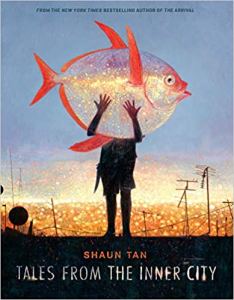 Shaun Tan’s Tales from the Inner City (2018) is more varied in tone than Kafkaesque, but it too contains dark elements as it explores the relationships among animals and supposedly superior human beings. The 25 prose poems and short stories here are Tan’s “sister volume” to his earlier collection of 15 illustrated short pieces, Tales from Outer Suburbia (2009). In both these works, it is the illustrations that will speak most eloquently to readers of all ages. Tan’s stories in this latest volume, though, seem geared to a tween on up audience.
 As he has explained on his
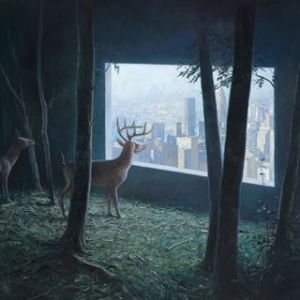
 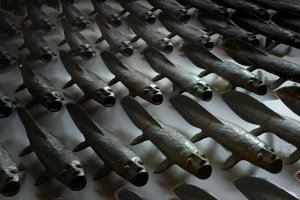 inspire the final visual piece, in each instance here a full-color painting. Sometimes Tan photographed real-life places, gaining naturalistic details, while at other points, his own drawings or “doodles” were his visual inspiration. One illustration—of a deer on the upper floor of a skyscraper—even early on was a diorama, populated by stand-up figures Tan made! The author built clay-and-plaster models for another painted illustration here, that of fish with almost human faces.
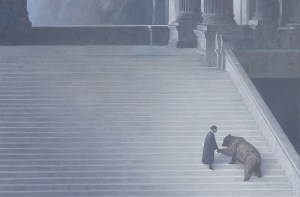
 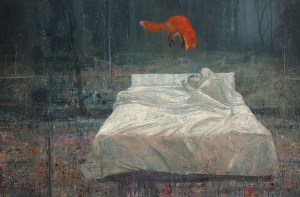 Giant snails on a city bridge; a leaping fox in a sleeper’s bedroom; in an echo of Kafkaesque legal systems, a bear with its lawyer lumbering up courthouse steps—these eerie images are memorable and thought-provoking. Yet it is Tan’s longer works centering on dogs and cats that also touch one’s heartstrings. A series of 13 wordless, double spread paintings depict the
  long history of human-canine interaction while also referencing the devotion of dogs to their humans. The short poems that accompany these paintings highlight the sad reality that dog lives are so much shorter than human ones—people will inevitably experience the loss of this bond. As Tan writes, “And when you died I took you down to the river. And when I died you waited for me by the shore. So it was that time passed between us.”
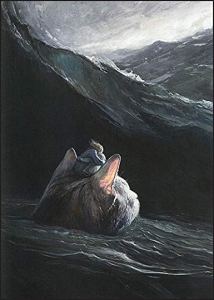 In a parallel twist on this theme, Tan illustrates a cat loss story with a painting of a literally absurd but emotionally-true situation. Just as the death of their cat has rescued a woman from frozen emotions, allowing her to shed tears as she grieves with other bereft cat “owners,” we see a giant cat rescuing its people. The woman and her young daughter sit on the now gigantic cat’s head, kept safely above a sea of crashing waves. Her newly-found ocean of tears will not capsize this mother with grief. Tales from the Inner City is full of such moving images, sometimes provoking sentimental as well as sharply-questioning responses.
 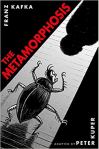 Metamorphosis (2004). It already appears in some high schools’ curriculum. For an overview of Kuper’s works, including the more light-heartedly satirical “Spy vs. Spy” pieces he has created for Mad magazine, readers can browse the author/illustrator’s
  Giving “experiences” rather than “things” is a trend this winter holiday season, making graphic literature a fashionable, two-for-one joy for the tween-and-up readers on your gift list. They can hold a volume in their hands, actively scanning between text and images, flipping back-and-forth between pages, as they mull over and revel in how a great graphic work builds its many layers of meaning. I have two sumptuous books to recommend this month, works that will move hearts and minds even as their rich imagery and high-quality production values satisfy hands and eyes. One will even tickle funny-bones as it is read and reread . . . . These recently published novels have already been acclaimed among this year’s potential award winners.
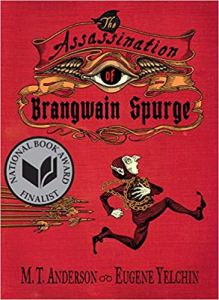 The Assassination of Brangwain Spurge (2018), written by M.T. Anderson and illustrated by Eugene Yelchin, uses humor and the traditions of fantasy fiction to comment slyly on real-world politics and problems. Its central characters are elves and goblins, at war with each other for a thousand years, whose different takes on that history and mistaken ideas about one another mirror more than a few conflicts today. When elf Gawain, a timid historian, is drafted to be the ambassador to the goblin kingdom—and ordered to spy on the goblins as well, the fun begins. How Gawain interacts with his goblin host Werfel and his distant elven spymaster Lord Clivers is the central plot here, one packed with breathless action and escapes as well as scenes of daily goblin life and high court pomp. Goblin habits are, by human standards, often gross! Young readers and others merely young-at-heart will enjoy details there, including the behavior of Werfel’s affectionate pet—a flying, fishlike creature with tentacles. But it the way Anderson and Yelchin tell this story that makes this book such a gem.
 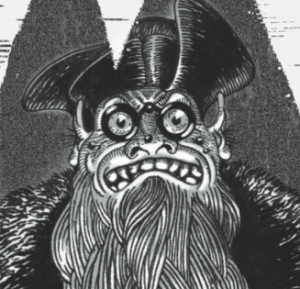 Gawain is a hybrid graphic novel—one that intersperses pages of prose with pages of wordless images which themselves advance its story-telling. (I have written about other hybrid graphic novels, including
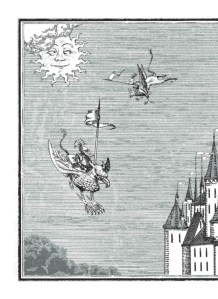
 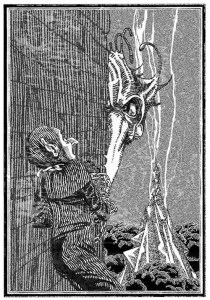 Award-winning illustrator Yelchin inventively styles these imagined views as Renaissance engravings, in the vein of Albrecht Durer’s woodcuts. There are more than 180 pages of black-and-white images in this 500 page book, with changes in perspective and distance advancing fast-paced action even as other scenes contain so many humorous, clever details that the eye lingers. Readers may well page back to see and savor more—I know I did. Yelchin gives characters here such distinctive facial emotions and body language that we empathize with these cartoonish characters’ woes even as their antics make us smile.
 Anderson’s language will also delight those readers who appreciate the somewhat old-fashioned, formal language of traditional fantasy epics, also when appropriate switched out to other verbal styles. The “broken Elvish” some Goblin nobles try to speak is a hoot: one enthusiastically invites Gawain into her home by saying “I punch you with me house hard, many time.” The book trailer for The Assassination of Gawain Spurge, which concludes with Anderson and Yelchin pretending to bicker about their collaboration, captures the tone as well as the content of this work.
 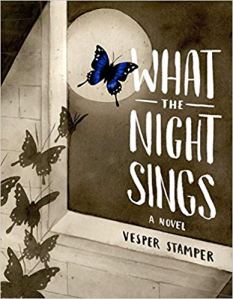 Vesper Stamper’s richly-illustrated novel What the Night Sings (2018) is more serious in tone. Focusing on the Holocaust experiences and survival of 16- year old Gerta Rausch, a German-Jewish musician, this powerful work is both moving and uplifting. Illustrator/author Stamper, herself born in Germany but raised in New York City, shows in images and words how profoundly resilient the human spirit is. At first, a younger Gerta is sheltered by her musician father and the opera star who mothers her; Gerta does not even know that she is Jewish! But their family is betrayed, and Gerta and her father herded into concentration camps. He does not survive. Gerta is near death when victorious Allied troops rescue her as they liberate prisoners at Auschwitz. (Some prior knowledge of the era might be helpful for tween readers, though When the Night Sings may also serve as sobering introduction, raising important questions.)
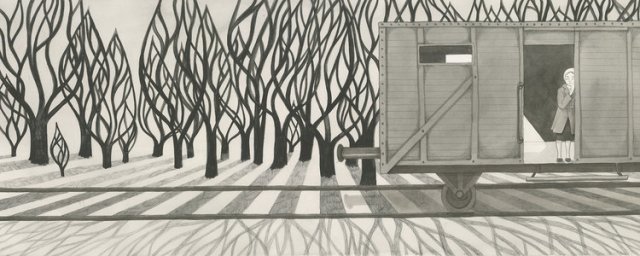 Gerta slowly rediscovers her singing voice and finds love in a displaced person camp, later marrying and immigrating with her new husband to Israel. Simple sentences, each word aptly chosen, are rich with metaphor as they communicate teen-aged Gerta’s thoughts: She realizes that her musician father’s viola, which she has managed to save, “is a forest. It is a living tree. It is the heartwood of our family.” This refrain is also seen in images throughout the book, where trees shown first as abstract, barren roots, trunks, and limbs gradually thrive and blossom. Gerta herself is sometimes shown in impossible, symbolic juxtaposition to these backgrounds, rather than realistically.
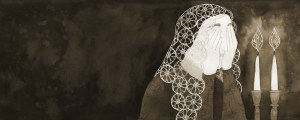
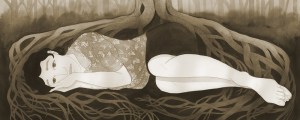 reappear later in this poignantly illustrated volume, in scenes which range from sorrow to hope and joy. Stamper depicts her characters’ many emotional and literal journeys in varied visual formats: quarter-page as well as full page or double spread illustrations, along with a dozen spot illustrations, all embody significant moments or emotions. Their muted palette of grey and sepia ink washes is as haunting as the sparse eloquence of Gerta’s religious husband-to-be Lev, also liberated at
 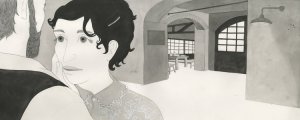 Auschwitz, who says, “The way I love you . . . It’s like music. It’s like praying.” Lev and Gerta relate to traditional Judaism in very different, yet ultimately complementary ways, as Stamper reveals through luminous words as well as images. I was not surprised to read in an
  readers will welcome. It contains information about events in Stamper’s life leading to that degree as well details of her Holocaust research, including photographs. A relevant map, glossary, and suggested further resources conclude this hardcover volume, printed on high-quality, heavy stock paper, enhancing the depth of shaded illustrations and further distinguishing it as a special, “giftable” volume.
 Santa Claus may not be this season’s biggest holiday myth. A more troubling fantasy here in North America may be the myth of the perfectly happy, affluent family—one celebrating its winter holidays with big smiles in a bright, cheerful home filled with presents. The many ads and other images featuring such families can be a far cry from what some kids and teens actually experience. Today, I look at two graphic works—one a personal memoir and the other a novel—that vividly depict real-life family problems as these play out during holidays as well as ordinary days. Addiction is the main problem in both books. Readers teen and up will appreciate how the central figures in these works cope with and survive family woes and, in one case, even win a bright future.
 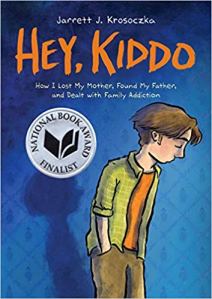 Author/illustrator Jarrett J. Krosoczka dedicated his recent memoir Hey, Kiddo: How I Lost My Mother, Found My Father, and Dealt with Family Addiction (2018) not only to his grandparents and mother but to “every reader who recognizes this experience.” Teens who know 41 year-old Krosoczka only as the
 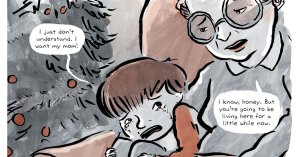 following year. Throughout this memoir, which follows Jarrett through high school graduation at age seventeen, holidays figure prominently: Halloween, Thanksgiving, and Mother’s Day are fraught with meaning and tension. Traditional Mother’s Day cards suit neither the love and disappointment of his relationship with mother Leslie nor the complicated devotion grandmother Shirley provides. It is sometimes hard for bitter-tongued Shirley to see beyond her own needs and beliefs, as when she dismisses the portrait teen-aged Jarrett has labored over for his grandparents’ 45th wedding anniversary gift. Her saying “It doesn’t look anything like us. You’re not that good” is terribly hurtful to him.
 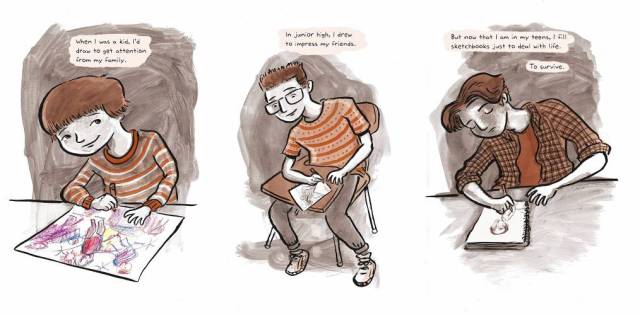 spotlighted by its placement on a double spread page with a black background. Such double spreads highlight other emotionally significant moments in this eight-chapter, 300-page work. We also see how some parental patterns have unintentional influences. Shirley and Joe themselves drink heavily, leading to household arguments. On a lighter note, Joe’s affectionate hello to Jarrett, “Hey, Kiddo,” is echoed by Leslie in some of the letters she writes to her son when she is (unbeknown to him) in prison. Jarrett Krosoczka as author does a great job capturing and reproducing the rhythms of everyday, idiosyncratic, and sometimes profane speech.
 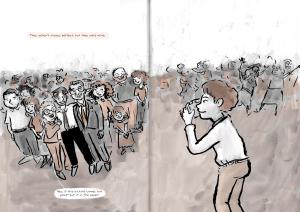 ornament. Readers never lose track of where we are in this memoir, while Krosoczka catches us up on subsequent events in an affecting final “Author’s Note.” The following “Note on the Art” is where we learn the origin of the book’s limited color scheme—a tribute to his grandfather Joe. Krosoczka at age 41 concludes his heartfelt memoir with images supporting his recognition that Joe and Shirley were “two incredible parents right there before me the entire time. They just happened to be a generation removed.” I myself find it moving that this echoes the dedication of his first published book, Goodnight, Monkey Boy (2001). Even back then, the 23 year old author/illustrator acknowledged “Grandma and Grandpa, the best parents a kid could ask for.”
  David Small, a Caldecott Award-winning children’s book illustrator, won further acclaim and awards in 2010 for his own painful graphic memoir, Stitches (2009), detailing his youth and dysfunctional family life in 1950s America. Small’s new graphic novel, though, titled Home After Dark (2018), is a fictional work set in the same time and milieu, but based on experiences told to the author/illustrator by a friend. This harshly poetic book is a breath-taking achievement!
  with no words at all. Russell is abandoned by his mother and later by his alcoholic father, set adrift in a small California town. This community is rife with school yard bullies, racist attitudes towards Asian immigrants, homophobia, and sexual stereotypes that make “girl” a slur when spoken to or about any teen age boy. Russell cannot even escape in sleep, as his fears and experiences transmogrify into frightening dreams. One dream transforms his limited understanding of the town business men’s Lions Club into a circus where Russell finds himself thrown into an actual lion’s cage. In a devastating image, Small draws the terrified teen crouched inside the lion’s wide-open jaws.
 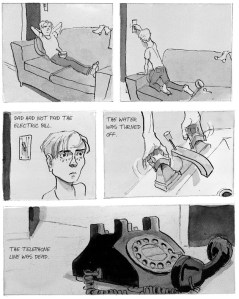 Yet there is also some hope here. Russell, who near the book’s conclusion says “I am nobody’s son,” is taken in by the Chinese immigrant family whose trust he has already betrayed once. The final page and image is of Mrs. Wah, calling Russell into their house, with the welcoming words that “Supper is ready.” For a teen who has despaired of life, summing up his biggest, seemingly insurmountable problem as his wish “to live without hurting anyone,” a second chance in that circumscribed, pre-Internet world now seems possible. Teen readers might want or need to talk about this book with others, for background insight into the era as well as discussion of the novel’s events and ideas. Home After Dark is well worth that commitment of time and energy for readers ready to explore the many issues, including alcoholism, it addresses.
  I plan now to decompress from Home After Dark by reading as many of the ten Lunch Lady graphic novels as are available in my local library! I have only personally read her adventures in a series of compilation volumes, the Comics Squad books, which Jarrett Krosocska contributed to as well as co-edited. (I reviewed one a few years ago
  reread my own copy of David Small’s searing memoir, Stitches. I will also remember to count each and every win as any woes arise. Fine graphic literature is definitely in my win column, along with family and friends, for whom I feel fortunate and remain grateful.
 What do we tell school-aged children who see, read, or hear news about this past weekend’s massacre at Pittsburgh’s Tree of Life synagogue? You already may have had to deal with initial reactions, but I have some print resources to offer—suggestions which may be helpful, depending on the ages and maturity of the children and your relationship (parent, teacher, librarian) to them.
  Two graphic novels published by the Anne Frank House in cooperation with the Resistance Museums of Friesland and Amsterdam help explain some of the causes—and horrible results—of 20th century anti-Semitism, unfortunately still pertinent today and so dramatically obvious this past weekend. A Family Secret (2007) and its sequel The Search (2007), both written and illustrated by Eric Heuvel (originally in Dutch) explore in well-researched and well-crafted form the origins and consequences of anti-Semitism made public policy by Adolph Hitler and his Nazi forces—not only in Germany but in the countries German forces conquered, often with the help of many complicit citizens there. The results of voting a bigoted despot into power and then going along with increasingly biased laws are dramatized in these novels in ways that will engage and enlighten young readers, even as they resonate loudly for adults. With an election facing us here in the United States in another week, it is important to remember that many of the most bloodthirsty political leaders of the last 100 years have, around the globe, gained power first as elected officials.
 Heuvel’s two graphic novels focus on the lives of two girls—German Jewish refugee Esther and Dutch Protestant Helena—neighbors from ages twelve through sixteen, starting in 1938, when Esther and her family arrive in Amsterdam. A Family Secret follows the girls through 1942, while The Search concentrates on events in their lives from 1942 onward. All these events are made even more immediate by being told through a contemporary, framing lens: We readers discover these stories at the same time that Helena’s twelve- or thirteen-year old grandson Jeroen does, going through mementos in his grandmother’s attic. It is through his curiosity and persistence that we not only learn about these past events but that Helena discovers that Esther (but not her parents) survived being arrested! The Search gives most attention to Esther’s (and other Nazi victims’) experiences under the Nazis and in World War II’s aftermath. Esther’s having found safety and a new life in the United States takes on poignant, new meaning now, just days after the Pittsburgh massacre.
  Helena’s family’s reactions to the Nazi invaders runs the gamut: her father is a Dutch police man who dutifully if reluctantly follows Nazi orders to arrest Jews, while one of her brothers is active in the illegal Dutch resistance movement. We learn of Dutch individuals who aid Esther while others chase the bewildered, lone girl away. Some of their Amsterdam neighbors protest Nazi cruelty while more accept it, either out of reluctance to question authority, fear, or their own mistaken, anti-Semitic views. Through Esther’s accounts, we learn the ways in which these Dutch reactions are akin to some German ones, though the author and his museum expert sources do an excellent job further spotlighting how economic hardship and scapegoating of Jews in Germany contributed to Hitler’s election and continued support there.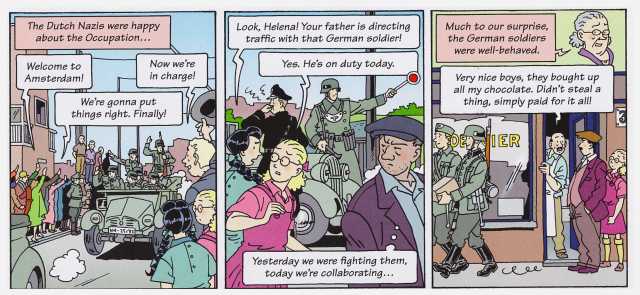

 Heralding Halloween, plastic ghosts and ghouls materialized on some front porches back in September. This horde will rapidly increase–adding movie monsters, comic book creatures, and graveyard trappings—as October 31 approaches. Yet the truly terrifying may not be what we see but what we can only imagine and dreadfully anticipate. This psychological truth is the reason that one graphic novel has haunted me for several years, since I first read it. Today I want to spotlight the chills found in Emily Carroll’s Through the Woods (2014), an eerie masterpiece with a profound understanding of mayhem and mystery, far beyond the jolly trick-or-treating or “haunted houses” of Halloween. Readers tween on up with a taste for the macabre will greatly appreciate this multiple-award winning work.
 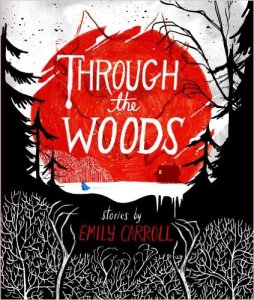 This collection of five stories—one first created as a web comic by Canadian author/illustrator Carroll—is effectively bracketed by an introduction and a conclusion that are themselves scary tales. The introduction addresses a child’s fear of what monsters might lurk in the dark, while the conclusion reminds us that, even if Red Riding Hood escapes a wolf many times, the hungry wolf still only needs “enough luck” to find her “ONCE.” Here Carroll explicitly addresses the darkness underpinning many fairy-tale happy endings. Her story “A Lady’s Hands are Cold” is also a variant of a familiar tale, that of Bluebeard, the husband who marries woman after woman only to murder them. The other stories depict human or supernatural evils linked to everyday rather than fairy-tale events.
  “His Face All Red,” a jealous man kills his brother, but the slain man mysteriously reappears. (This is the only story with a male protagonist.) “My Friend Janna” shows what happens when the accomplice of a fake medium truly sees—or thinks she sees—real ghosts. “The Nesting Place,” the longest piece here, follows a young, recently-orphaned girl who goes to visit her adult brother and his fiancée. Beginning with the words “Belle’s mother had told her about monsters,” this story shows the horrifying, surprising ways the girl discovers some truths underlying that message. Yet these thumbnail plot sketches do not convey how and why this book is so powerful. It is Carroll’s visual artistry, an integral element in her storytelling choices, that makes Through the Woods such a memorable work.
 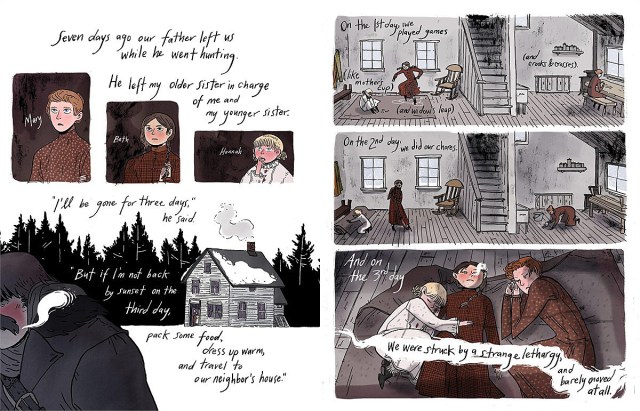 dramatically positions any words and just one image in the center of a page, as a result making the surrounding, extensive black or white background another significant factor in the story’s emotional tone. This may be seen in the opening images, where a small blue figure is centered in a looming black forest, with a disproportionately large, blood-red sun dominating the stark white sky. The technique of creating a suspenseful, ominous tone is also evident in “His Face All Red,” as the bewildered killer travels deep underground to see what if anything has happened to his brother’s body.
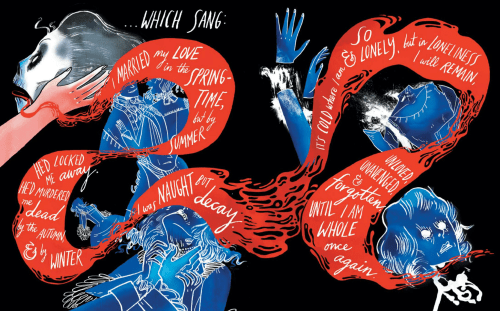 on the page, while word balloons trail like smoke or a mysterious, ghostly melody across pages and through scenes. At several points in this volume, notably in ”A Lady’s Hands Are Cold” and “In Conclusion,” word balloons have appropriately startling, blood-red backgrounds instead of the more typical white or black. In an interview, Carroll has
 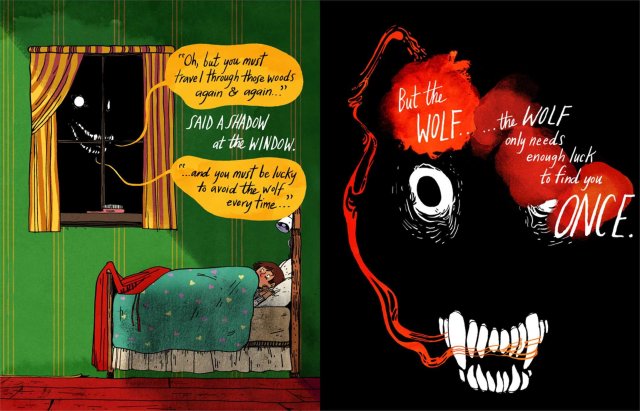 never fully displayed, just suggested. For instance, we learn on the last page of “Our Neighbor’s House” that the neighbor “IS NO MAN,” but we are not shown or told what kind of creature he is. Similarly, on the final pages of “In Conclusion,” we see only the wolf’s frightening eyes and teeth, not his full face or figure. What we imagine here, what is unknown, looms larger in the imagination just because of what we do not see. In the same way, the final terrifying page of “The Nesting Place” is especially horrible because we see only an ambiguous bit of what is now monstrous in young Belle’s life.
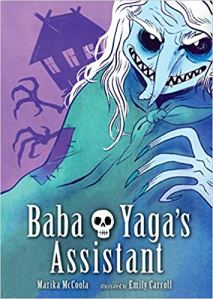 For those who savor Through the Woods—or for those shy of horror or readers a bit too young for Carroll’s full-on macabre ambiguity—Baba Yaga’s Assistant (2015), written by Marika McCoola and illustrated Emily Carroll will be a lower-stress treat. Carroll had fun, as she notes on the book’s flyleaf, drawing that Russian folk tale’s “old crone full of riddles, rocks, and countless pointy teeth,” but the novel itself is about conquering one’s fears and resentments. Specifically, this fantasy graphic novel deals in an upbeat way with a young teen’s learning how to be part of a blended family with a stepmother and stepsister.
 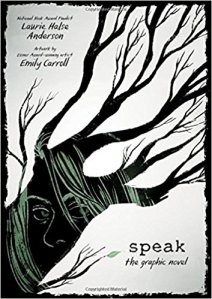 I myself am eagerly awaiting a library copy of the recent graphic version of Laurie Halse Anderson’s award-winning novel, Speak (1999). That powerful work about rape and recovering from rape has been reissued with illustrations by Emily Carroll as Speak: The Graphic Novel (2018). Author Anderson wrote the script for this release, coordinating with Carroll through their editors, and praises the illustrations. Anderson notes that Carroll’s “ability to create tension is masterful.” The author adds that Carroll’s art gives readers “more perspective on the intensity of the emotion” the main character experiences. Anderson pays tribute to Carroll, eloquently summing up her contribution her by saying, “The addition of the art turns a haunting melody into a resonating chord.”
  Have you been busy calming your young people’s new school or classroom jitters? In my senior citizen circles, this duty falls to grandparents as well as parents and school staff. It can be even more frightening or puzzling for students new to a country as well as a school—and more complicated for the families and other adults who want to help them. (These difficulties are now exponentially worse for folks affected by President Trump’s immigration policies mandating zero tolerance and family separation.) Today I look at two picture books and a graphic novel full of wise, loving insights into the problems and joys of immigrant generations within families. While these three recent works are about Vietnamese and Thai immigrants to the United States, their sharp observations extend beyond any one ethnicity or particular national borders.
  Drawn Together (2018), written by Minh Le and illustrated by award-winning Dan Santat, is a gorgeous, heart-warming picture book. Vietnamese-American Le and Thai-American Santat call upon their own experiences of being unable to converse with grandparents who did not speak English to spotlight how communication between generations may occur in other ways. The loving grandfather in this book may not be able to offer school advice, but he and his elementary-aged grandson do come to a profound understanding. They bridge their language gap through making art—a resolution capsulized in what we finally realize is this book’s punning title.
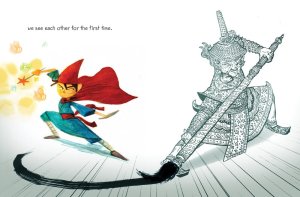 world beyond words” where they metaphorically “see each other for the first time.” The boy draws himself as a colorful wizard while the grandfather inks himself as a traditional Thai warrior as they joyfully depict themselves together battling and defeating a fierce dragon. Santat then shows them racing across a bridge towards one another, each assuming the previous colors of the other, as they next realize—“happily . . SPEECHLESS” in a smiling hug—that words no longer need be a barrier to communication. (Le’s cunning word play is again evident, with “speechless” now used in its positive sense.)
 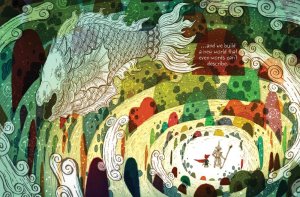 that this was his first effort to depict his own culture and that he lavished time and effort in learning and using traditional ink-and-paintbrush techniques. Readers of all ages will appreciate the visual richness here, with those detailed black-and-white drawings complemented by kid-colorful block images, both styles merging to convey the book’s satisfying, sumptuous “messages” about family and art. A brief, kid-friendly
 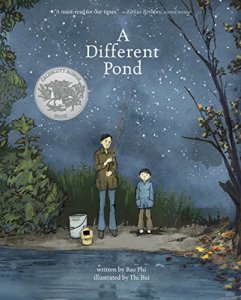 Picture book A Different Pond (2017) has won multiple awards for its Vietnamese-American creators, author Bao Phi and illustrator Thi Bui. This quietly luminous, poignant work is semi-autobiographical, focusing on a typical event in Phi’s boyhood in 1980s Minneapolis (now my own hometown). Unlike the unquestioned affluence depicted in Drawn Together, where a large-screen TV and ample food and art supplies are shown, Phi’s immigrant family was working-class and hard-pressed for cash. The grandson in suburban Drawn Together is dropped off and picked up by his mother in a shiny car. Bao Phi’s mother, though, rides a bicycle to her multiple, inner city jobs. And the central event in A Different Pond is an early morning fishing trip Phi and his father take not for sport but for food. As his father explains in the book, “Everything in America costs a lot of money.” This is particularly true for immigrants with low-paying jobs, a situation familiar also to illustrator Bui. On the book’s frontispiece, she dedicates the book “For the working class. . . .” while author Phi writes that it is “For my family, and for refugees everywhere.”
 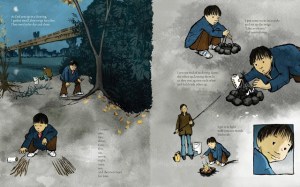 Bao Phi’s cash-poor family is rich in other ways. His gentle father’s steadfast kindness yields a smile rather than anger when the boy cannot bear to hook a minnow for bait. Bao Phi instead is praised and feels proud for efforts he can contribute. Father and son talk together comfortably about fishing in Vietnam. Neighborhood acquaintances interact in friendly ways with the pair, and the hard-working parents unite at night over family dinners with all five kids. They tell stories as “Mom will ask about their homework. Dad will nod and smile. . . .” It does not matter that, as the adult Phi poetically recalls, “A kid in my school said that my dad’s English sounds like a thick, dirty river. Because to me his English sounds like gentle rain.” Education is regularly valued and supported in this close-knit immigrant family—throughout the year, as well as on those momentous opening days.
 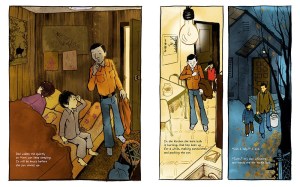 been one-note cartoons. She uses warm yellows, reds, and oranges to show the warmth of family life inside the Bui family apartment. In an interview, Bui explains how she included typical Vietnamese refugee elements, such as fish sauce stored in an old jar and a no-frills grocery store calendar, to personalize the family’s minimally-furnished apartment. Such typical elements also adorn the book’s end papers. I myself especially like the book’s final page, which shows the sleeping boy, colored with the book’s indoor, golden tones, surrounded by the cool blues of the “faraway ponds” of the family’s shared dreams.
 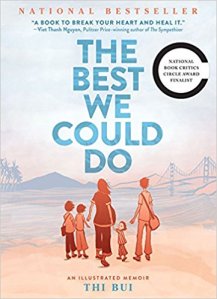 Thi Bui is both author and illustrator of her remarkable graphic family history, The Best We Could Do: An Illustrated Memoir (2017). Nominated for multiple national awards, this moving saga of the Bui family’s escape from war-torn Vietnam in the 1970s and their life in the U.S. will be appreciated by readers teen and older. Its framework of the adult Bui’s birthing and parenting her first child, together with the politics and mention of wartime violence, make this saga less engaging for tweens. Its life lessons—communicated in black, white, and subtle gradations of orange—are complex and sometime sad ones.
  Unlike the contented son in A Different Pond, Thi as a girl dreamed about escaping her life. Generations of family violence and abandonment had shaped her father into a bitter man. Her mother’s personal goals had been set aside to meet their growing family’s needs in wartime. As the war escalated, their background as teachers endangered the pair rather than helping them in what is in now North Vietnam. Father Bui’s strengths combined with those of Thi’s mother enabled them to flee Vietnam and survive as refugees, but they paid a high price. Among other losses, their degrees were useless in the U.S., and the pair took on multiple minimum-wage jobs.
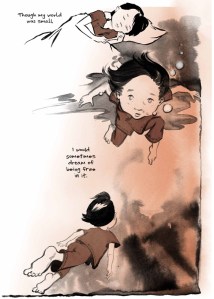 intended lessons. The unintentional ones came from their un-exorcized demons. . . and from the habits they formed over so many years of trying to survive.” These words appear on a page alternating a large close-up of child Thi’s sad face with an image of her studying and then mid-distance views of her solemn parents, their separate, weary images in frames yoked together by a mysterious trail of smoke. Their children’s success in school is never enough to please these parents and calm their fears. Their harrowing experiences escaping Vietnam as “boat people” and then living in a refugee camp have left indelible psychological marks on them and, to a lesser extent, their children.
 The Best We Could Do ends on a hopeful note, though, with Thi Bui coming to understand and value her mother still more and accepting that her relationship with her psychologically-damaged father will remain limited. The author/illustrator concludes this insightful, moving memoir with an image of her now 10- year old son, one harkening back to her own girlhood dreams of escape. Both figures are shown as swimmers. While young Thi only dreamed of being free, she thinks her son can actually “be free.” Her family’s intergenerational chain of emotional harm, exacerbated by being refugees, finally has been broken.
  As you absorb news accounts of refugees seeking safety in the U.S., or as you work to calm new school year jitters for the youngsters you know, using your own life lessons to guide them, perhaps thoughts of the refugee stories reviewed here may offer some illumination . . . for yourself and others. Perhaps your family has its own immigrant or refugee stories to draw upon. A library-based
  With school supplies already on store shelves and in newspaper ads, autumn is looming! It is a good time to remember how valuable unstructured play and long summer days can be for our young people before they head back to school. Two new graphic novels spotlight the joyful growth that sheer play and unhampered summer days may bring to tweens and young teens. The exuberance and charm of The Cardboard Kingdom (2018) and All Summer Long (2018) will bring smiles to adult faces as well as their intended young audiences.
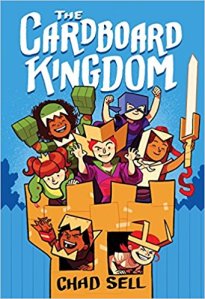 Do not throw away those cardboard boxes! You may find, as author/illustrator Chad Sell has, that youngsters want to create creature costumes that imitate or spin off the ones devised by the sixteen kid characters in The Cardboard Kingdom. This series of interlocking graphic short stories, written by ten collaborators along with Sell as the sole illustrator, features bright colors and boldly-drawn, cartoon-like figures to tackle some serious issues. Yet this book is never heavy-handed or didactic, mingling humor and lots of imaginative action into neighborhood playtimes that in Sell’s words “tell meaningful, emotional stories rooted in the characters’ own struggles.” Or, as collaborator Barbara Perez says, “Some of the characters are based on very real parts of each of us.”
 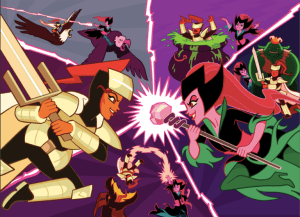 POWERFUL AND AMAZING.” Wordless panels or pages are employed effectively throughout the book, with some other kids challenging their traditional gender identities or roles. The girl neighbor Jack assumes will happily play an endangered princess storms off to return as a competitive knight, while in “The Prince,” Miguel daydreams of being the princess rescued by that handsome hero. Yet Miguel is satisfied when the Prince suggests that Miguel become the “Royal Rogue,” his compatriot in “the many adventures ahead.” Crayon-wielding Miguel draws a whole wall full of pictures of these adventures.
  narrative along. Another visual element unifying the book’s fourteen stories is how Sell depicts children’s shadows. These reflect how the characters imagine themselves rather than the actual outlines of the cardboard costumes they wear. The short, angular forms cut out of cardboard or discarded cloth for their dramatic play become long, elegant swirls or dangerously large bodies, armor, and weapons. Sell pays further tribute to childhood imagination by frequently drawing scenes where the neighborhood kids appear both in their home-made costumes and—above their heads or nearby—as the fantasy or fairy tale characters they pretend to be.
  Other kids learn to creatively cooperate rather than compete. “Alchemist” Alice and “Blacksmith” Becky, after humorously trying to outdo each other for “customers” eager for fantasy weapons, join in a new business venture—the pretend “Dragon’s Head Inn.” Other kids learn how to cope with family expectations or problems. Dismayed and subdued by her grandmother’s disapproval, loud Sophie reclaims her natural exuberance as the “Big Banshee.” Seth arms himself against his parents’ separation, including the potential danger his father now poses, by assuming an imagined, costumed identity—the watchful, protective “Gargoyle.” Even the somewhat older neighborhood bully, Roy, intrigued by all the fun he sees in cardboard kingdom play, ultimately joins in. There is also room for kids less inclined towards active play, with the “Scribe” bonding with “Professor Everything” over reading comic books.
  characters enact. There is also room for younger brothers and sisters in these playtimes, in a neighborhood of wide-ranging ethnic and racial diversity. If this diversity seems aspirational rather than realistic, these aspirations leave us feeling hopeful rather than doubtful. After a grand adventure involving all sixteen kids, the book’s final scene shows the children exiting a school bus on their first day back to middle school. Their fantasy shadows hover overhead, representing the psychological and social growth they have achieved during a play-filled summer.
 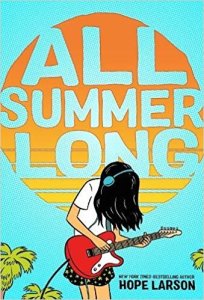 The cast of characters in Hope Larson’s All Summer Long is smaller but no less engaging. We meet 13-year old best friends and neighbors Bina and Austin on their last day of 7th grade. They have always spent summer days together. Bina is dismayed that this summer Austin will be attending a month-long soccer camp. Even after he returns, Austin does not want to spend as much time as before with a girl best friend who is not a “girlfriend.” Humorous mishaps involving baby sitting and a longer, painful argument occur as Bina discovers how to fill her summer days, unstructured save for some required reading. Bina comes to realize how essential music and guitar playing are to her, gaining confidence in her abilities, as she learns to trust a new friendship and reestablishes a strong connection with Austin. While Austin is a secondary character here, Larson does not slight how he overcomes doubts and peer pressure to figure out who and what he values, once the unstructured half of his summer provides opportunity for this growth.
 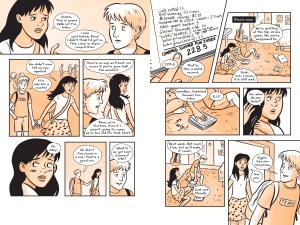 “rightness” of this attitude. Bina is depicted in orange and Austin in white. No attention drawn to the fact that Bina’s mother is a different shade of orange, her father white, or to the seemingly unexceptional reality that her white-appearing brother is married to an orange-colored man, one of a few characters drawn with typical African-American features. Apart from those characters, we have only a few hints about which ethnicities or races are represented by the novel’s many orange figures. (One hint is the Asian name displayed outside a pharmacy.)
  Another storytelling technique Larson uses throughout this book’s eight chapters to engage us with Bina’s summer of self-discovery is the unusual use of boldfaced words representing actions as well as sounds. In varied typefaces, we are told that boldly-drawn, cartoon-featured Bina has begun to “FLOP,” “SLIIIDE,” and “STARE” during her emotional adventures. Visually enhanced by differing perspectives and alternating close-ups with more distant views, these adventures conclude with Bina’s first week in eighth grade. With new self-confidence to counter lingering doubts, she has decided to form her own musical band. Readers appreciative of Larson’s insights into these teenage mishaps will be pleased to learn that she is planning two sequels to All Summer Long. She says they will “follow Bina’s “musical journey from. . . starting a band, to navigating the music scene” and also feature other characters introduced in this graphic novel.
  readers may enjoy the opportunities Chad Sell provides to
  Bears and bison and wolves, oh my!
 Ted Rechlin’s graphic novels are a safe, very satisfying way to discover Yellowstone’s dominant predators. Early readers (as well as we older folks) will enjoy Silvertip: A Year in the Life of a Yellowstone Grizzly (2011) and Epsilon: A Yellowstone Wolf Story (2013). I know I feel lucky to have found these artful books for sale at the Gallatin County Museum in nearby Bozeman, Montana, and now to have learned about this talented author/illustrator’s other works at his
  Told in the first person, Silvertip’s casual language works well with deftly-designed images to depict the sometimes humorous, sometimes serious and dangerous moments in the life of the adult bear Silvertip. For instance, his assertion that “I’m big and scary. . .Most of the time. . . . Some of the time. Okay, maybe once in a while.” comes alive when viewed alongside images of Silvertip, just awake after hibernation, stumbling and tumbling in the snow. Rechlin alters the grizzly’s facial expressions as well as body language throughout the book to match Silvertip’s experiences. Through this character’s recollections, we also witness Silvertip’s experiences as a bear cub, gradually discovering his abilities.
  from his food. Close-ups alternate with mid-distance and long views in the visual storytelling here. Rechlin wisely keeps some panels and pages wordless, while also smartly employing larger, colored fonts for the different roars creatures emit. Besides that larger bear, Silvertip encounters a wolf pack, the blonde grizzly who briefly becomes his mate, and ground squirrels too small to be his summertime prey. Along with these meetings, Rechlin points out the foolish, potentially dangerous behavior of some tourists when Silvertip meets a park ranger warning photo-eager folks to stay away from the grizzly bear. Even Silvertip is amazed at their behavior!
 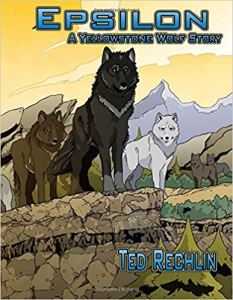 Epsilon: A Yellowstone Wolf Story is another full-color work filled with accurate scientific information, this time told in the third-person. It begins with Epsilon being the adult, 9 year-old leader of his pack in the park’s Lamar Valley. Most of this story, though, follows Epsilon from the time he is just a yearling, the survivor along with two siblings of an attack by another wolf pack. Individual and pack behavior is shown and told with great economy and verve. The years speed by as we see such highlights as the pack working together to bring down large game for food, playing with their pups, and confronting another adult wolf pack to reclaim their original home territory in Lamar Valley. Older as well as young readers will appreciate the savvy way in which Rechlin depicts the decisive conflict there: Epsilon’s fight with the other pack’s alpha (or head) wolf is shown through alternating panels showing only their fierce eyes and expressions, the loser finally seeming cowed just before a page shows him running away from Epsilon. Only one word is needed there as commentary: “Done!” The book’s final pages are a double page spread showing Epsilon and his pack howling triumphantly in Lamar Valley.
 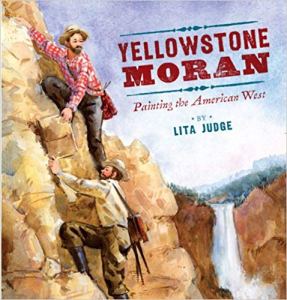 I also recommend two picture books related to the history of Yellowstone Park and the national park system. Yellowstone Moran: Painting the American West (2009), by award-winning author/illustrator Lita Judge, uses full water-color illustrations to depict the adventures of artist Tom Moran, who in 1871 bravely accompanied the first scientific expedition to what would later become Yellowstone Park. Moran was so eager to see and record its reported wonders that he fibbed about knowing how to ride a horse! He quickly, if painfully, learned how to ride.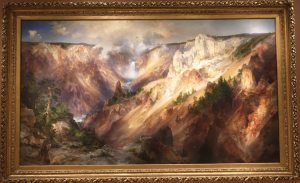
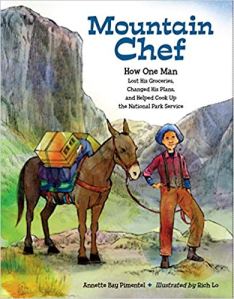 Readers of all ages will delight in the sprightly language of award-winning picture book Mountain Chef: How One Man Lost His Groceries, Changed His Plans, and Helped Cook Up the National Park Service (2016). Author Annette Bay Pimentel uses tantalizing imagery to describe the skills of Chinese-American chef Tie Sing, who “baked sourdough rolls as light as the clouds drifting above the peaks” and spread linen tablecloths “brighter than white-water foam.” In 1915, millionaire naturalist Stephen Mather persuaded the already famous Sing to cook on an expedition through California’s Sierra Nevada mountains. Mather hoped this trip would convince the influential men he had invited to support a new law creating a national park service. Illustrator Rich Lo’s vivid, digitally-rendered pencil and water color images join with Pimentel’s words to show how Sing’s skill and ingenuity did indeed help Mather achieve this goal in 1916.
 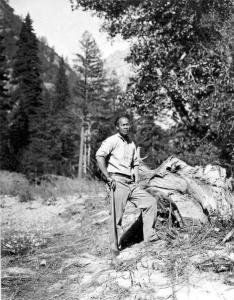 accidents overtook them was by creating fortune cookies with inspirational messages. These all referred to the natural wonders around them, with words such as “Long may you build paths through the mountains.” Pimentel’s introductory pages do not shy away from the discrimination Chinese-Americans experienced then, information expanded upon in four supplementary pages at the picture book’s conclusion. There, photographs also depict Tie Sing and the expedition’s most significant members, giving details about how they contributed in different ways to the 1916 creation of the national park system. I learned with pleasure there and
 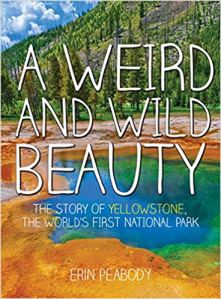 Moving on from picture books, tween and teen readers may also enjoy the more in-depth information about Yellowstone Park in Erin Peabody’s 15-chapter A Weird and Wild Beauty: The Story of Yellowstone, the World’s First National Park (2016). Its focus on the 1871 expedition, complete with judicious sidebars and many contemporaneous as well as current photographs, has led me from its well-crafted, suspenseful narrative to George Black’s more hefty, adult-oriented Empire of Shadows: The Epic Story of Yellowstone (2012). I hope to be able to finish its 400-plus pages before this library copy is due back!
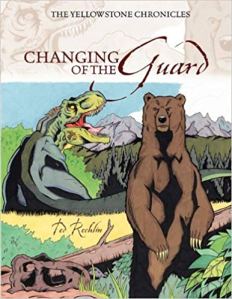 As I “park myself” for more reading, I also hope to look at some of Ted Rechlin’s other works, including Changing of the Guard: The Yellowstone Chronicles (2009), depicting the shift from dinosaurs to mammals in that region. His newest work, Jurassic (2017), an award-winning dino-centric graphic novel, will also now be on my radar. If you have dinosaur fans among your young readers, take note. If a visit to one of our other U.S. national parks is in your plans, you may already have some relevant books in mind and to suggest. I would be pleased to hear from you! If not, check out your library for further park-specific works. This 2016 list of
  What kinds of reading will you do this summer? “Summer reading” can have very different meanings. Will yours be hummingbird sips of brief pieces, pages of mainly light-hearted material scanned in between other outdoor activities? Or will you and yours chow down on long, possibly serious works—books you have not had the time to read until school was out and work put aside? Today’s Gone Graphic looks at both possibilities for readers ages tween on up. I also explore how that first kind of summer reading can lead into the second, and take a look at some graphic novels which illuminate painfully serious current events—ones I fear will extend beyond this coming summer.
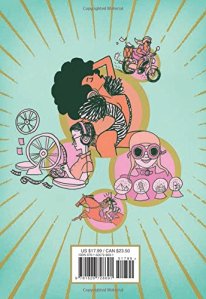
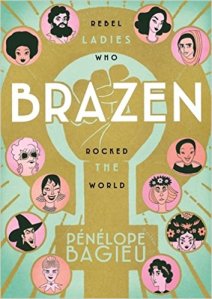 I just loved Penelope Bagieu’s recent Brazen: Rebel Ladies Who Rocked the World (2018). The 29 mini-biographies in this 300 page book first appeared separately, as weekly digital comics in the French newspaper Le Monde—making each piece just the right length for a refreshing summertime mental “sip.” (Montana Kane provided the English translation here.) For print publication, author/illustrator Bagieu added a double spread splash page at the end of each bio, wordlessly commenting on high points in the account. And what remarkable life stories Bagieu zestfully depicts: spanning the globe, ranging from ancient times to the present, spotlighting some lifelong rebels but also others who first “rocked out” as grandmothers or who now are still teens.
  A few figures may well be familiar to readers: world-circling journalist Nelly Bly; actresses Margaret Hamilton and Hedy Lamarr; entertainer Josephine Baker; astronaut Dr. Mae Jemison. But Bagieu has researched so thoroughly that fresh, sometimes surprising details are revealed in her portrayal of their lives. And other subjects here will probably be unknown to many readers. Ancient Greek gynecologist Agnodice, Apache warrior and shaman Lozen, and Syrian activist Naziq al-Abid may well be unfamiliar. In an interview, Bagieu has said that “I realized I did know a lot of super awesome brave women. . . . But since they’re not labeled as ‘heroes,’ they don’t have books or movies about them. . . . [so] I just felt like I wanted everybody to know about them too and fix that injustice!”
 Some of the heroes I discovered here for the first time include Afghan teen rapper Sonita Alizadeh, who today
 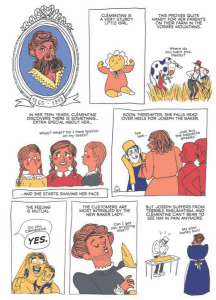 “What’s wrong with you?” Despite having a physical oddity, Clementine is the one here with healthy personal balance and space. She asserts herself to achieve love, success, and happiness. Transgender pioneer and reluctant celebrity Christine Jorgensen replies to her detractors, “Kisses, haters.” These verbal, humor-laced jabs have visual parallels. Fluid lines depict expressive faces and active bodies with minimalist, cartoon-like verve throughout this book. Its main biography pages, each organized in six to nine panels, also support and reflect this informal, “dashed off” style, with many panels omitting background details and even borders. This style enhances the blocks of color Bagnieu uses here, limited to a varying four- or five-color palette, which add further punch and unity within each bio.
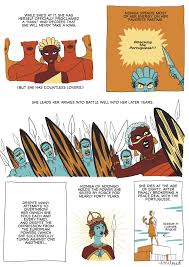
  Waldo’s) within a herd of cattle, similar to those helped by her innovative animal husbandry designs. The foregrounding and fierce look of Queen Nzinga as she watches European ships approach her domains of Ndongo and Matamba sum up her battle-ready, triumphant spirit. Similarly, the skewered perspective Bagnieu uses to depict Frances Glessner Lee peering into one of her forensic miniatures conveys her personality with humorous pizzazz. Is Chinese Empress Wu Zetian really dropping the heads of executed enemies from a high bridge? The black silhouettes there are suggestive, rather than definitive, as is information about that 7th -8th century figure.
 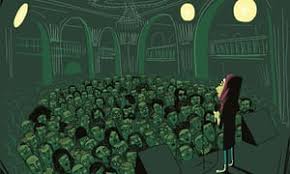 In these and a number of splash pages, Bagnieu opens up her palette to include more colors. At other times, as when a stage spotlight shines on anguished rapper Sonita Alizadeh or as lighthouse keeper Giorgina Reid stands stalwart in the snow, a reduced palette conveys the woman’s intensity.
 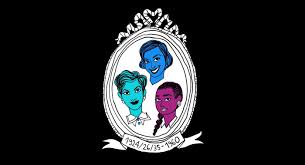 may lead into serious terrain, such as the child abuse Bridges experienced or the torture endured by the Central American rebel sisters known as “Las Mariposas” (the Butterflies). Bagnieu’s illustrations there just suggest with thin lash marks and torn garments what these women suffered. Other, lengthier accounts may offer more details for those seeking to learn Dominican history.
 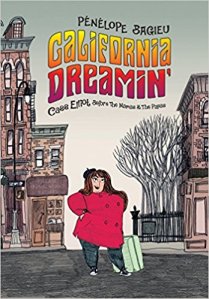 this edition’s back matter. Delving into that list may also lead to extended and possibly serious summer reading—“chewable” stuff.) Bagnieu’s own autobiographical end note, delightfully continuing the book’s graphic format, may further inspire readers to look at her other, longer graphic works. I enjoyed Bagnieu’s full-length biography of 1960s-70s pop star Cass Elliot, California Dreamin’: Cass Elliot Before the Mamas & the Papas (2015; 2017), already lauded as a 2018 ALA Best Graphic Novel for Teens. It is an engaging look at Elliot’s serious ambitions and problems.
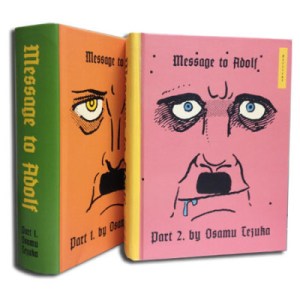 Osamu Tezuka, published in Japan in 1983 -86, and originally translated into English as Adolf. These books set mainly in Germany follow three different characters named Adolf, one Jewish and another Adolf Hitler himself, in the years before and during World War II. Tied together by a Japanese character seeking to solve and avenge his brother’s murder, their combined 1300 pages will not be light reading, I think, even if the books are currently being marketed as a “political thriller” for adults.
  War, anti-Semitism, and related complex issues also figure in two other lengthy works tied to troubling current events. The recent actions of Israeli military forces against civilians, many unarmed, in Gaza bear examination in many ways, including looking at past
 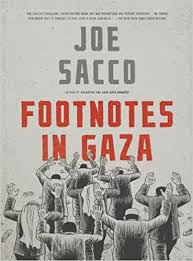 events there. Graphic journalist Joe Sacco does just that in Palestine (1996; 2001; 2007), winner of a 1996 American Book Award, and Footnotes in Gaza (2009), another multiple award winner. (I previously have discussed Sacco’s work briefly
  Ironically, while war and violence in Gaza strike children as well as adults, Sacco’s books are best absorbed by readers who are mature tweens or older. I have just begun to look at books about Gaza for younger readers, noting that picture book The Story of Hurry (2014), written by Emma Williams and illustrated by Ibrahim Quraishi, is one work with a child’s eye view of life there. Perhaps you readers have others to recommend?
  Natalie Rosinsky