Mighty Small? Not at All

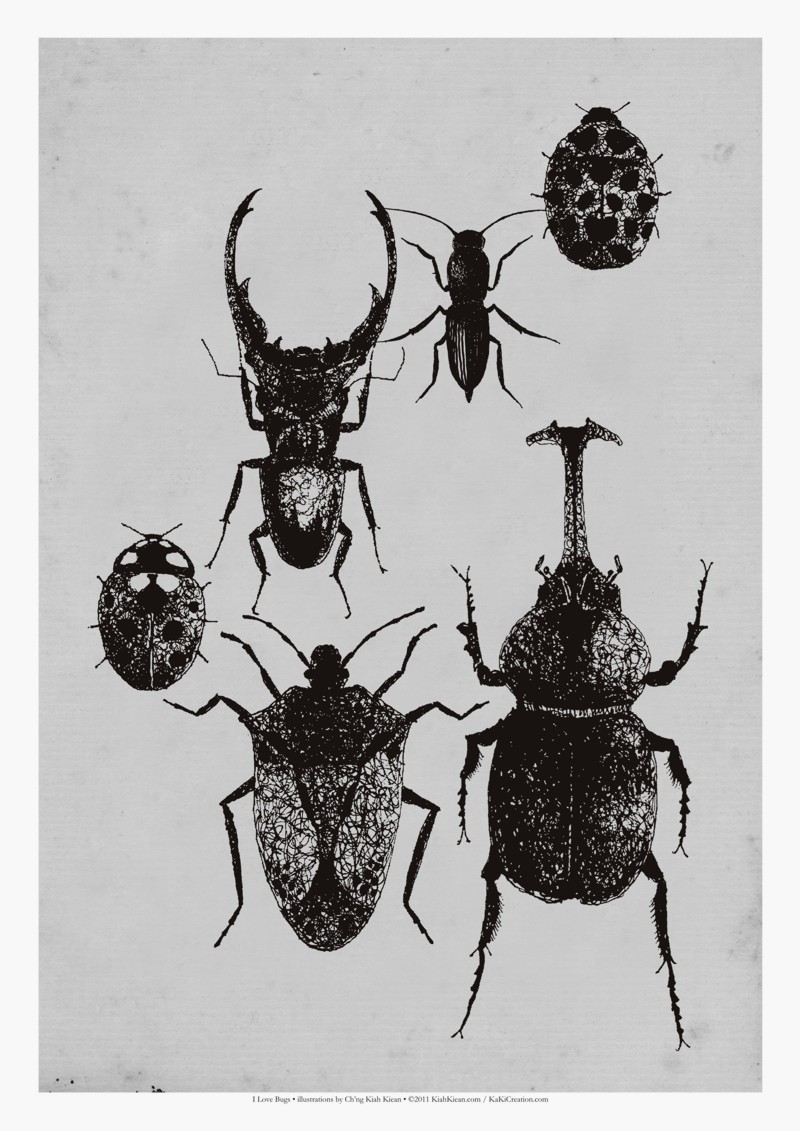
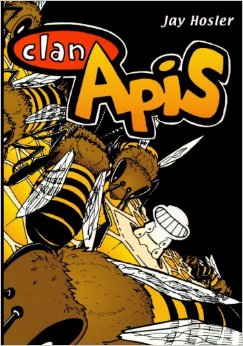
KKCN11-PRT006-102_I-Love-BugsSpringing into summer, we Minnesotans see bugs everywhere.  Mosquitoes, those tiny terrors, have yet to be out in full force, but ants trail along sidewalks and beetles bustle in gardens.  Out past my suburban home, farmers are readying their crops against infestation, while beekeepers statewide are trying to save diminished hives.  It’s an apt time of year for a brand-new graphic novel by biology professor Jay Hosler, whose highly-praised Clan Apis (2000; 2013) packed so much emotion and humor, along with information, into its life cycle story of Nyuki, a honey bee.   This time, in Last of the Sandwalkers (2015), gifted author/illustrator Hosler introduces us to the exciting world of beetles.  Their abilities and sheer diversity may surprise readers of all ages, not just the middle school crowd Hosler originally targeted, even as the “human” traits of his characters capture our hearts and minds.  There is nothing small at all in what beetles can do—or in Hosler’s accomplishments here!  Last of the Sandwalkers is richly satisfying, a high point in popular culture’s longstanding interest in insect and arachnid life.  I will touch on that tradition, still strong in comics and movie superheroes and villains, at the end of this post. 
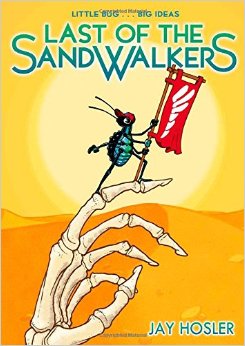
51tlcyb1w9L._SY344_BO1,204,203,200_Last of the Sandwalkers is a fun and thrill-filled blend of genres—adventure, epic quest, family drama, and science fiction—which also lets Hosler fulfill his goal of “helping readers understand science better.”  In fact, his beetle characters are themselves scientists, setting out to discover whether there is life outside their desert oasis home, a palm tree their civilization calls Coleopolis.  Central character Lucy, a sandwalker beetle, excitedly believes there may be other living creatures, while senior Professor Owen scoffs at this possibility.  Only when their expedition is well underway does Owen reveal his treacherous reasons for joining this quest—personal vanity and rigid religious beliefs.  The existence of other creatures would threaten Coleopolis’s state religion, which worships a god called Scarabus.  Owen’s sabotage does not diminish the joy the others take in their discoveries (a mouse skeleton and other insect species) or discourage them on their perilous trek homeward.  (Those hungry bats and birds! That rushing stream and deep pond!)  These determined scientists include Lucy’s adoptive parents and foster brother, who are two other kinds of beetle, with their own distinctive physical traits.  Hosler helpfully introduces these characters in the opening “Graphic Guide to Identifying Beetles” and also provides chapter-by-chapter “Annotations” plus a bibliography at his book’s end.  But it is the way he incorporates these traits into his characters’ personalities and their adventures that is most memorable.
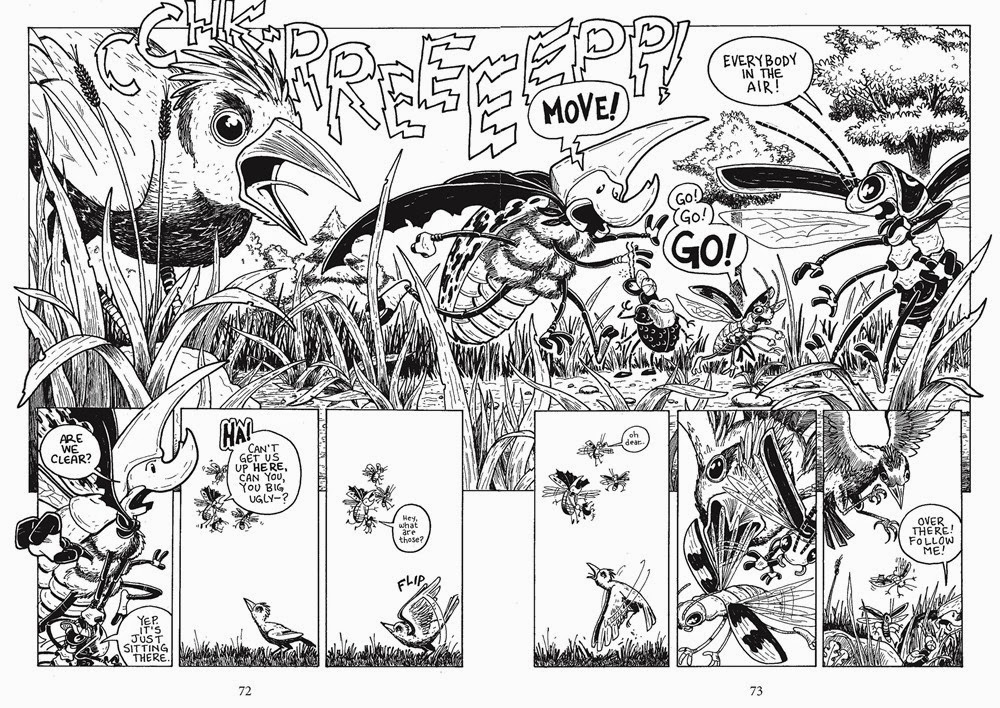
last_of_the_sandwalkers_pages7273

For instance, large Mossy with his huge mandibles and horn is protective of his foster parents and sister, even as they all good-naturedly bicker and tease each other.   Upbeat Lucy may be frustrated at times by her family, but she never denies them the water that condenses on her bumpy, desert-adapted “shell.”   Similarly, acerbic Professor Bombardier, who can literally spray her enemies with acid, has demandingly high professional standards for her family, but these mask genuine warmth and concern.  These feelings extend to husband Raef, with his infuriating tendency to lose his head—literally, as well as figuratively, as Hosler reveals mid-book that Raef is a cyborg, with his beetle consciousness uploaded into a robot body!  This science fiction element becomes important in the plot, but it is not the only science fiction aspect of this fantastic adventure.  As Hosler has remarked in an interview, the variety of “adaptions [insects] have for survival” makes them seem like “super-powered aliens.”  Hosler also recognizes how comics have developed such extraordinary characters, saying that this book is in some ways his tribute “to the Fantastic Four: a family with unique abilities, exploring the unknown and overcoming massive obstacles through teamwork.”  

last_of_the_sandwalkers_page130-600x877This author/illustrator acknowledges comics history in other ways.  His expressively drawn, black-and-white characters include Ma’ Dog, the last of an imaginary beetle species Hosler terms the “Kama-Sheebay.”  With their story-sticks displaying picture placards that illustrate spoken tales, these storytellers are a clear reference to Japan’s traditional kamishibai.  Those wandering storytellers led up to Japan’s influential comics industry of written manga and filmed anime.  Since the truth-telling “Kama-Sheebay” were outlawed generations ago from Coleopolis, Ma’Dog can knowledgeably help its scientists navigate the strange perils they face outside that oasis.  Throughout these adventures, Hosler makes effective use of black backgrounds, varied panel size, and overlapping word balloons and figures to highlight and unite images.  His artful shifts in perspective and distance also rivet our attention as we follow the story, its dramatic and humorous peaks often announced loudly by typographical changes.  At other times, Hosler conveys more nuanced interactions through casual conversations, where the rhythms of informal, everyday speech ring true.  
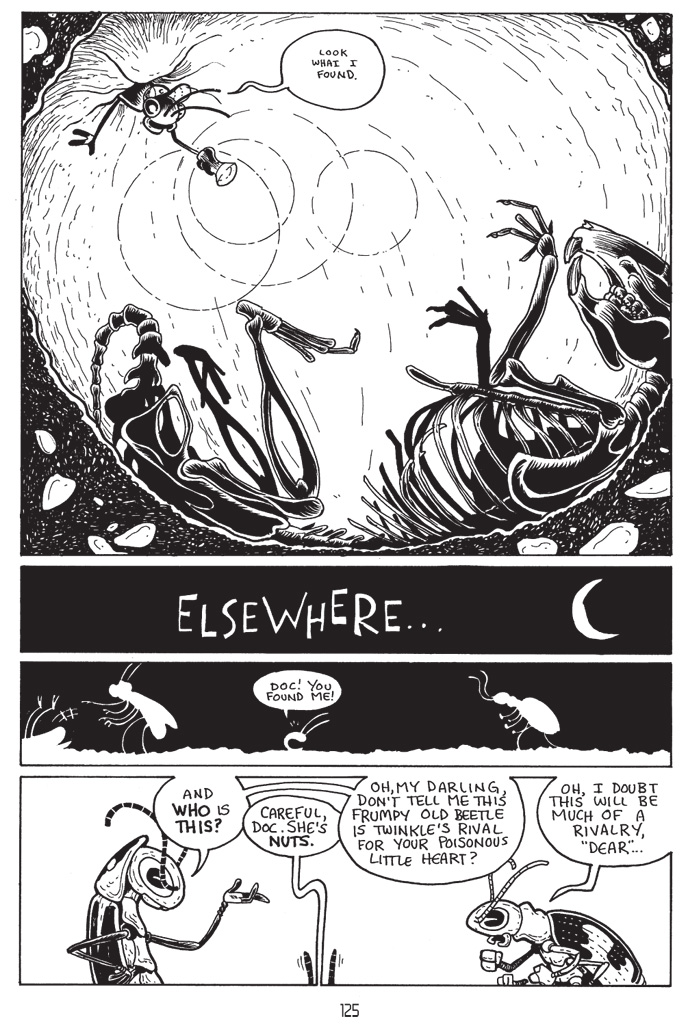
9781626720244.IN06 (1)In interviews, this accomplished author/illustrator has been asked whether he plans a sequel to Last of the Sandwalkers, since we are never told how Raef comes to be a cyborg.  I am encouraged by Hosler’s willingness to consider a sequel, as I am also curious about the gigantic skull of a “Hu-mon”—huge monkey, the beetles’ label for humans—the tiny scientists discover.  How will their world-view (or ours) change if they encounter and can communicate with human beings?   Like adventurous Lucy, skyrocketing off at the end of the book, we know that in this world of possibilities, “The real fun is just beginning!” That  high note is a great way to round off both the physical adventures and the scientific inquiries of this energetic, hugely entertaining book.
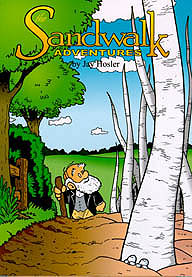
61ecdo3VcPL._SY344_BO1,204,203,200_Eager readers, though, do not have to wait for that sequel to enjoy more of Professor Hosler’s graphic works.  Besides Clan Apis, he has also authored The Sandwalk Adventures (2003), which humorously explains evolution through conversations between its exponent Sir Charles Darwin and a hair mite living in Darwin’s left eyebrow!  (The possible “squick” factor here may be a plus for upper elementary and tween readers.) SATSome graphic pieces also appear in installments at Hosler’s science comics blog, “Drawing Flies.”    The science there is sometimes high school level or above, but readers of all ages will take pleasure and learn from the blog’s multipart “Field Guide to Superpowers.”  It compares comic book superheroes old and new with natural creatures—including beetles, spiders, and ants—which actually have each hero’s “superpowers,” scaled down to the creatures’ sizes and environment.    
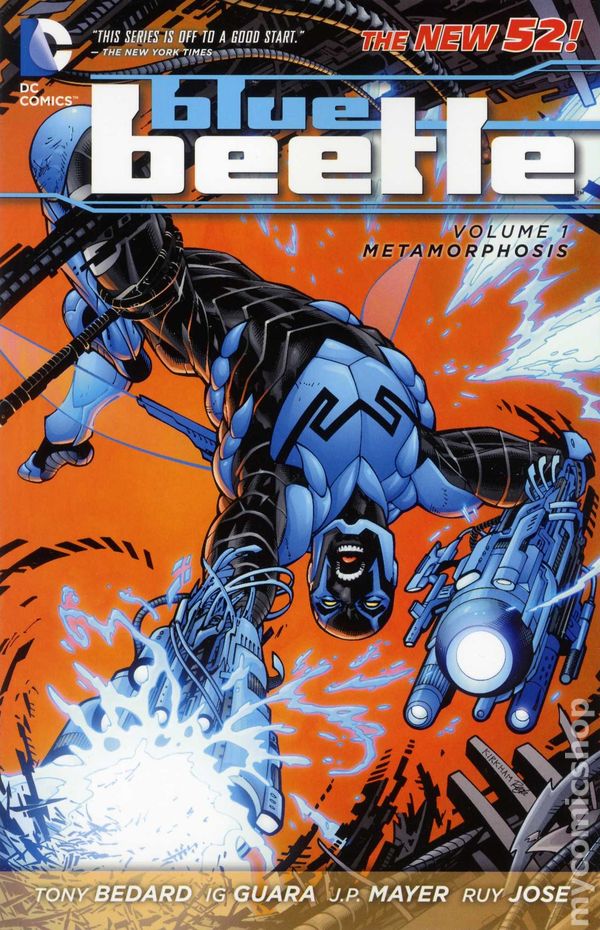
Similar scientific accuracy is not always evident in the comics themselves!   But scientific curiosity is not the main reason that readers enjoy these works and their movie spin-offs.  Spiderman may be the best known “bug” superhero, but it is Peter Parker’s teenage problems as much as his adventures that hold our interest.  The same may be said about the most recent incarnation of the “Blue Beetle,” a crime-fighting superhero who first appeared in the 1930s.   During the 1960s Cold War, he reappeared to battle the USA’s Communist enemies.  In the 1990s, the “Blue Beetle” was more of a humorous character.  Between 2011 and 2013, though, a Texas teenager named Jaime Reyes was featured as the “new” Blue Beetle in a series of seventeen comic books. 1203701 These have been collected in several paperback compilations, beginning with Blue Beetle, Volume 1 Metamorphosis (Comics issues 1-6, 2011; 2012).  Young readers may appreciate how Jaime copes there with problems ranging from everyday life to alien invasions.  They may already know this character from his guest appearances on superhero animated and live action TV shows such Smallville.  
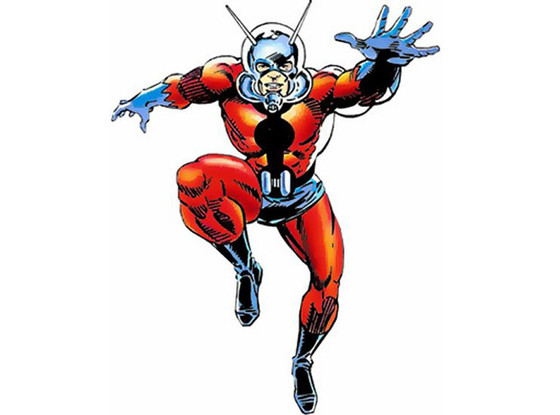
“Ant-Man” is another “bug” superhero who first appeared in the 1960s, with different human characters assuming his costume and powers.  Some were even criminals who took this opportunity to reform their ways.  At times, Ant Man was joined by superhero “Wasp Woman” – a very different character than the villainous Wasp Woman (or other mutated “bug” monsters) of 1940s and 50s movie thrillers. reg_1024.antman.mh.101512 (1) A new feature film about “Ant Man” debuts in movie theaters next month.  Will it make our eyes and minds “bug out” with excitement?   Will a Wasp Woman make an appearance in this film?  Summer is certainly the right season for ants and such critters to flourish. . . .  
  

Posted in comics, graphic novels | Tagged , , , , , , , , , , , , , , , , , , , , , , , | Leave a comment

Satisfying Sequels . . . and More

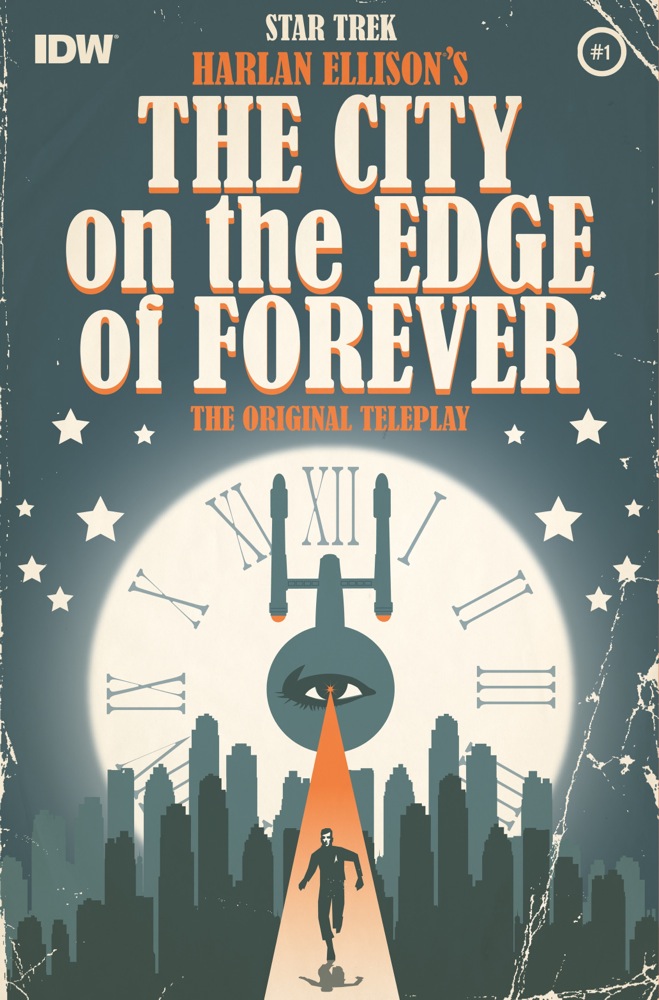
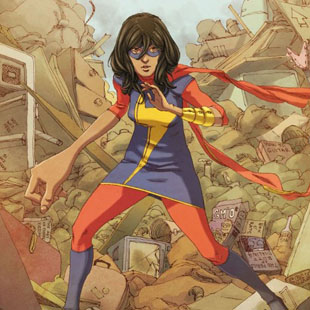
GirlcomWhen it comes to graphic literature, do you like to “snack” on smaller, individual comics, or would you rather sit down to the “full meal” of a compilation? When publishing sequels, today’s comic book industry caters to both tastes. Some eager fans of the new Ms. Marvel, teen-aged Kamala Khan, recently “snacked” on new individual issues (numbers 6 through 11) of her adventures as they debuted separately each month. Other admirers of this Muslim-American superhero waited for the next “full meal” offered by Marvel Comics: a single paperback volume compiled of those issues, titled Ms. Marvel: Generation Why (2015). (Kamala’s origin story and first adventures—issues 1 through 5—are collected in Ms. Marvel: No Normal [2014], reviewed here in January, 2015.) Today I want to describe how satisfying and rich this second volume is, and discuss how another highly-anticipated second volume, the autobiographical March, Book Two (2015), lives up to its award-winning predecessor. (I reviewed March, Book One [2014] here in November, 2014.) The on-time, regularly scheduled appearance of these sequels is a dramatic contrast to two other notable, recent publications—books that took twenty-five years or longer to follow their original versions. The tween and up audience targeted by Ms. Marvel and March could have grown up and had teens of their own during this lag time! But I will touch on the merits and publication history of Here (2015) and the graphic novel Star Trek: The City on the Edge of Forever–The Original Teleplay  (2015) at the end of this post.
download (6)In Ms. Marvel: Generation Why, author G. Willow Wilson continues to depict the authentic concerns and daily lives of today’s teens—laced, in her lead character’s case, with being Muslim and the daughter of Pakistani immigrants. While some classmates only see how strict Kamala’s parents are (they do not permit her to watch horror movies, let alone date boys), Wilson shows us that Kamala understands this strictness comes from concerned love as well as traditional values. In this volume, while Kamala continues to push at and sometimes disobey family rules, she also comes to see the wisdom her parents can offer. In fact, after rescuing a handful of teens, Kamala rejects one boy’s put-down of social involvement—an attitude stereotypically associated with “Generation Y,” people born between 1980 and 2004. She instead answers with the “Why” offered by her family and faith. As Wilson has Kamala realizing about herself, “Man, I sound like my Dad. Stay involved. Work hard. Have goals.” Nowadays, when violent interpretations of Islam provoke distorted generalizations about Muslims, it is good to see this depiction of the constructive impact of Islamic values and leaders on their followers. A sullen Kamala expects to be lectured about “Satan and boys” by her mosque’s imam, but instead she receives supportive guidance for her curfew-breaking adventures. Sheikh Abdullah encourages her, saying “If you insist on pursuing this thing that you will not tell me about, do it with the qualities befitting an upright young woman: Courage, strength, honesty, compassion and self-respect.”

MsMarvel07-3But such serious messages do not reflect the overall ebullience and sly wit that best describe the tone of this book. It’s just plain fun to read! Author Wilson has again effectively paired with gifted illustrators in the graphic storytelling of Kamala’s recognizable daily life, altered now by her superpower to change her body’s size and shape. (At one point, we even see Kamala camouflaging herself as a sofa!) The volume’s cover image sums up the overlapping strands in Kamala’s life: We see her using her smart phone with one hand while her other arm stretches way, way behind her to knock out a fleeing bank thief. Dollar bills, springing out of the thief’s satchel, cascade around the teen, dressed in a superhero outfit that—with its long sleeves, tights, and high neckline—conforms in part to Islamic rules of modest dress. Jacob Watt is the illustrator for issues 6 and 7 here, while Adrian Alphona, the illustrator of Ms. Marvel: No Normal, returns as Wilson’s partner for issues 9 through 11. The cover art of volume two is also split, with Jamie McKelvie and Matthew W. Wilson responsible for issues 6 through 9 and Kris Anka supplying cover art for numbers 10 and 11.

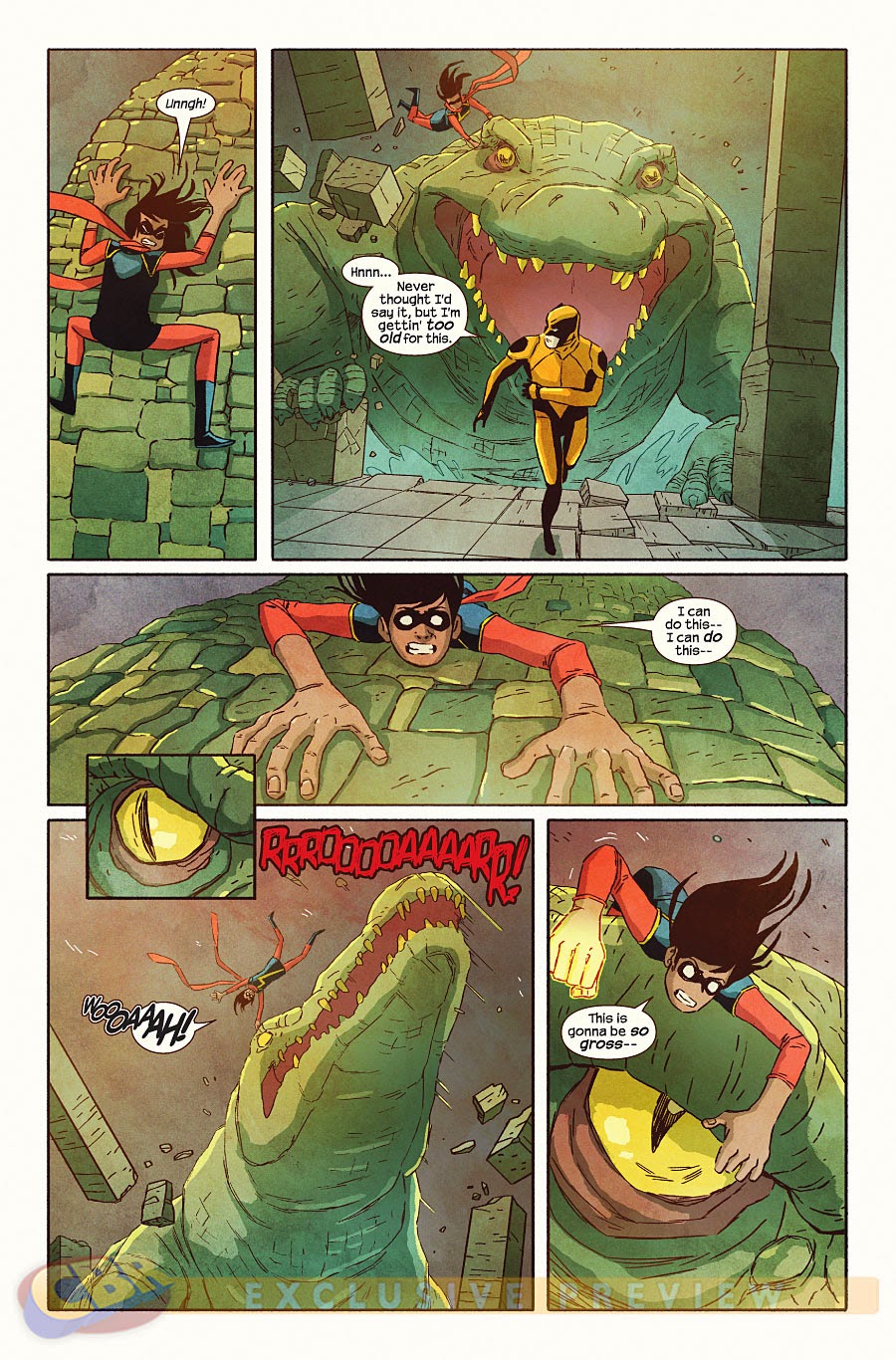
Wilson’s fresh dialogue nimbly intertwines with images in Generation Why’s two related story arcs. In the first, Kamala teams up with one of her personal heroes—Marvel Comics superhero Wolverine. With believable teen enthusiasm, she bounces up and down excitedly and enthuses, “I totally put you first in my fantasy hero team-up bracket!” Wolverine, bewildered, replies “Huh?” The two confront gigantic, mutated alligators in a booby-trapped lair as they foil a plot by the bird-headed supervillain Inventor. Along the way, Wolverine offers Kamala some wise adult advice. We also learn just how Inventor came to have that bird’s head. While Wolverine would prefer to keep this adventure private, he learns that he is no match for a quick-fingered, tech-savvy teen. Kamala has “already pictogrammed [the] whole episode” and put it in online.

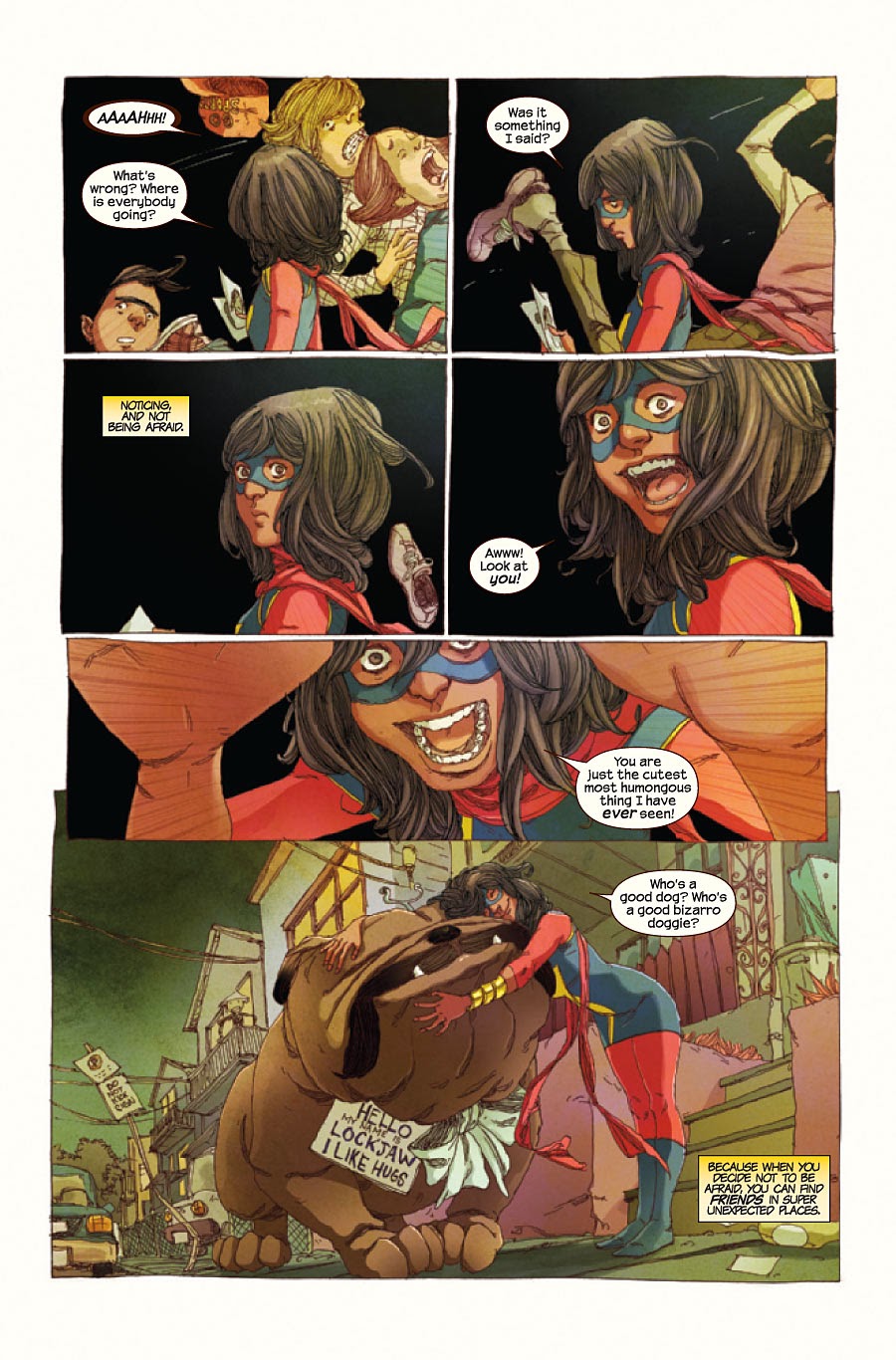
MsMarvel08-2In the second story arc, Kamala is accompanied by an enormous, super powered dog named Lockjaw, a gift from another new figure in Marvel Comics’ expanding universe of characters. With the help of her classmate/sidekick Bruno, Kamala foils another of the Inventor’s plots, along the way shrinking herself down to mere inches to stop the gears of one of his dastardly inventions. The colorful details in that full-page image, where we see mice contentedly living in the spaces between cogs, along with the varied, rich hues used throughout this second volume, make following Kamala Khan’s adventures a visual treat. A variety of close-ups alternate with long and mid-distance views, along with different sizes and colors for lettered sound effects, adding further “punch” to that extended final battle. Elsewhere, even in quiet moments, our lingering eyes are consistently rewarded, as when we notice on the cover of issue 11 that hungry Kamala is devouring a cupcake with such gusto that she has an icing mustache.

This Ms. Marvel—shown sometimes wind-blown, stumbling, and sloppily-dressed—is one that young readers will readily relate to, as she is still learning how to be an adult as well as a superhero. Whether readers recognize their own community in Kamala’s or see one somewhat different from their own, the expert graphic storytelling here makes reading this book a pleasure. Ms. Marvel: Generation Why is currently on the New York Times bestseller list, while the first volume about superhero Kamala is a finalist for a 2015 Hugo Award as well as an Eisner Award for best new series. Author Wilson and artist Alphonsa are also finalists for individual Eisner Awards.

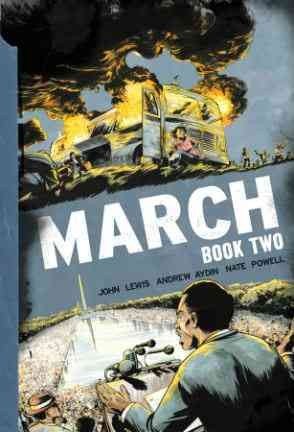
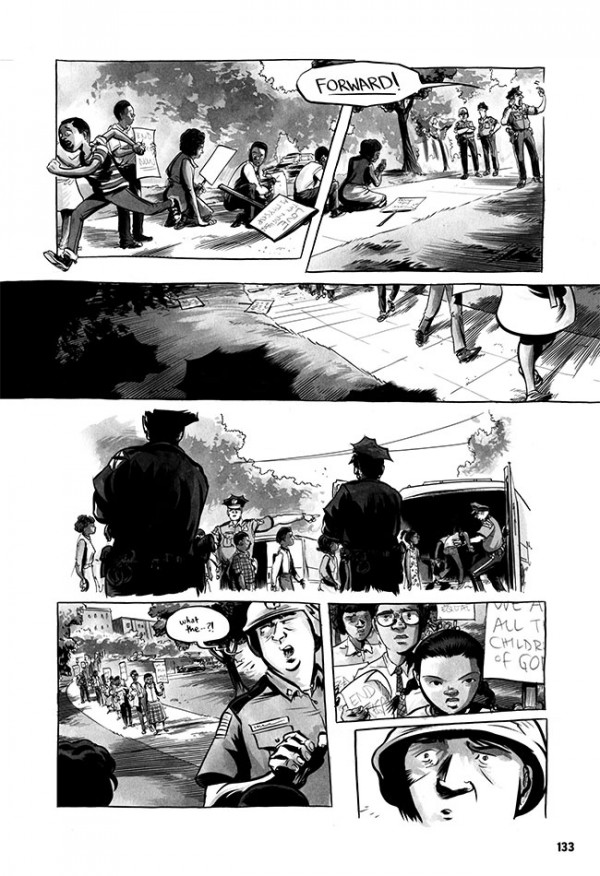
9781603094009_custom-96bb6f183e39c79f911e4bef3bc50eb9ccd512de-s300-c85With March, Book Two, we move from fantasy to history. This middle book in a planned trilogy continues to depict the inspirational life story of Congressman John Lewis, the notable civil rights leader who today still represents Georgia citizens. While March, Book One described Lewis’ boyhood and some activities leading to the historic 1965 protest on the Edmund Pettus Bridge in Selma, Alabama, Book Two focuses on the painful battles for equal rights fought between 1961 and 1963. These include the beating, jailing, and assassination of protestors in the segregated South—some of these assaults being condoned or even committed by police. We see adult “Freedom Riders” being assaulted as they attempt to desegregate buses, and we also see children gathered on city streets being battered by torrents of water from high-power fire-hoses. Then, with almost incredible brutality, police dogs are ordered to attack the children. In this sequel, co-authors Lewis and Andrew Aydin, together with phenomenal artist Nate Powell, continue the dramatically compelling framework begun in Book One: all these events are juxtaposed against the historic 2008 inauguration of Barack Obama, the United States’ first Black president.March-book-two-interior-133-100dpi-600x876

The exclusive use of black, white, and grey shadings is an effective technique in both March volumes. Black backgrounds emphasize the figures of important civil rights leaders, as we learn more about the inner workings and lesser known heroes of that movement, while gradations of black and grey dramatize the terror of unjust, at times brutal imprisonment and violent attacks. Powell frequently links panels of different sizes and perspectives with word balloons or lyrics banners that reinforce the relationships among the scenes they depict. One especially telling double page spread organized in this way juxtaposes Aretha Franklin’s full-throated rendition of “Let Freedom Ring,” sung at President Obama’s inauguration, with smaller, inserted panels showing the aftermath of a 1961 assault on Freedom Riders in Montgomery, Alabama. The confused revulsion there of one young boy as he looks at his bloodied hands, having been egged on by his mother to attack Blacks, is an especially telling image. His reaction is a sharp contrast to the smug self-satisfaction of a uniformed police officer also present during that attack. As current events show, violence against Blacks in the United States—despite hard-won changes in the law—continues to harm our citizens and society.

March-book-two-interior-160-600x360

Congressman Lewis’s sad, angered tweets about current violence against Blacks appeared in a Washington Post article about the March books.  The power of March’s graphic storytelling is so great that thirty school systems have already added these volumes to their curriculum, and they are also included in some university courses. Media coverage such as the Rachel Maddow interview of the books’ creators, which intersperses historical TV news coverage with pages from the books depicting these filmed events, further heightens public awareness of this history. Yet the eloquence of both written versions of Congressman Lewis’ speech at 1963’s watershed D.C. rally for civil rolls right off the page, its message also communicated through Nate Powell’s sometimes wordless but equally eloquent images. March, Book Two concludes by spotlighting one shockingly memorable day: at the bottom of the last page, we are shown the interior of a fire-bombed church in Birmingham, Alabama, on Sunday, March 15, 1963. Adults call the names of two young girls, not yet knowing they have been killed by this blast, while in the middle of the page, the stained-glass face of Jesus Christ has been obliterated. At the page’s top, the extended wail of approaching rescue vehicles seems to comment on the horror of this man-made, religion-defiling event.

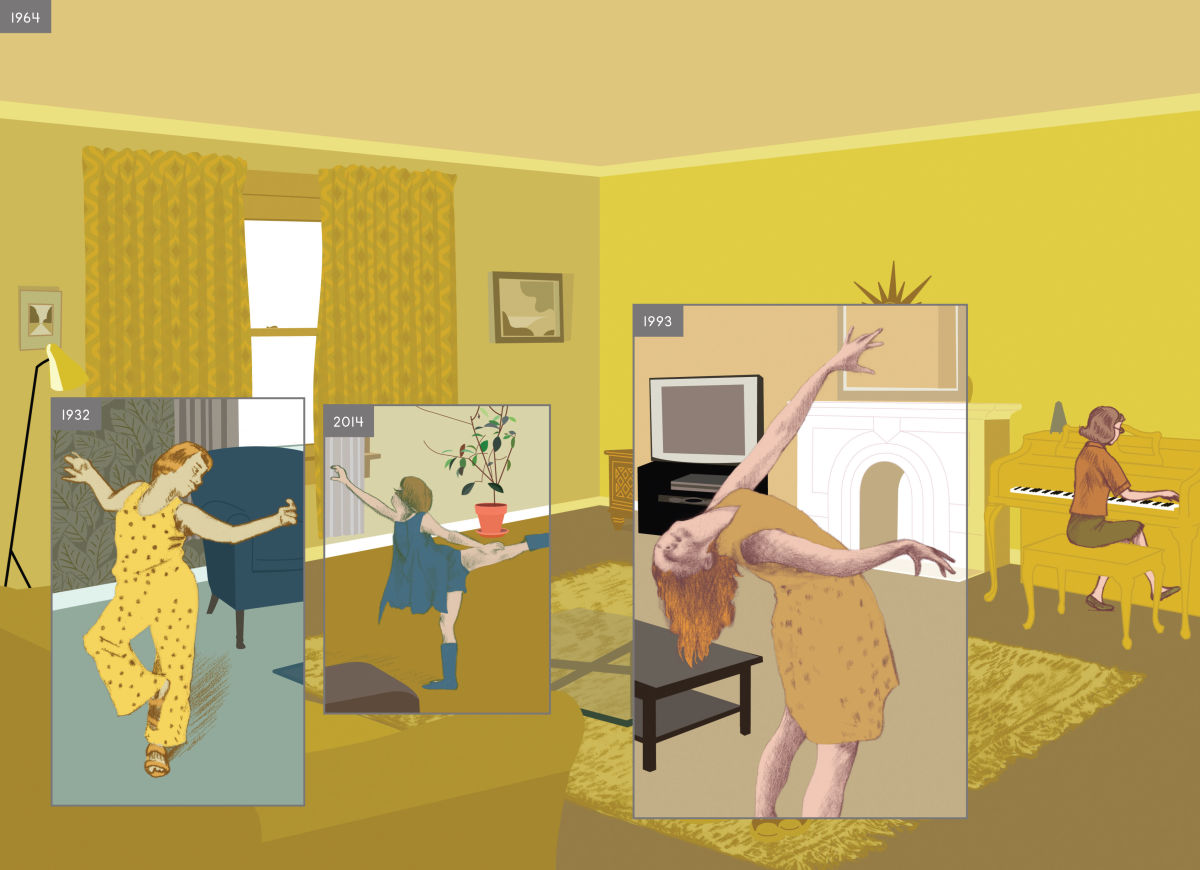
978-0-375-40650-8Asked when March, Book Three might appear, Congressman Lewis has said that, just as the civil rights movement took years to achieve some goals, publication of that volume may take some time. Yet the 17 months between publication of the first two books, as well as their rousing reception, suggests we will surely see the trilogy completed within this decade. That pace is distinctly faster than the publication record of lauded author/illustrator Richard McGuire’s Here (2015). This visually engrossing, nearly wordless book—depicting the history of one location in New England from prehistoric times through our own distant future—sprang from a six-page, black-and-white comic strip that appeared in 1989.

Each page of Here depicts a moment of time in this space, but other frames depicting other moments also appear in many of these pages. In 1989, this was an innovative technique that influenced other graphic novelists, such as award-winning Chris Ware. Today’s book-length work—now drenched in luminous color but still set primarily in the living room featured in the 1989 version—was so eagerly anticipated that Here’s development was itself the focus of a recent museum exhibit. While older readers will “get” more of this volume’s historical references and psychological subtleties, even upper elementary-school kids who enjoy challenges can appreciate its narrative layers, surprises, and occasional humor. Readers of all ages interested in décor and fashion will find the changings styles of the people and furnishings in Here a delight.

2.HERE-Dancers-20140720-2-40-1200 (1)

0306-startrek (1)Not twenty five but forty-eight years separate graphic novel Star Trek: Harlan Ellison’s City of the Edge of Forever, the Original Teleplay (2015) from its source material! That popular episode of TV’s first Star Trek series debuted in 1967. Its tale of accidental time travel back to the 1930s and attempts to save and return to the future was an instant hit.  Ever since, though, science fiction luminary Harlan Ellison has maintained that the show’s producer broke faith and contracts by changing Ellison’s original script. Ellison even wrote a book in 1995, containing alternate versions of his original teleplay, about this conflict. Surprisingly, despite this discord, Ellison himself approves of the graphic adaptation of his work, in its Foreword and Conclusion praising authors Scott and David Tipton and illustrator J. K. Woodward. This praise is justified. The pace of this graphic novel, its smart alternation of color with black-and-white for character-specific conflict, and use of pithy dialogue make it a very good read. First appearing as five separate comic books, this compilation volume issued by IDW Publishing now seems just like a TV show, with four high-tension moments  (the issues’ cliffhanger endings) acting as “breaks” for commercials. Some familiarity with Star Trek will enhance reader enjoyment of this well-done graphic novel, but extensive knowledge is not necessary.

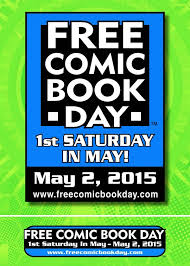
images (8)Still hungry for graphic snacks or meals? A highly anticipated new movie featuring Marvel Comics’ characters debuts today—The Avengers: Age of Ultron. There are also rumors that more than one upcoming Avengers comic book will include guest appearances by Kamala Khan. But even before that, stop into your local independent comic book store on May 2. Since 2002, the first Saturday in May has been “Free Comic Book Day” in these stores, which have a limited number of specific titles that publishers make available for free. Here is a link to a list of this year’s free books,  some better suited to young readers than others. As for me, I will satisfy my appetite for the new Ms. Marvel by sitting down to late June’s “full meal” of Ms. Marvel, Volume 3: Crushed (Ms. Marvel issues 12 to 15 and Shield #2). Will I also resist “snacking” if I wander into a comic book store before then . . . ? I make no promises.

Posted in biographies, comics, graphic novels, memoir | Tagged , , , , , , , , , , , , , , , , , , , , , , , , , , , , , , , , , , , , , , , , | Leave a comment

Recognizing Words . . . Reading Stories

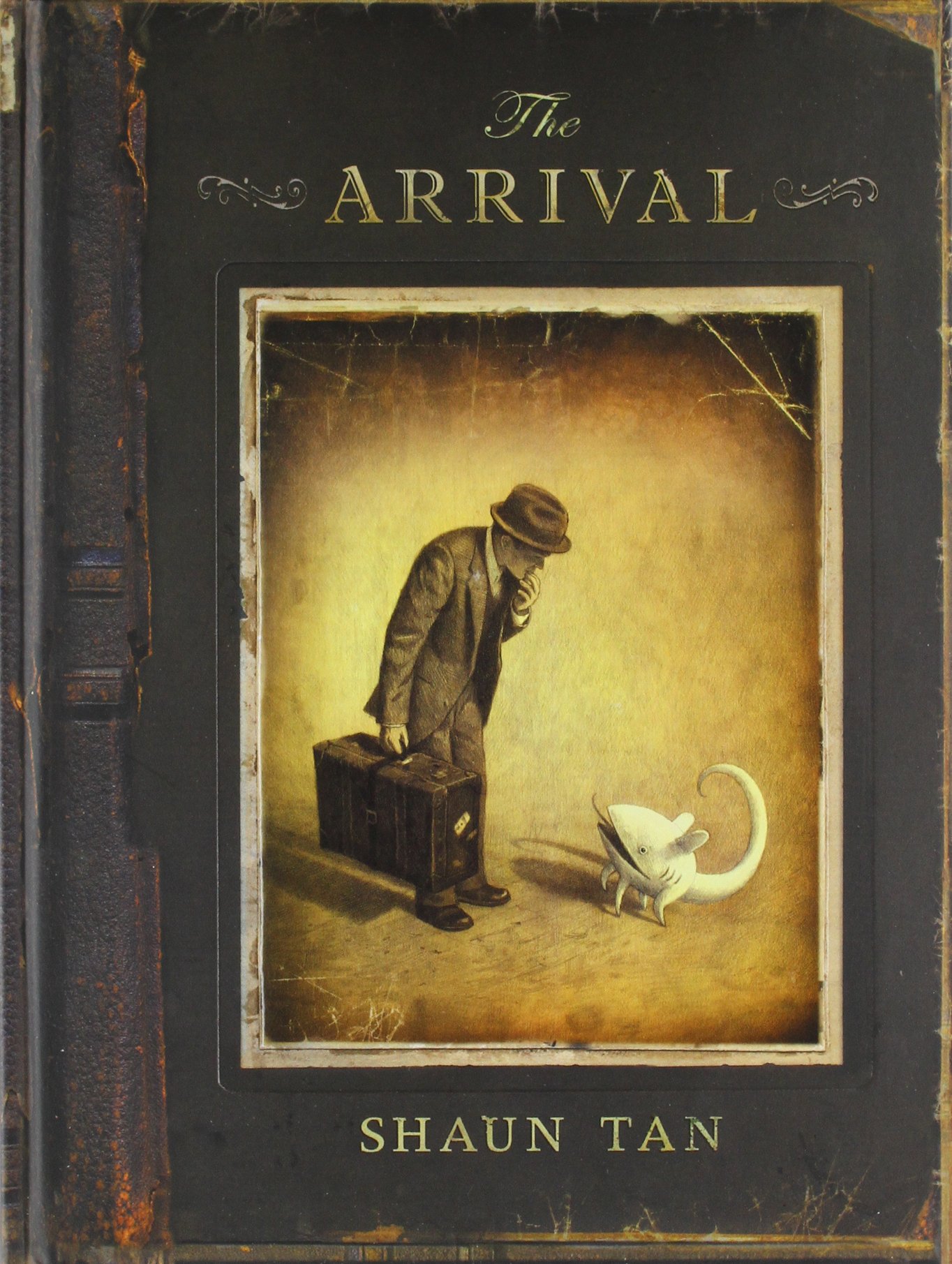
warning-sign-for-iriomote-catBeing illiterate was frustrating!  In Japan last May, I could not read package labels in grocery stores and pharmacies, follow the directions posted on street maps, or understand the background information displayed on many museum exhibits.  Japan’s written language is a complex combination of three different systems, none of them the Latin (sometimes called Roman) alphabet used in written English.  I had learned enough spoken Japanese to hold simple conversations during our two week stay, but I had not even attempted to grasp written Japanese.  Fortunately, people were helpful when I would awkwardly voice questions, and some of those packages and maps also displayed pictures, reminding me of my favorite all-ages wordless work, Shaun Tan’s The Arrival (2006).  Reading is not always or only about recognizing words . . .  which brings me to the topic of today’s post.

A new wordless graphic novel, Peter Kuper’s The System (2014) also got me thinking about Tan’s book, and the audiences for such works.  It is no surprise to anyone who works with or has kids that preschoolers enjoy picture books whether or not they have words.  David Weisner’s award-winning, fantasmagorical Tuesday (1991; 2011) and Bill Thomson’s vivid Chalk (2010) are just two great examples of contemporary wordless books that captivate their targeted audience, young pre-readers.  Folks involved with English as second language learners or professionals assessing speech abilities also recognize how useful wordless books can be for many age groups.  But fewer people are aware of the wordless novels created specifically for older readers, such as Kuper’s The System—or that these books were some of the modern “grandparents” of today’s graphic novels.  So I thought today I would spotlight some of these superficially wordless books.  I say superficially wordless because, as renowned author/illustrator Art Spiegelman has noted, “Wordless novels are filled with language, it just resides in the reader’s head rather than on the page.”

tumblr_inline_nk3ay1LsHY1suock4 (1)

Spiegelman—whose acclaimed graphic family memoir Maus (1991) won the 1992 Pulitzer Prize for literature—is an enormous fan of wordless graphic novels.  In fact, he has just completed an international lecture tour, complete with musical accompaniment to his slide show, about the history of these works.  How I wish that Minneapolis-St.Paul had hosted one of  Spiegelman’s events, advertised under the title “Wordless!”   Those of us who couldn’t attend one of these events will just have to be satisfied with the brief segment of his presentation available on line, and the leads he provides there to influential artists of the 1920s through 1950s, such as Flemish Frans Masereel, German Otto Nuckel,  and Americans Lynd Ward and Si Lewen.  Their graphic novels–such as Lynd Ward’s Gods’ Man  (1930;2010), with woodcut images reminiscent of medieval art—deal with adult life and struggles, and will be best appreciated by readers teen and up. 

4680725754_9f251c5897

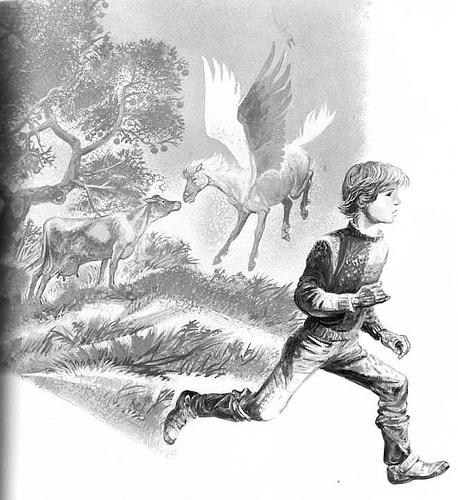
Yet, knowing that Ward (1905 – 1985) had also illustrated and written traditional picture books, I was pleased to discover his one wordless book for kids: The Silver Pony, A Story in Pictures (1973).  Its grey-toned pages depicting a Midwestern farm boy’s adventures with a winged pony—whether imagined or fantastically true—will delight not only kids but anyone young at heart.  Even though the small family farm Ward envisions is nowadays a vanishing reality, images such as a curious cow confronting that Pegasus are delightfully unforgettable.  Ward’s depiction of the boy’s adventures is also an illuminating reminder of how imagination gives all of us wings. 

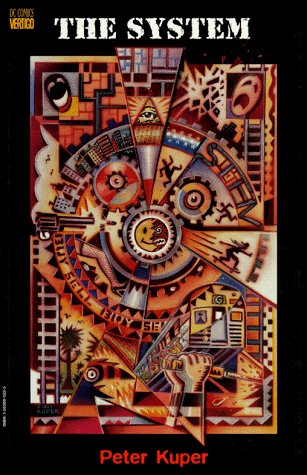
Still, wordless novels  written for teens and up are my focus today.  Peter Kuper and Erik Drooker are two contemporary author/illustrators who excel in this format.  Both are also successful magazine illustrators and—probably not coincidentally, given their shared interests—both worked on the “Wordless Issue,” number 39 of World War III Illustrated, a semi-annual  magazine focused on social commentary and journalism.  Both Kuper and Drooker are concerned with global issues, yet each also has strong New York City ties, often featured in their work.  That is certainly true of Kuper’s The System (2014), explicitly set in New York City, with a darkened NYC subway system map featured on its inside cover, frontispiece, and title page.  This powerful, arresting novel–first published in 1995 as three DC comic book issues and then in 1997 in one paperback volume—is as relevant today as it was in the 1990s, even though a few of its NYC locales have undergone dramatic changes.  (Times Square is no longer a seedy hangout for illegal or questionable activities, and the Twin Towers are, of course, no more.)  

System_

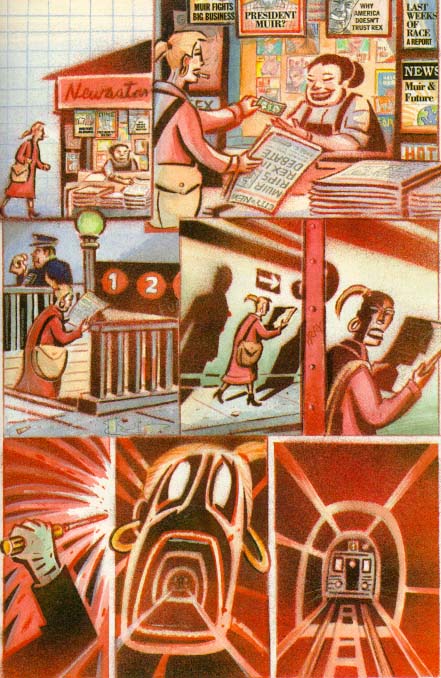
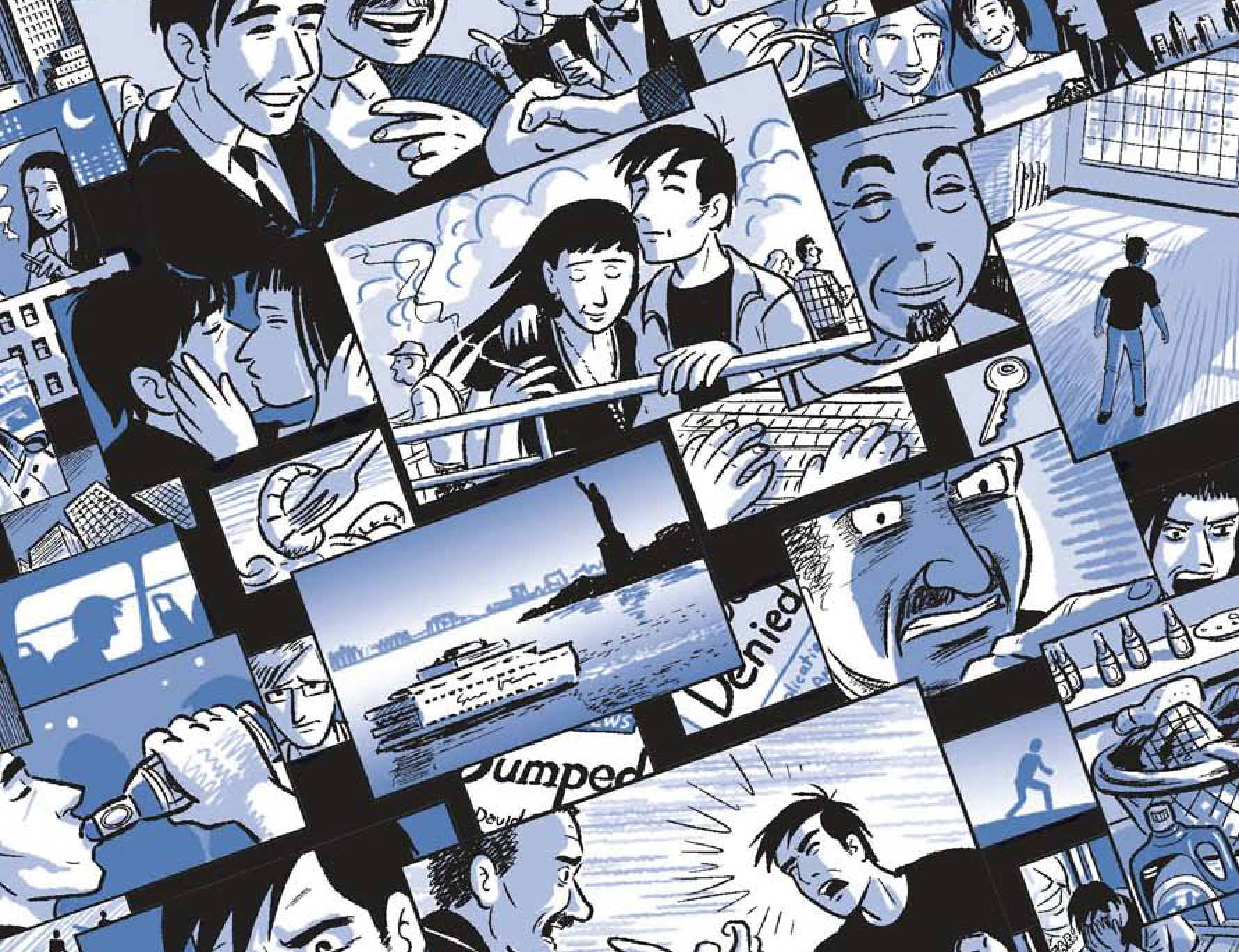
Kuper created the book’s color-saturated pages by the unusual, labor-intensive means of stencil cutting and then spray-painting his images.  Their colors sometimes bleed into one another, a visual effect he chose to support his storytelling goal: to see how the lives “of a subway car full of commuters  . . .  crisscross and impact one another in positive or even catastrophic ways . . . .”   It is a great goal, as we wonder and watch in suspense to see how the different story arcs overlap and finally come together.   Kuper’s characters are the working poor (including a mother supporting her child by working as a stripper), minor drug dealers, police officers “on the take” as well as overworked detectives, victims of a racist attack, and the homeless.  The one suburban, seemingly middle-class character is a man catching the subway at Grand Central Station, travelling in to regularly visit his hospitalized, AIDS-stricken lover.  Financial and social success are dubious achievements in this slice-of-life book.  The only richly-dressed character is a smuggler of explosives, while images of  newspaper and TV news headlines spotlight corrupt officials.  In Kuper’s world-view, our current systems—of government, business, and even health care—are failing large numbers of people.

system1

Fragments of newspaper stories, picket signs, a missing person flyer, and a final, ironic sound effect “word balloon” are the other, infrequent verbal cues that sharpen and refine The System’s satisfyingly complex narrative.  Kuper also uses three literary epigraphs, each mentioning a “system” or “systems,” that drive home his point.  Even without these cues, though, Kuper’s images are strong and clear enough to communicate the novel’s gist. 

images (5)

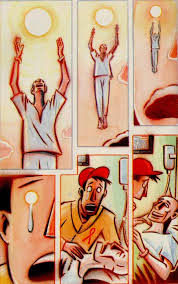
In The System, one image frequently morphs into another—for instance, a subway entrance transforms into the gaping mouth of a strip club customer.  This technique helps readers transition from one story arc’s setting to the next.   Kuper also uses this technique to engage us with his characters’ emotions.  As the hospital visitor imagines his lover’s death, we see the lover ascending towards the sun, only to have this image transform into the teardrop descending from the grieving visitor’s eye.  At the novel’s conclusion, a black window shade is pulled down on one of novel’s happier outcomes, only to turn into underground darkness, the subway tunnel abode of the homeless man who has scavenged a terrifying surprise.   Kuper also uses several double page spreads to great dramatic effect and is a master in varying perspective and close-ups with mid and long distance images.  Readers who relish irony and tales of urban life and strife will wholeheartedly savor The System.

61t6lwUzXoL._UY250_

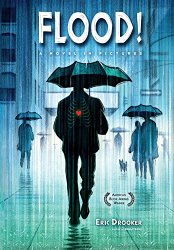
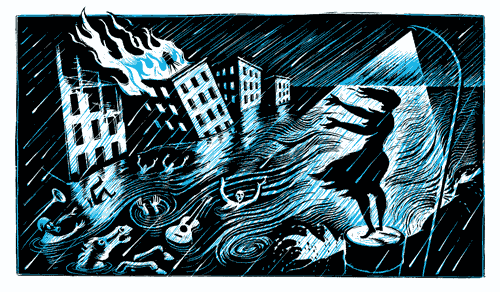
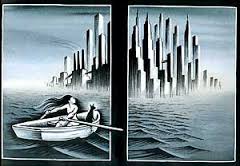
Erik Drooker’s Flood! A Novel in Pictures (1992; 2002) is stunningly good—an intense, semi-autobiographical look at the experience of an urban artist who loses his factory “day job.”  He then wanders the bleak streets, subways, and boardwalks of New York City, seeking relief first in sex, then in amusement park side shows and rides before returning to his drawing board.  Limited use of color is important in this mainly black-and-white book; it is only in its second half that Drooker adds bright blue to his expressionist images, emphasizing the phantasmagoric nature of his narrator’s experiences.  The artist sees an Inuit tale he is illustrating come to life, seems to float above Coney Island’s roller coaster, and “sees” images of the United States’ grasping, harsh treatment of Native Americans, Blacks, and urban protestors.  Like the flood that engulfed Biblical Noah’s degraded world, a rising tide covers iconic New York City skyscrapers, but only the artist’s cat—adrift with the shivering artist in a rowboat—finds shelter on a new, post-apocalyptic ark.  

flood-barefoot-woman

Drooker varies panel size and makes frequent use of double page spreads to communicate the intense, inner reality his book expresses.  Its  extreme angles and bold, dense images are reminiscent of 1920s and 30s Expressionism and that era’s renderings of “primitive” tribal art.   Frequently viewing the skeletal interiors and hearts of Drooker’s characters, we know that Flood! is meant as metaphor, not reality.  But the pounding, pulsating intensity and rhythms of this graphic novel make it feel real.  In 1994, this work was deservedly honored by other writers with an American Book Award.

bloodsong

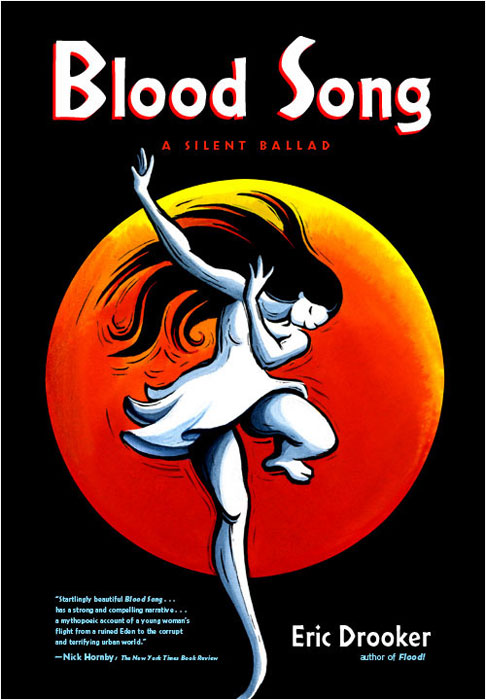
Like Flood!, Drooker’s Bloodsong—A Silent Ballad (2002) limits color on its primarily black-and-blue pages.  Drops of red blood and flashes of yellow and orange make only brief appearances on a darting butterfly, in the wail of street music, or the cry of a newborn infant. Unlike Flood, though, Bloodsong is not tied to one, identifiable locale.  Its tale of a young woman and her dog fleeing brutal soldiers who ravage their tropical home could take place in many parts of the world.  The inhospitable city in which they find refuge is also never identified. Drooker has said that he wanted to create “a fable . . . a fairy tale of sorts” in which his character comes of age as “corporate globalism [is] devouring natural resources and human labor with increasing speed and cruelty.”  Drooker visually sets the stage for this haunting, mythic story with images of  the Milky Way galaxy that zoom in to images of Earth and later zoom back out.   We care about the big-eyed, lithe-limbed girl who is determined to survive, no matter how scared or outnumbered she is.  We feel for and with her as she finds a kind lover in the Big City, only to have him unjustly torn from her as they form a new family.  By using each double page as a diptych, Drooker moves this story along at a fast pace that leaves us satisfyingly breathless.  We want to see what happens next as we turn each page! 

images (7)

Close-ups alternate with more distant views, from varied perspectives, in these water-colored pages drawn with bold, often sinuous scratchboard-etched lines.  Drooker believes that “the visual affects us on a different level than the written . . .” that it is “an ancient language.”  Readers of Bloodsong will enjoy its  eloquence, set to the rhythms of an anti-war, anti-establishment melody.

811YX31IFLL (1)

Like Bloodsong, Shaun Tan’s acclaimed The Arrival (2006) is not set in a specific locale.  In fact, some details of its cityscapes—such as the shadows of seeming dragons overhead, larger-than- life port statues unlike any Earthly ones, and small, oddly-shaped creatures who mysteriously pop up as useful pets—make its setting a fantastic one.  Its sepia tones, akin to old-fashioned photographs, also help set this wordless novel in an alternate, early- industrial  time.  Yet these strange elements only serve to heighten how universal and down-to-Earth Tan’s story of immigration is—relevant to readers no matter what their own background or current location.    Australian Tan, whose end “Artist’s Note” explains that his sources include his own father’s immigration from Malaysia, reinforces this theme of universality through the book’s inside covers, which are filled with sixty passport-like drawings of people with features and clothing from around the globe.  Tan’s style of realistically drawing features, communicating different ethnicities as well as rendering emotions clearly, further anchors his whimsical setting in recognizable experience.

Shaun Tan - The Arrival 112-113[1]

shaun-tan-the-arrival

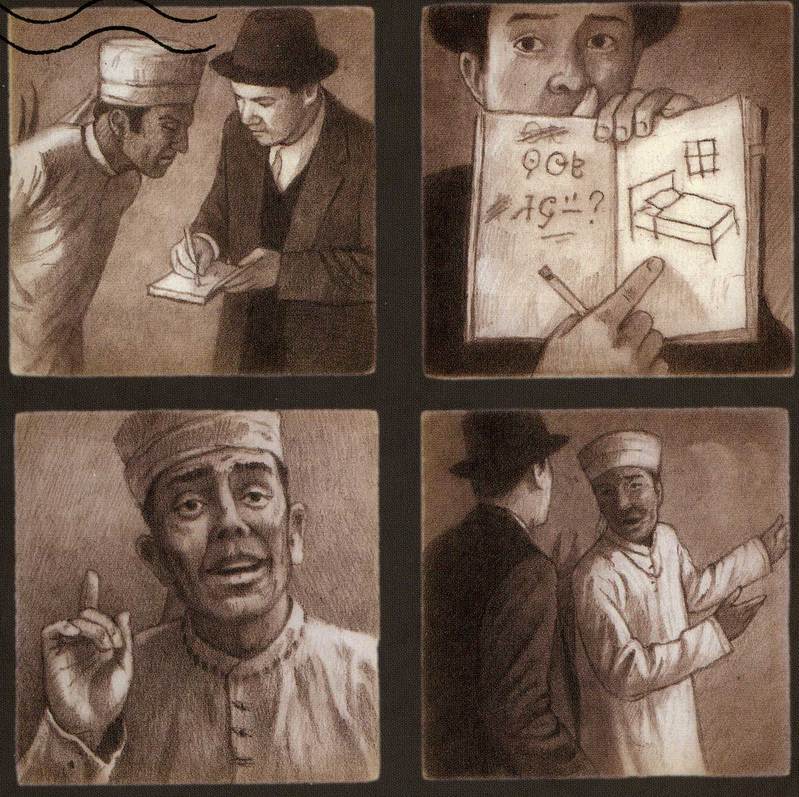
 Tan’s main character is a man who leaves his wife and daughter, journeying by sea to a large and distant foreign city.  Upon his arrival, the difficulties he has understanding local signs and following written directions are readily apparent to readers because we too cannot decipher the written language Tan has created!  At these moments, as I reread this favorite book, I felt as though I were back in Japan, situationally illiterate again.  We see Tan’s protagonist fumble in his first job posting flyers, as he unknowingly, humorously positions them upside down.   The newly-arrived immigrant uses a notebook filled with pictures to make himself understood and to acquire bits of new-to-him written language.  Slowly, he finds other jobs and friends, some themselves former immigrants who describe their own reasons for having left their homelands.  Full page and double page images—some dramatizing vast distances or devastating war scenes, others showing the warmth of people who welcome the newly-arrived man—alternate here with pages filled with many small panels.  One such page shows the main character, missing his wife and daughter but now employed for some time, as he posts a letter and then awaits a family reunion.  Each row of small panels contains a different seasonal plant or item, indicating a year spent waiting until, at last, his family arrives.  The novel ends happily with father, mother, and daughter now settled into their new life together.  Its final image is of that young girl now helping a brand-new immigrant, suitcase still at hand, to interpret directions on a map that she herself no longer finds bewildering.  Tan’s wordless novel will gratify readers of all ages—regardless of which characters they most identify with here.

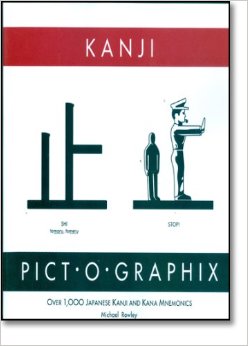
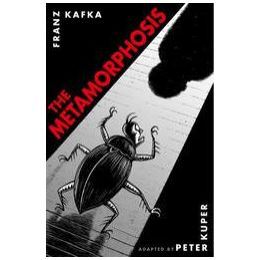
41AkMyDa-lL._SY344_BO1,204,203,200_In fact, completing this post, I feel inspired to look at my gift copy of Michael Rowley’s Kanji Pict-O-Graphics (1992).  It teaches some basics of written Japanese by associating these symbols with—what else?—the pictured things they resemble.  If Shaun Tan’s protagonist can learn to read foreign script . . . .  I also am looking forward to the Frans Maaserel and Otto Nuckel wordless novels I have ordered through interlibrary loan.  I know, too, that the next time I want to read Franz Kafka’s surreal novel The Metamorphosis, I will seek out Peter Kuper’s graphic adaptation of this classic work. 2001968517-260x260-0-0_the_metamorphosis_by_peter_kuper

 And now that I know that Erik Drooker designed animated sequences for a filmed biography of poet Allen Ginsberg, the 2010 movie taking its title from Ginsberg’s famous poem Howl ,  I am interested in download (5)seeing that film as well.   These sequences are also available in book form, illustrating that title poem.  So much to see —and read—that one might almost be (not wordless, never that) but speechless with anticipation.

Posted in graphic novels, picture books | Tagged , , , , , , , , , , , , , , , , , , , , , , , , , , , , , , , , , , , , | Leave a comment

The IDIC of Leonard Nimoy: 1931 to 2015

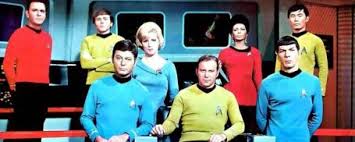
afd-196312

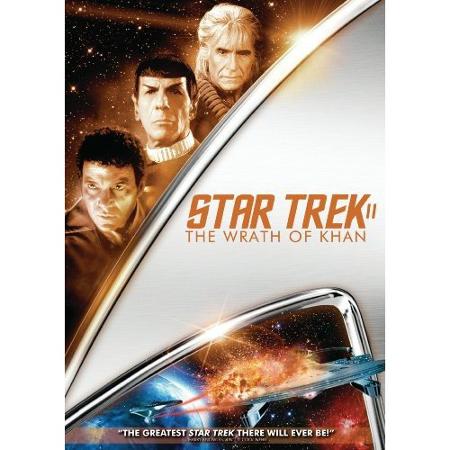
Thirty-three years ago, the death of Mr. Spock seemed intolerable.  That was the gist of a feature article I wrote back then for the Mankato Free Press.  I was responding to 1982’s  brand-new movie, Star Trek II : The Wrath of Khan, which ended with the scene of Spock’s coffined body on the newly fertile soil of planet Genesis.  I prophesized that we would not only see Spock’s return but many more iterations of this character.  As a young literature professor, I also tied in some of the Star Trek novels of Vonda N. McIntyre, an award-winning science fiction author.   

download (4)

To set the context further here, this was before any of the Star Trek live action offshoot series—Next Generation, Deep Space Nine, Voyager, and Enterprise— had debuted.  I and other fans had only seen the original 1960s Star Trek series, which first aired when I was a high school sophomore, and perhaps caught episodes of the Saturday morning animated series first broadcast for two seasons in the 1970s. Today, I smile ruefully as I realize that there have now been twelve Star Trek movies made, not just the five my article predicted. 

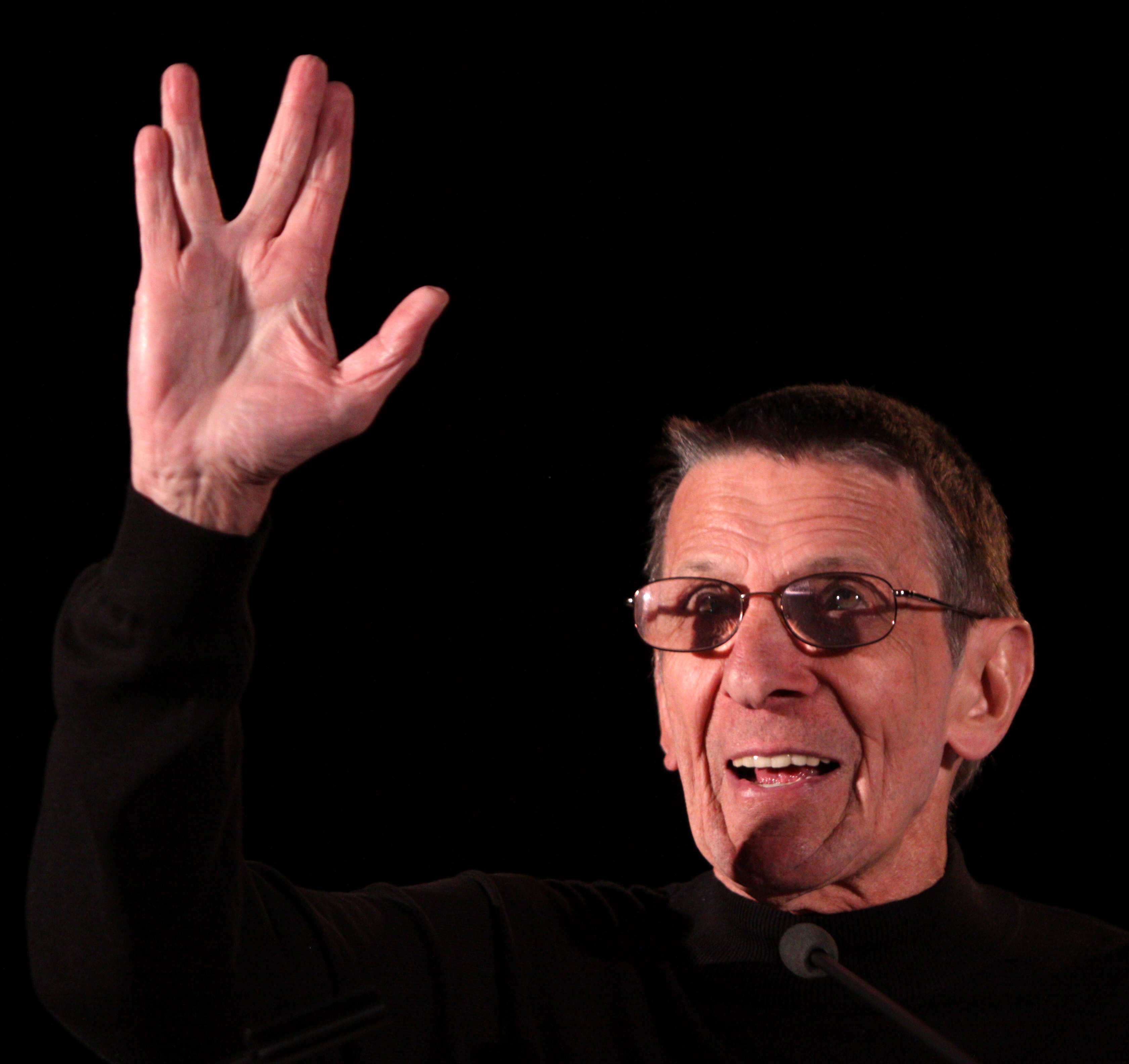
color_nimoy_headshotWhile I was right about Spock’s return, I did not foresee that years later the death of Leonard Nimoy (1931 to 2015), the actor who embodied Spock, would seem just as intolerable as Spock’s demise.  In part that is due to Nimoy’s continued association with the Star Trek franchise and fan phenomenon, but in large part this heartfelt loss is due to Leonard Nimoy’s own sterling qualities.  His advocacy for tolerance and individual rights—the Infinite Diversity in Infinite Combination (IDIC) Star Trek popularized as Vulcan philosophy—was also Nimoy’s own personal philosophy and way of life.  As our Jewish mothers might have said, “What a mensch!”  Nimoy had long ago explained how Spock’s signature Vulcan greeting—hand held high with fingers spread apart—was based on Judaism’s traditional gesture of priestly blessing.   And Nimoy in turn ultimately embraced the way his most famous acting role gave him an entrée into the lives of thousands of followers, typically ending his calls-to-action and encouraging Tweets with the Vulcan wish that they “Live Long and Prosper” (LLAP). 

Leonard_Nimoy_by_Gage_Skidmore_2 (1)

With news of Leonard Nimoy’s passing last month, the Internet revived magazine features about his kindness to isolated teen fans; videos about his passionate involvement with Yiddish, the language of his youth; and accolades about his support for Jews and other minorities world-wide, along with his warmth as friend and family member.  Nimoy’s sense of humor and wry self-mockery circulated again in a commercial he had made with Zachary Quinto, the actor who in 2009 received Nimoy’s approval to play a young, alternate timeline Spock.  Glowing tributes to Nimoy poured in from human fans around the globe and even one from  outer space.  We have yet to decipher any condolences that other galaxies and their inhabitants may have sent our unheeding way!     

In memory of Leonard Nimoy, I reproduce here my July 8, 1982 feature piece, “‘Star Trek’ book guarantees long life for Spock.”  In retrospect, I might as accurately have titled the piece   “Leonard Nimoy guarantees long life for Spock.”  And now memory and story take up the mantle.


 *******************


k2-_eb97e44c-edb4-4f2d-8698-7237990b4dfa.v2

The gleaming, oblong form nestles in its green bower like a yet-to-be discovered jewel.  The camera slowly withdraws, revealing more of the Edenic setting of planet Genesis, the newly created world on which Mr. Spock’s space-travelling casket has come to rest.  As the movie audience participates in these final moments of Star Trek II: The Wrath of Khan, we begin to realize that Spock’s sacrifice of his own life to save the Starship Enterprise and its crew may not be a permanent one.  The film’s close, prolonged focus on this unharmed, gem-like casket; its panoramic survey of these new, idyllic surroundings; and the pronouncements of Admiral Kirk and other grieving cast members about “new life,” “new beginnings,” and “rebirth” suggest that the popular Mr. Spock may well be resurrected in some way for eager audiences of Star Trek III, IV, and V.

But marketplace factors are not the only reason why Mr. Spock will never “really” die.  And Star Trek III, IV, and V are not the only media in which we may hope to see him.  As devoted fans of the often-rerun 1960s TV series know, a multi-media industry has sprung up around its cast of characters.  Star Trek: The Movie and Star Trek: The Wrath of Khan are merely the most expensive and elaborate of the series’ spin-offs. At fan conferences around the country, one may buy Star Trek paraphernalia, talk with guests of honor invited from its original cast and production company, or play related video and board games.  One may also purchase any number of Star Trek novels that have been written in recent years.  It is the latest of these novels, Vonda McIntyre’s not surprisingly titled Star Trek: The Wrath of Khan, which firmly convinces me that Mr. Spock will never die.

content (1)McIntyre’s novel is a book that would secretly please that enigmatic Science Officer of the U.S.S. Enterprise.  Obviously promoted to capitalize and reinforce the success of the Paramount Picture’s film, McIntyre’s novel boldly goes beyond this commercial mission.  It captures many of the reasons for Star Trek’s—and Mr. Spock’s—massive continuing audience appeal.  As a result, the novel is even more faithful to the ideals of the original series than this latest, entertaining film.

Characterizations and unresolved conflict lured viewers of the original Star Trek.  Part-Vulcan, part-human, Mr. Spock was someone with whom many could identify.  He was an alien in two cultures—just as society-at-large often labels members of racial, ethnic, religious and sexual preference minorities, as well as the female majority of our population and young adults, as aliens or less-than-human “others.”  Spock was also trained in Vulcan logic to be detached from human emotions.  Those of us who have learned to “shut off” our feelings while watching the 6 o’clock evening news could further relate to this frustrating life-style. We watched Spock and then-Captain Kirk with interest as they struggled with troubling emotions and Starfleet Commands that did not always meet individual needs or situations.

The film Star Trek II revives many of these conflicts.  Regulations vs. human needs are an issue from its first cadet training simulation to Spock’s final, “illegal” self-sacrifice.  Even while dying, the supposedly unemotional Science Officer is prevented by a glass barrier from touching the hand of James Kirk, his closest friend.  Vonda N. McIntyre’s The Wrath of Khan reproduces all of these gripping scenes—and then does more.

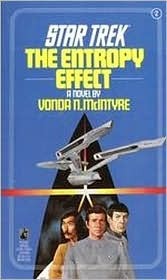
216646As in The Entropy Effect, her first Star Trek novel, McIntyre focuses on relatively minor characters to explore the ideas represented by the major characters of Spock and Kirk.  In The Entropy Effect, she concentrated on Mr. Sulu, whose Asian background both strengthens and complicates his experiences in Starfleet, and on two women Starfleet officers of her own creation.  In The Wrath of Khan, McIntyre expands the film’s portrayals of Lt. Saavik, Cadet Peter Preston, and the Project Genesis scientists slain by Khan.  Through these characters, she examines the concept of “alienness,” and the issues of law vs. justice, and individual vs. collective survival.

McIntyre’s Saavik, like Mr. Spock, is a person torn between two cultures.  In this novel, we learn that Saavik is half-Vulcan, half-Romulan—the unwanted child of Romulan invasion and rape of a Vulcan scientific colony.  McIntyre details the student-teacher relationship between “logical” Saavik and Spock fully and compassionately.  We see that Spock’s isolation is not a unique experience but one that is continually recreated by social circumstances.  Saavik is brutally shaped by her heritage just as Spock is affected by his.  Peter Preston, the youngest cadet aboard the Enterprise, is the first friend Saavik has ever had.  He is also Chief Engineer Scotty’s nephew, and must struggle with the burden of this personal relationship as he tries to make good on his own.  By drawing full portraits of Preston and the Genesis scientists (two of whom are also “aliens”) McIntyre intensifies the impact of their deaths in the fight against Khan.  Her novel makes us realize the value and loss of each individual life in a struggle for collective survival in ways that the film does not.

Vonda N. McIntyre is one of many science fiction writers in the last 15 years whose works explore the humanistic issues highlighted in 1960s commercial science fiction by Star Trek.  This “social science fiction” movement, strongly influenced by feminism, emphasizes human and social relationships rather than future technology.  The continual growth of such social science fiction is ultimate proof that Mr. Spock will never die.  His hopes and fears, dilemmas and triumphs, have become an irrevocable, central part of America’s popular culture.

star-trek-nimoy (1)

Posted in articles | Tagged , , , , , , , , , , , , , , , , , , , , , , , , , , , , , | Leave a comment

“Larger-than Life”? Art, Fame, and Family

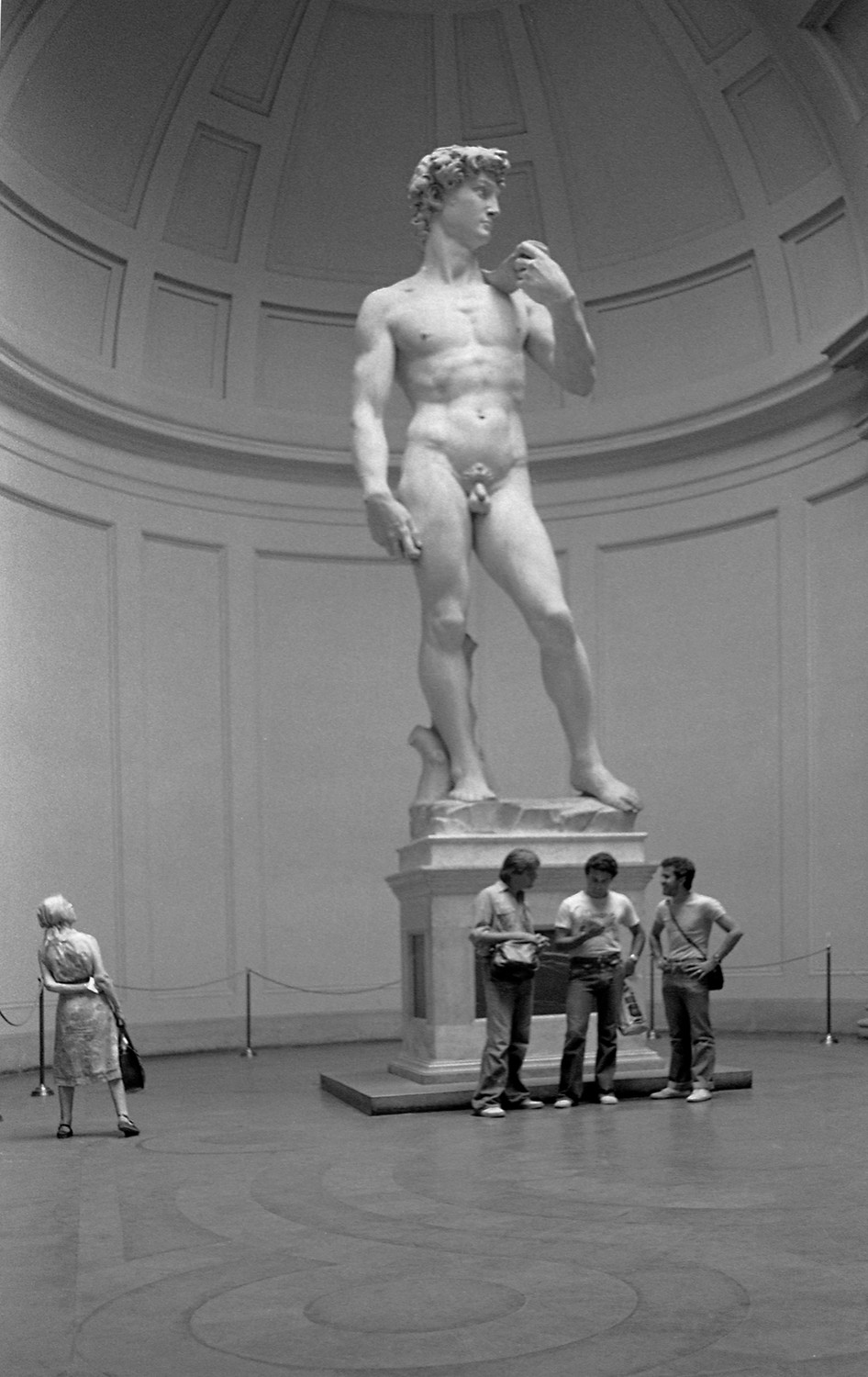
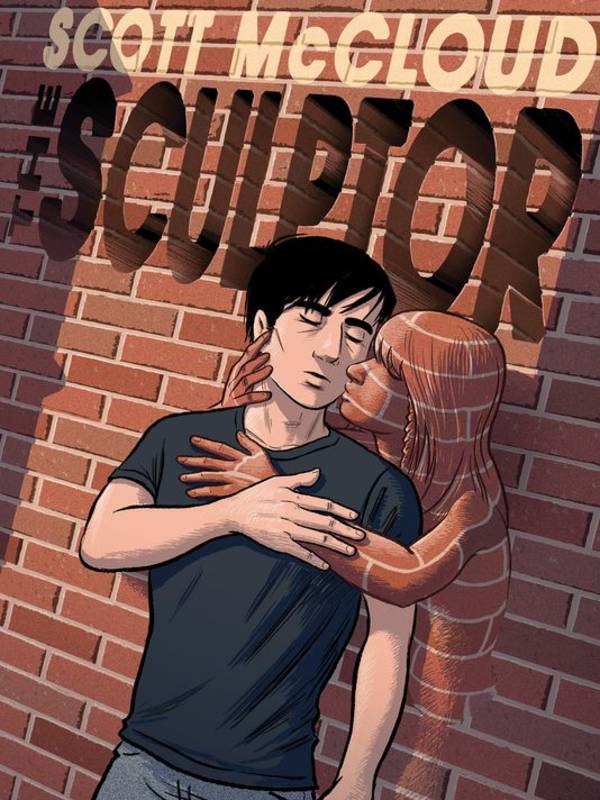
il_fullxfull.161339915 (1)Does the expression “larger-than-life” bring images of Mt. Rushmore, the Statue of Liberty, or Michelangelo’s David to mind?  This term is often used to describe the scale of public art, designed to impress viewers with its grandeur even alongside natural wonders or city scenes.  Yet “larger-than-life” can also refer to  someone’s reputation or personality.  “Larger-than-life” may even refer to the impact such a famous or impressive person has on the lives of others—his or her legacy to future generations.  These multiple meanings are on my mind today, as I ponder my family’s recent interactions with artist/illustrator Scott McCloud and his brand-new and truly wonderful graphic novel, The Sculptor (2015), a fierce yet poignant look at what it means to create art.

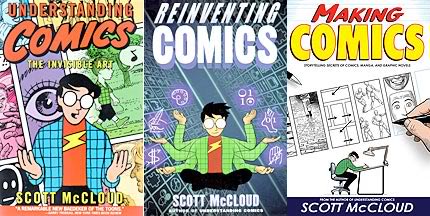
sculptor-coverUntil now, McCloud has been perhaps best known for his influential ideas about graphic storytelling, summed up in three books: Understanding Comics: The Invisible Art (1993), Reinventing Comics (2000), and Making Comics (2006).  These Harvey and Eisner Award winning graphic nonfiction works were enough to make McCloud a recognizable name in our comics-filled household.  (His earlier,  affectionate, yet sharp-eyed riff on superheroes and pop culture—the series Zot! [1987-1991; 2008]—still remains less well-known.)  Back in 2008, I excitedly told my then college-student son that Scott McCloud had just completed Google’s online, comic book guide to its new web-browser Chrome. Daniel knew just who I was talking about—and just why that made this online guide an even bigger, more special event.  Now in Portland, Maine, Daniel remembered McCloud’s “larger-than-life” impact on readers and creators of comics when he thoughtfully sent me a signed, hot-off-the press copy of The Sculptor.  Tucked inside was his note that this was “an early birthday present (bought & sent to you in advance in hopes that you’ll receive it before buying your own copy).”

scottmccloud

This early gift surprised and delighted me.  (“Dedicated to me!” I still squeal, “And with its own, drawn-on-the-spot cartoon of a girl, my very own Scott McCloud ‘avatar’!”) And it did arrive just in time.  Portland was one of the first stops on McCloud’s nationwide tour promoting The Sculptor.  My copy came just a week or so before McCloud nearing the tour’s end visited Macalester College in St. Paul,  Minnesota.  Since the college is just minutes from my home, of course I went to hear him speak.  I surely would have bought my own copy then, though I suspect any autograph I stood in line for that day might not have had that lovely little personalized cartoon.  I think being told by Daniel that the book was for his mother, who is also a fan of comics and graphic works, McCloud might have taken some extra moments for the doodle I now prize.

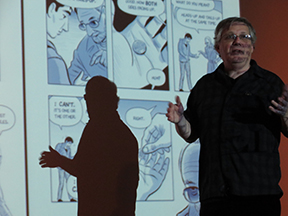
How McCloud behaved, along with what he said when he spoke at Macalester,  relates directly to The Sculptor’s plot and themes.  Its 500 pages depict how much its central character, 26 year-old sculptor David Smith (not—as this young man points out—the renowned mid-century sculptor also named David Smith) wants and sacrifices to achieve the kind of recognition accorded these days to Scott McCloud.  McCloud’s own reputation had drawn an audience large enough to fill Macalester College’s student union auditorium, even in subzero weather.  Surprisingly, though, this giant in the world of comics is in person not at all “larger-than-life.”  Soft-spoken, dressed informally, and relaxed in demeanor, McCloud conversed easily with Eric Lorberer, the editor of Rain Taxi Review, who interviewed him.   Despite his relative fame, McCloud remains modest about his drawing ability compared to other artists and earnest and friendly when answering questions from the crowd.  This seeming “disconnect” between fame and taking pride, power, or total satisfaction in artistic success is at the heart of The Sculptor.  Its young protagonist makes an incredible sacrifice for his art that today’s 54 year-old Scott McCloud proclaimed he would not.  Explaining how his wife and own life had inspired characters mccloud-on-stage-weband some events in the novel (an explanation detailed further in the book’s Afterword), McCloud said The Sculptor is a mature, rueful look at youthful aspirations and singled-minded ambition.  It is not the book McCloud would or indeed could have created in his 20s, when its plot first occurred to him.

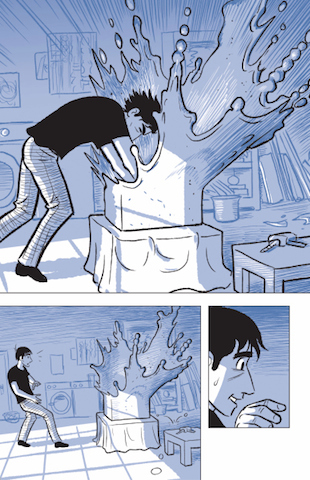
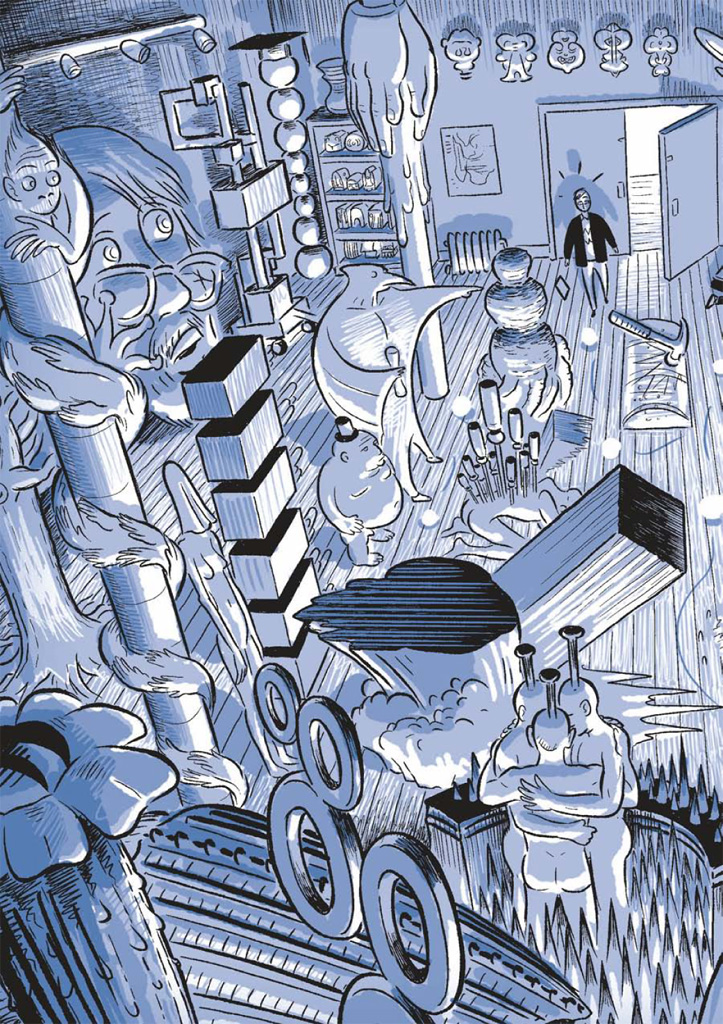
Described as an “anti-fantasy” by one reviewer, The Sculptor is in simplest terms a variation on the legends that inspired Goethe’s Faust.  Instead of selling his soul to the Devil for knowledge, though, McCloud’s hero makes a bargain with Death.  On his 26th birthday, David Smith—scorned by art critics after some early success—accepts an offer from Death: Smith will be given a superhero’s powers to sculpt with his hands, to create the “big, monstrous, beautiful things” he sees in his mind, “demanding to be seen, demanding to exist,” but in return he will have only 200 more days to live!  Death, which appears to Smith as his departed Uncle Harry, shows the young man the quiet joys (and frustrations) of family life he will be giving up with this trade, but Smith still opts for images (4)artistic achievement and fame.  What he does not reckon with is how slowly and capriciously artistic worth is acknowledged in today’s world and how his view of this bargain will change when he falls in love.  McCloud’s graphic storytelling elevates this familiar and somewhat predictable plot to breathtaking heights—literally as well was figuratively, as much of David Smith’s art is monumental in size, scaled to New York’s cityscape.

sculptor-2

McCloud uses wordless or nearly wordless pages to great and varied effect.  They provide the novel’s mysterious, attention-grabbing opening; in double-page spreads show the frenzy of focused artistic creativity; and in multiple-page sequences capture both the dilation and compression of time during moments of great emotion.  This powerful novel (best suited to readers teen and up) depicts the intimacy of love-making, the despair of clinical depression, and the imagined experience of dying.  McCloud’s palette of blues, blacks, and greys—through subtle variations in tone—conveys a shifting range of emotions and experiences.  For instance, when David Smith is asleep or unconscious, an entire panel or series  of panels is black.  As he slowly awakens or regains consciousness, his fuzzy-headedness is suggested by grey word bubbles, their remarks displayed in soft-focused lettering. At other points of angry intensity or action, large, thick black letters sweep slantingly across pages.  Loud sounds or raised voices are also marked by changes in letter size and font.

23474-v1-600x1

Yet anger, despair, or grief are not the dominant emotions in this book.  Equally there are joy, hope, humor, and the gamut of feelings associated with falling in love and becoming a family. McCloud’s fine ear for dialogue as well as his drawing skills make us believe in the world of David Smith and the characters who inhabit it.   Boldfacing some dialogue establishes its natural rhythms, as when David first unexpectedly encounters his uncle and says, “Well, great to see you!” as he embraces him.  This synergy between words and images is constant.  For instance, David’s girlfriend Meg never actually says she is pregnant when she reveals this news to David; in three panels she does say, “I . . . haven’t been . . . real careful about . . . birth control . . . .”  Her expression there, combined with the looks between her and David in the following three wordless panels, as well as in the panels and pages that follow, convey the range and scope of David’s reactions to this news, knowing as she does not that he has only eleven days left to live.  Here as throughout The Sculptor, McCloud varies close-ups with mid and far-range views and changes in perspective to great effect.

sculptorbg

In dying, David Smith will leave not only warm-hearted, quirky Meg (whose independent spirit extends to rejecting medication for depression) but the “family” of her friends who have also embraced him.  Theirs is a multiracial, multicultural community, celebrating birthdays, backgrounds, and the holidays of different religions in realistically varied economic circumstances.  Economics and class differences also figure in the studio and gallery spaces of the art world friends and acquaintances who are another part of the life Smith has traded for his magical hands.  New York City and its heterogeneous population are themselves characters in The Sculptor, with its many scenes of urban life round-the-clock.  In his St. Paul talk, McCloud spoke of travelling to New York just to photograph the inhabitants of different city neighborhoods, to have true-to-locale models for the background characters he then drew.  This attention to detail is evident throughout the novel, but has added poignancy in its breathtaking, heartrending conclusion.  I will not “spoil” this conclusion with comments on its specific images or dialogue.  I do suggest, though, that you reread the final three pages and note again the placement and content of the lone panel on the book’s very last page.

9781596435735.IN08The Sculptor will remain a “larger-than-life” part of my personal library.  I plan to keep my son’s early birthday greeting–handwritten on a torn-out, lined notebook page—inside my gift copy of this book.  I confess that it means a great deal to me—not only the care and thought that went into this present but the fact that my husband and I have been able to transmit our love of reading and art to Daniel, now 28 years-old.  It is part of our “longer-than-life,” intangible legacy to him, together with whatever else he will remember about us.  We (now older than Scott McCloud) have lived our lives with family, literature and art placed ahead of any modest professional fame we managed to achieve.  Even without such a personal note but especially with it, The Sculptor is a wonderful testament and tribute to our multicultural family’s values.


Posted in comics, graphic novels, Uncategorized | Tagged , , , , , , , , , , , , , , , , , , , , , , , , | Leave a comment

Jews, Muslims, Christians: The Rabbi’s Cat Speaks

download (2)

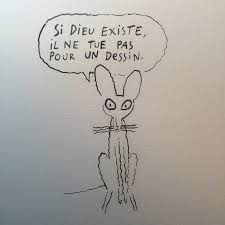
A skinny, big-eyed cat stands out among the responses cartoonists world-wide  drew to last month’s  terrorist attacks on the French magazine Charlie Hebdo and a kosher grocery store in Paris.  Sixteen people were slaughtered and others injured—all to honor those terrorists’ twisted understanding of their religion, Islam.  Charlie Hebdo had been singled out because of cartoons it published depicting Islam’s great prophet, Mohammed.  Jews, the grocery’s main customers, were targeted for their religion by the anti-Semitic terrorists. On the social medium Instagram, that tensely-posed cat proclaimed in French, “If God exists, He does not kill for a drawing.” 

61JRfCm3eTL._SX258_BO1,204,203,200_

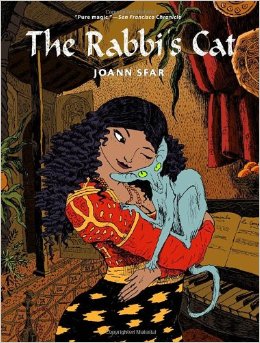
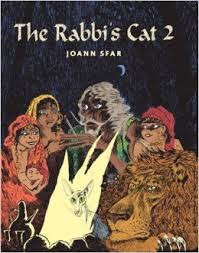
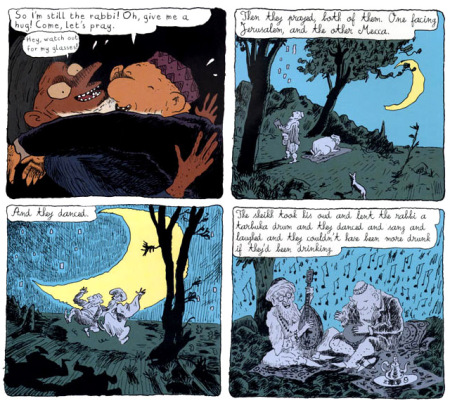
Why have a cat make this point?  French readers probably recognized this figure as no ordinary pet or stray but instead as “the rabbi’s cat,” a popular creation of successful, prolific French illustrator/author Joann Sfar.   Perhaps better known in North America as the creator of the kids’ graphic novel Little Vampire Goes to School (2003), a New York Times best seller (reprinted with new material in 2009 as Little Vampire), the illustrator of the popular kids’ Sardine series of space adventures (2006 to 2012), or as the illustrator of YALSA-lauded teen graphic novel The Professor’s Daughter (2007), Sfar has also created numerous graphic works that draw upon his Jewish heritage.  These include The Rabbi’s Cat (2005) and The Rabbi’s Cat 2 (2008), graphic novels that have won many European awards and in 2006 also won the Eisner Award for best U.S. edition of foreign material.  Sfar used material from both books when he co-created an animated film titled The Rabbi’s Cat (2011)  which in 2012 won the Cesar Award (France’s equivalent of the Oscar) for best animated film. 

images (1)

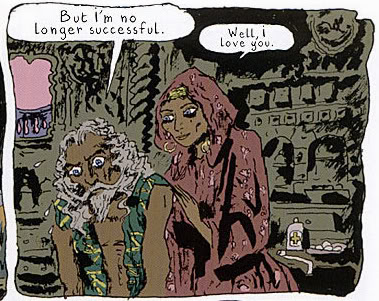
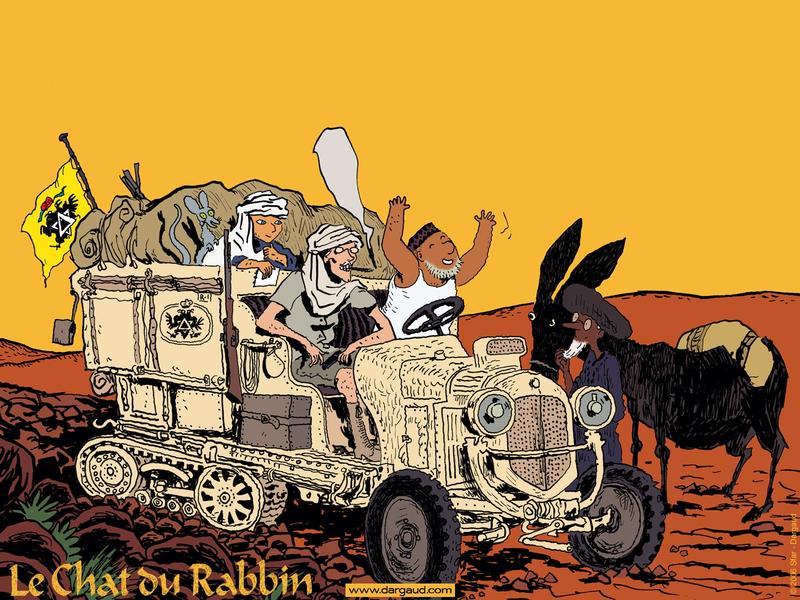
Set in 1930s Algiers, Paris, and—later—sub-Saharan Africa, all three Rabbi’s Cat works depict a colorful, complex world of relationships among people of different religions—a network of shared beliefs and values at odds with the deadly “us vs. them,” black-and-white views of today’s Islamic terrorists.  While Sfar also shows the religious intolerance sometimes manifested by Christians as well as Muslims (bitter seeds that would soon sprout in Nazi Germany) as well as the narrow-mindedness of some Jews, his overarching theme is how people may and should live peacefully together, regardless of religious difference.  Not naïve, Sfar also shows how European racism and class consciousness often have lumped Jews, Muslims, and all Black Africans together as supposedly inferior beings.  Yet engaging characters, amusing and exciting plots, and drawings aswirl with energy entertain readers (and viewers) so thoroughly that the important ‘messages’ in Sfar’s graphic works are a bonus, never heavy-handed.  Because some familiarity with different cultures and religious practices is assumed, and because there is some bloodshed and brief nudity shown, the Rabbi’s Cat books and film will be best enjoyed by those aged tween and up. 

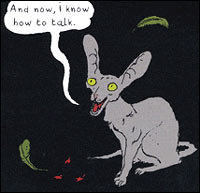
Self-centered and heedlessly playful, Sfar’s nameless cat is in many ways a typical feline.  In the first pages of The Rabbi’s Cat, we ‘overhear’ him thinking, “I never disturb [the rabbi] when he reads.” At that very instant, Sfar shows the cat sitting on the rabbi’s open book, his tail curving up against the middle-aged man’s nose.  The fun really begins, though, after the cat devours the household’s pet mynah bird.  Magically acquiring the bird’s ability to talk, the cat demands his right as a Jew to a bar mitzvah (confirmation ceremony)!  Having learned to read, it seems, alongside the rabbi’s adult daughter Zlabya, the cat is able to outtalk the rabbi and even gleefully out-reason the rabbi’s own spiritual counselor.  Here Sfar pokes fun at the pomposity and intellectual limits of some religious leaders even as he shows the strength and worth of less quantifiable love and affection.  Both the rabbi and his cat want the best for Zlabya, but neither is happy with the husband she chooses: a young French rabbi, who takes her back to Paris.  Experiences there test her father’s long held beliefs about the importance of religious rules governing daily life.  Meanwhile, lovely Zlabya copes with feeling out-of-place in cosmopolitan Paris, and the rabbi’s cat reluctantly makes friends with a street-wise dog.

cat_talk200-6c909fbaaf4cc253bf9c95623c03630fb06149a7-s400-c85

In depicting 1930s Algiers, Sfar has said he used stories told by his father’s family, who lived there for generations.  The close bonds between some Jews and Muslims there are reflected in Rabbi Sfar’s sharing that last name and a distant ancestor with his good friend, Sheik Sfar, a wandering Islamic musician and mystic. “Sfar” is a word in both Hebrew and Arabic.  Its different meanings (“to write” and “yellow”) are not important to the fellowship between the men, just as differences between Jews and Muslims are ironically not important to prejudiced Europeans, who disdain both groups.  In Algiers, a waiter at a fancy café haughtily tells the rabbi that “the establishment serves neither Arabs nor Jews,” while in Paris the rabbi’s musician nephew can only earn a living by pretending to be an Arab, singing popular, somewhat vulgar Arabic street songs. The impresario who hires him does not care that this entertainer is really Jewish, an expert in his own musical traditions. 

rabbiscat

In both Rabbi’s Cat volumes, Sfar lovingly depicts North African architecture and seasides (so like his own ‘hometown,’ the French Mediterranean city of Nice). Colorist Brigitte Findakly deftly enhances Sfar’s work with vibrant, sunny colors that convey his locations’ hot days, with rich blues, purples, and greys suggesting   the cooler nights.  Throughout both volumes, Sfar’s sprightly drawing style—cartoonlike curves and exaggerated or minimalized features—conveys strong emotions and actions with bold, apparent ease.  Black silhouetted figures or faces and black backgrounds are also used to great effect in these works.

sfarpanel379x301

The Rabbi’s Cat 2 fleshes out some side characters from volume one and introduces intriguing new ones.  Malka of the Lions, a roguish, aging Jewish adventurer (and distant relative of the rabbi) and his pet lion (an old acquaintance of the cat) turn up just as Zlabaya and her husband, now back in Algiers, are in need of marriage counseling.  Two Russians—a Jewish artist and a former nobleman—who have fled Soviet Russia for very different reasons also appear here.  In the first half of this book, Sfar depicts how different customs (as well as languages) sometimes separate European Jews (Azhkenazim) from African or Middle Eastern ones (Sephardim), causing mistrust as well as humorous misunderstandings.  Ironically, such distinctions do not matter to anti-Semites.  The rabbi and his expanded circle, including Sheik Sfar, deal with Oran’s prejudiced mayor, himself a Catholic priest, who is inciting mob violence.  He proclaims, along with many vile and false things, that “France wasn’t built in the shadow of mosques and synagogues!”  Robust Malka fights back, while the rabbi finds greater comfort in retreat and study.  Observing his master among other pale, absorbed scholars, the rabbi’s cat ruefully notes, “People imbue you with such power, while you shiver at the slightest cold.  What strategies people come up with to hate you!”  Here the cat is clearly voicing a conclusion Sfar himself has made. 

chat2

In the second half of this book, the travelling group continues to encounter bigotry.  A brief, insider’s joke about Belgian cartoon luminary Herge takes place when the entourage meets a boy reporter who looks just like his famous character, Tintin.  The lad is as ignorantly self-assured and convinced of Black inferiority as Tintin was in Herge’s early books.  But most of the group’s cross-continent adventures are more dramatic and serious.  Their uneasy stay with a tribe of Islamic extremists—despite Sheik Sfar’s best efforts—ends in bloodshed, with scimitars literally coated in dripping red, while a limited meeting with sub-Saharan Black Jews reveals that group’s unexpected prejudice against all Whites, even other Jews.  Here the Russian artist’s actions and words may along with the cat’s  ‘voice’  Sfar’s opinions.  The Jewish man has gone against multiple conventions to marry his Black, non-Jewish love.  To spare the gentle rabbi pain, the Russian also then lies about the existence of those Black Jewish bigots.  As this artist explains to his new wife in the book’s last panel, “Telling things like they are is not my job.”   Yet this statement is not merely a justification for lying.  It is rather, I think, a rationale for Sfar’s art.

Truths—about religious belief and practice, personal choices, political actions—are not simple.  There is no real way to tell them “like they are,” but their complexity may be suggested and sometimes even briefly captured by gifted words and images, such as the ones in The Rabbi’s Cat canon.  In this sense, in the face of recent brutal terrorism born of intolerance, these works by Joann Sfar offer us both caution and inspiration.  The recent history he embellishes reveals that we can be so much kinder to one another, however different our beliefs; however, they also suggest that we are capable of  even worse acts of violence and degredation—as other annals this past week, with its commemoration of International Holocaust Remembrance Day, confirm. 

pascin-temp

I know that having renewed my acquaintance with his sly, sometimes self-deluded but often wise feline I am eager to catch up with Sfar’s first film, Gainsbourg: A Heroic Life (2011, unrated), an impressionistic biography of Serg Gainsbourg, the so-called French (and Jewish) Bob Dylan.  I am also eagerly awaiting this spring’s publication in English of Sfar’s recent graphic novel, Pascin, a biography of the Jewish Modernist painter Pascin.  That highly social, bohemian artist’s life received one chapter in Ernest Hemingway’s memoir of 1920s Paris, A Moveable Feast.   I am certain that Sfar’s appetite for Pascin’s life and works will supply readers teen and up with further hearty fare.   


Posted in graphic novels, Uncategorized | Tagged , , , , , , , , , , , , , , , , , , , , , , , , , , , , , , , , , , , , , , , , | Leave a comment

Resolutions: A New Year for New Superheroes

6a00d8345158e369e200e54fcb96768834-800wi (1)

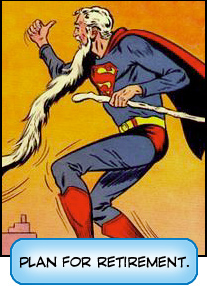
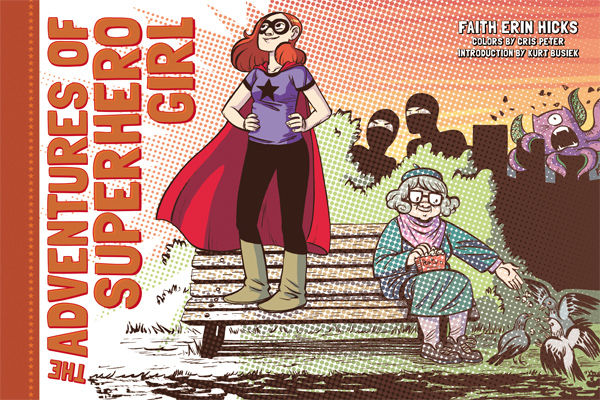
New Year’s resolutions—many of us make them, but fewer manage to keep them!  It’s not surprising, then, that comics fans and media outlets   have poked fun at this tradition itself or at current events by imagining the New Year’s resolutions of classic superheroes.  Since my husband is soon to retire, I like Mark Engbom’s take (on the right) on one of Superman’s resolutions.  But 2015 is ringing in new superheroes, with their own takes on New Year’s resolutions and their own, new-to-comics issues to resolve.  It gives me pleasure to start 2015 by reviewing two warm, wise-hearted, and good-natured comics compilations.  I think readers tween and up will very much enjoy, sometimes smiling in rueful or surprised recognition, Faith Erin Hicks’ The Adventures of Superhero Girl (2013) and Ms. Marvel: No Normal (2014), written by G. Willow Wilson and illustrated by Adrian Alphonsa. 

shgcover

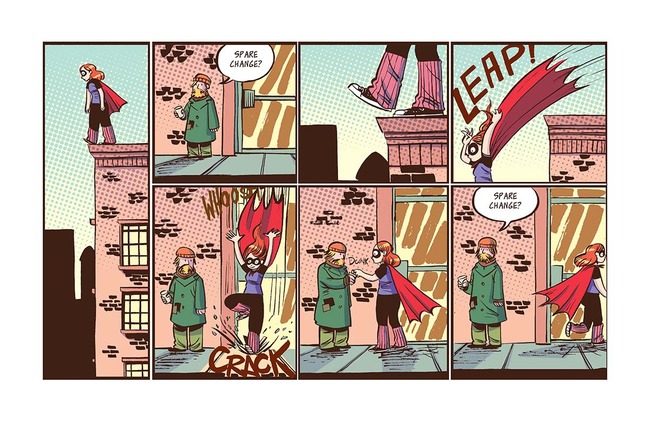
The Adventures of Superhero Girl originally appeared as a weekly, black-and-white comic strip in a Canadian newspaper, the Halifax Coast.  Its publication there explains the episodic nature of Superhero Girl’s adventures, many of them complete on one page, while others spread out to three to five pages (about a month in publication time).  Author/illustrator Hicks eventually put the comic strip online.  Collected in this volume by Dark Horse Press, Hicks’ tales about her college-aged hero appear here brightly colored by Chris Peters, whose addition of dotted backgrounds is an affectionate tribute to old-fashioned, pixilated comics. 

Superhero Girl is not your “typical” superhero—and that is the cause of much of her problems.  In low-crime, small-city Canada, people even tell her that her costume is not superhero-worthy and that her powers are not as awesome as they expected.  Some of her feats and good deeds are even ignored by those she helps.  This leads to feelings of low self-esteem, compounded by having an older brother who is the shining model of a superhero, with his own action figures and adoring fans.  As comics veteran Kurt Busiek points out in his introduction to this book, “Superhero Girl is about life . . . about being a younger sister, about being a broke roommate, about needing a job . . . getting sick, feeling out of place at parties . . . all wrapped up in the package of being a young superhero . . . .”  AOSG HC PG 001-thumb-650x422-82248

We can empathize with this masked heroine, lounging in sweat pants and sweater, as she reads her New Year’s resolutions to a bored-looking roommate.  At the same time, Hicks also leads us to gently laugh at Superhero Girl, whose woes are always shown as absurd rather than seriously life-threatening.  Aiming for noble, high-toned language, she instead causes us to chuckle when she declares in one panel, “I resolve that if there is even one citizen cowering in fear before the spectre of crime, I will be the one to punch that spectre in the face!” and then adds in the next panel, mulling over this resolution “ . . . if it has a face. If not, I’ll punch it wherever.” Hicks’ cartoonlike drawing of facial expressions and use of cartoon techniques such as different bold typefaces and word balloon outlines for sound effects are further ways she emphasizes humor, rather than peril, in these adventures.  Dialogue that mocks stereotyped villains—for instance, the evil chief ninja’s shouting “CRIME!!  MUAHAHAHA!”—adds another layer of fantastic humor. 

monacle_bear-126x300

Having defeated such ridiculous villains as the “Marshmallow Menace” and “Bear with a Monocle,” Superhero Girl on the following New Year’s Eve is no longer making resolutions but rather downheartedly, somewhat grumpily “compiling end-of-the-year crime statistics.”  When her roommate convinces her to go to a holiday party, the hero’s life takes a turn for the better.  A reconciliation with her brother, a redeeming good deed done for a “dissed” acquaintance (and possible future boyfriend)  . . .  . These hopeful New Year’s episodes skip ahead next to a final, summertime adventure, its concluding panel showing a confident  Superhero Girl as she knocks out a talkative ninja “nemesis” with a  resounding “POW!”  I was not surprised to discover that Hicks first drew this down-to-earth, funny hero in a comics workshop she gave at an elementary school.  The Adventures of Supergirl Hero, even though it contains college-age concerns such as job-hunting and interviewing, is kid-friendly enough to have won the 2014 Eisner Award for Best Publication for Kids, Ages 12 to 14. 

download

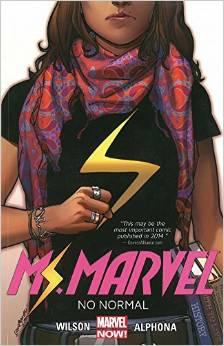
Marvel Comics, Incorporated has a history of “rebooting” its superheroes—placing new characters into the costumes and super-powered adventures that have already won fans.  Kamala Khan is the fourth “Ms. Marvel.”  She first appeared in 2013, in five comic book issues that have now been collected in one volume, titled Ms. Marvel: No Normal (2014).  Sixteen year-old Kamala does not make any New Year’s resolutions there, but if she did she would have two New Years to commemorate!  As a Muslim, Pakistani-American—the daughter of immigrants—Kamala might choose to acknowledge January 1, but she would also with her family and community be celebrating the Islamic New Year, Awal Muharram, based on Islam’s lunar calendar.

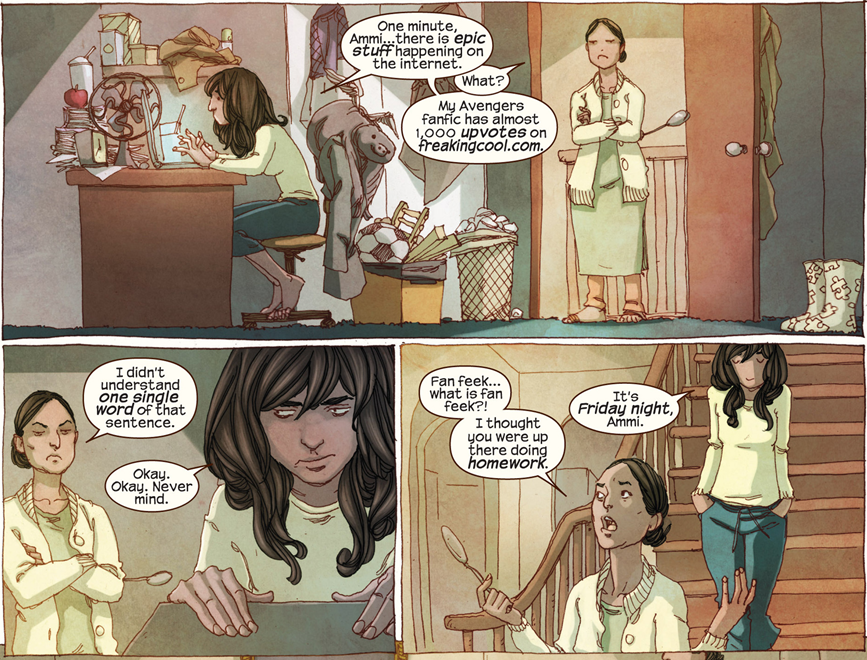
Such choices–involving multiple, sometimes conflicting obligations and desires—figure prominently in likeable Kamala’s life.  The Jersey City teenager, unlike most of her classmates, does not eat pork and is not permitted by her concerned parents to attend parties with boys.  Spirited, comics-loving Kamala chafes at these restrictions, thinking “Why am I stuck with all the weird holidays . . .  . Everybody else gets to be normal.”  After Kamala stumbles into an alien mist that gives her the superpower to elastically change size and appearance, her every day existence becomes even more unlike that mainstream “normal.”  Yet author G. Willow Wilson (herself a convert to Islam) and artist Adrian Alphona, along with colorist Ian Herring, do a sterling job of showing how Kamala’s religion and family inspire her superheroic efforts even as they sometimes crimp her teenage social life.  As Kamala notes, her father has always said that “people who rush in to help . . . are blessed.”  (In interviews, Wilson has explained how eloquent Sana Amanat, a Marvel editor, helped develop Ms. Marvel by sharing her own experiences as a Muslim growing up in New Jersey.) 

comic-pow-ms-marvel-fanfic

Ms. Marvel’s messages are fun-filled, though, not solemn lectures about being comfortable in one’s own skin or balancing cultural identity and family relationships.  Wilson and Alphona have Kamala figure out that being a brown, slightly-rounded teen is just as good as being a blonde, svelte heroine by discovering how uncomfortable a conventional, sexpot heroine’s costume is!  Its boots pinch and its swimsuit bottom rides uncomfortably high.  Kamala, the first Muslim-American superhero, adopts her more modest, skirted costume for practical as much as religious reasons.  This functional balance of goals with tradition is even indicated on the cover of Ms. Marvel, where the bare-armed teen carries not only standard high school text books but also a volume titled “Hadith [Islamic religious rules] for Life.”   Kamala continues to question the unequal restrictions placed upon her as a female within her family and mosque, but her Muslim classmate Nakia, a Turkish-American girl, is more accepting of these traditions.   

759946

Artist Alphona’s shifts in perspective and use of close-up as well as mid and long-distance views add “punch” to Kamala’s heroic rescues.  The artist’s drawing of faces and figures also emphasizes the tenderness within Kamala’s family along with its loving tensions. Wilson’s word-perfect dialogue seamlessly blends with these images throughout the volume, culminating in its final panel.  Its tight-focus shot of Kamala’s mother’s arms, folded resolutely as she announces, “You’re grounded.” are shown next to Kamala’s stubborn, somewhat sullen face as the teen mutters, “Wanna bet . . . ?”  More adventures and conflicts are ahead of resolute Kamala—and we can hardly wait to see more of her and the individualized characters introduced in this volume.  Besides the mysterious, super villainous “Inventor,” there is Kamala’s slightly older, somewhat pompous brother; classmates and friends from varied backgrounds; and the supportive, non-Pakistani teen who has a crush on her.  Currently appearing in individual comic books, issues six through eleven of Ms. Marvel will be published as a book, Ms. Marvel: Next Generation, in March, 2015.  I will not be surprised if it joins the first volume on the New York Times best seller list.

download (1)

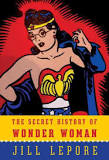
Before that second volume appears, I shall try to catch up with G. Willow Wilson’s graphic novel Cairo (2007), illustrated by M.J. Perker, which was one of the ALA’s 2009 Top Ten Graphic Novels for Teens.  Also in my library queue is Wilson’s non-graphic novel Alif the Unseen (2012), named Best Novel of 2013 by the World Fantasy Association.  In addition, writing about new superheroes has further whetted my interest in older favorites.  Based on the fascinating excerpt I read this fall in The New Yorker magazine, I am also eager to read all of historian Jill Lepore’s The Secret History of Wonder Woman (2014), a family biography as well as cultural history.  Which to read first?  I resolve to answer that question this month!  

Posted in comics, graphic novels | Tagged , , , , , , , , , , , , , , , , , , , , , , , , , , , , , , , , , , , | 1 Comment

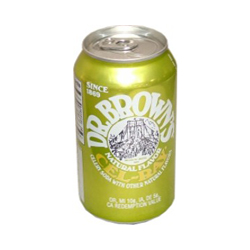
Memories and Motives–Dr. Brown’s Cel-Ray Soda

celray-old1-158x400

Even now, I can taste the sharp sweetness of Dr. Brown’s Cel-Ray soda.  This East Coast drink is my Yiddishkeit version of Marcel Proust’s madeleine, the bite-sized piece of sponge cake that launched seven volumes of Remembrance of Things Past.  I promise to be briefer.

When I was a child, I did not know that my favorite soda pop—a special treat during visits to the local delicatessen—was based on a nearly 100 year-old recipe.  According to its manufacturer, this fizzy, celery-flavored drink was first concocted in Brooklyn, New York in 1868.  Then, it was called Dr. Brown’s Cel-Ray Tonic, a reference to its supposed medicinal properties.  In 18th and 19th century North America, many fake medicines or tonics were sold as cures or relief that doctors could not provide.  Some of these tonics supposedly contained healing herbs or vegetables, such as Dr. Brown’s, while others reputedly contained Native American remedies, such as “snake oil.”  In the early 20th century, the new Federal Drug Administration cracked down on claims that “snake oil salesmen” could make about their wares.  That is when Cel-Ray Tonic became Cel-Ray Soda—though many people when they first sample this beverage would say that “soda” in no way describes its distinctive taste!

My mother and father, though, always humored my childhood requests for this treat.  And, many years later, my father even managed a small smile as I held a straw to his lips so he could sip a few drops of family history with me.  That would have been close to the end of his unusually long, nine year battle with ALS (Amyotrophic Lateral Sclerosis), also known as Lou Gehrig’s Disease.

Like that famous baseball player and many other victims of ALS, Dad had been fit and active.  Well into his retirement years, he swam several times a week and retained the lean, strong muscles of a former handball player.  But he had begun to walk slowly and sometimes trip on street curbs.  The eventual diagnosis of his ALS coincided with my decision to begin writing for children and young adults.  My second professional publication in this field was a magazine article titled “ALS—Mysterious Disease of Giants,” drawing upon research I had done to understand what my father was facing.  It appeared in a 1995 issue of the science magazine Odyssey devoted to eminent physicist Stephen Hawking, another ALS sufferer.  Not surprisingly, Dr. Brown’s Cel-Ray Soda did not cure Dad.  Modern medicine also failed him.  Years later, after my father’s slow decline, I accepted an invitation to write The Story of Pharmaceuticals for Compass Point Books.

Today, Professor Hawking remains perhaps the world’s most famous person living with ALS.  His adult life-story is the focus of a new movie, The Theory of Everything.  Hawking’s mind shines brightly even as deadened nerves and withered muscles make him dependent on a respirator to breathe, a wheel chair to move, and a computer to communicate.  My father, too, remained alert even as his body slowly shut down, and he could not really enjoy that sip of Cel-Ray Soda.  Twelve years after Dad’s death in 2002, modern medicine still has not found a cure for ALS, and I am very reluctant to see Hawking’s story on film.

DBCELRAY

I always have some personal reason for the subjects of my books and articles.  Sometimes it is curiosity or conviction.  Some topics present an intellectual challenge.  Sometimes I just want a change of pace or a chance to laugh.  With The Story of Pharmaceuticals, I was inspired by a person I loved and a disease I still hate.  I dedicated that book to my father, Sam Rosinsky.  And this updated essay is a further acknowledgment—not just of Sam’s valiant struggle but of the threads of memory, the bonds of affection and loss, that may be stirred anew by the creative process, itself calling up still more memories.  Such marvelous synergy. . . I raise a can of celery soda and drink to that and to Sam!  Another salute and swallow for Stephen Hawking and his first wife, Jane, upon whose memoir the filmed Theory of Everything is based.


Posted in articles | Tagged , , , , , , , , , , , , , , , , , | Leave a comment

Re-Gifting? Classic Novels and Plays Gone Graphic

download (13)

“Re-gifting” is the joking term for re-wrapped presents—those little-used or unwanted items that are sometimes conveniently handy as last-minute choices to give to someone else.  When classic novels and plays are re-packaged, so to speak, as graphic novels by publishers, are they anything more than such shallow or casual offerings?  I think the answer is a complex “Sometimes,” even though my personal history predisposes me to welcome these books.

As a working-class kid in the 1950s and 60s, I loved reading the Classics Illustrated sold at the nearby used bookstore.  These comics, first published in the 1940s, were my introduction to exciting characters and stories that I then sought out at the local library.  The Adventures of Robin Hood, The Call of the Wild, The Prince and the Pauper—these and many more classics first came my way through the yellowed but still-colorful pages of shopworn comics.   I was a voracious reader, my parents unaware of the furor back then about whether comic books could harm or twist young minds.  So, with Hanukkah and Christmas fast approaching, I have some questions for you fellow shoppers and book professionals.

Which books are on your gift-giving or ordering lists this holiday season?  If you want to share a treasured classic novel or play, will you give it in its original format or will you choose a graphic novel version?  And—if you do choose to “go graphic”—how will you make your selection?  Some versions are faithful to the original text; others use simpler language.  Some versions make wonderful use of visual elements to communicate tone and meaning, emerging as classics in their own right; others are less inspired.  There are a few amazingly creative graphic novels that are really sequels or counterparts to the originals.  You would never be accused of thoughtlessly “re-gifting” a standard classic work if you chose one of those!  Today I will highlight all these possibilities, in graphic novels for readers ages tween and up.

6482046

Author Nancy Butler (the pen name of Nancy J. Hajeski) has adapted four Jane Austen novels into graphic form: Pride and Prejudice (2010), Sense and Sensibility  (2011),  Emma (2011), and Northanger Abbey (2012).  (Before Marvel Illustrated published these volumes as part of its Graphic Classics series, it published each book serially in five separate comic book issues.)  In her introduction to Pride and Prejudice, Butler explains that she did not try to modernize Austen’s language or story; in Butler’s words, “you don’t update a classic; you give it free rein.”  Yet this view is not what the eye-catching cover by Sonny Liew and Dennis Calero suggests!  Its attractive ‘teen magazine’ headlines are deceptive.  Butler’s adaptation of this novel’s tangled courtships, family relationships, and social conventions remains solidly rooted in early 19th century, middle-class Britain.

For the story itself, Butler worked with interior artist Hugo Petrus to be sure that his images left enough room inside panels for her text-heavy word balloons and narrative boxes, richly-filled with 19th century language.  There are moments—such as close-ups on character Elizabeth’s judgmental or unhappy eyes or on two sisters’ hands as they comfort one another—when images convey and add to the storyline.  Yet this graphic version of Pride and Prejudice remains unusually word-heavy in its faithfulness to Austen.  Sometimes it takes effort to track the path of conversations held by the surprisingly sturdy, full-fleshed characters drawn by Petrus and vividly, at times garishly, colored by Alejandro Torres.  For me, these visual encumbrances make this graphic novel, which was nonetheless a New York Times “bestseller,” a mixed success.  Perhaps Butler’s other Austen adaptations, done with different illustrators, are more uniformly successful.

384351

Some readers, though, are not ready to tackle the language of such older, classic works.  For these readers, several publishers offer graphic versions with modernized and shortened text.  A British firm, Classical Comics, even offers Shakespearean plays and some novels in three formats: original text; a modernized version it calls “plain text”; and a much abbreviated, modern version labelled “quick text”.   Its quick text Romeo says of Juliet, “She is speaking. Oh, what an angel.”  I suggest that this flat rendition of young, star-crossed love holds much less appeal for readers than contemporary works about teen relationships, worded with today’s speech and idioms. I myself would rather read—or present to someone—a contemporary classic-in-the-making about first love, such as Rainbow Rowell’s text-only Eleanor & Park or  I. Merey’s graphic  a & e 4EVER (both discussed last year in this blog).

tw_n_coverOr, if I were interested mainly in how top-notch illustrators had chosen to interpret classic works, I might look at offerings of a publisher such as PAPERCUTZ.  Its nostalgically named imprint, Classics Illustrated, has an impressive roster  of illustrators and author/illustrators, including such luminaries as Gahan Wilson, Kyle Baker, and Peter Kuper.  Manga-styled Shakespearean plays might also be a great choice for readers already tuned into this globally popular Japanese graphic format.   A British publisher, MangaShakespeare.com Learning specializes in graphic works–containing abbreviated, original Shakespearean language—illustrated by first-rate manga artists.

Some graphic novels play with the characters and plot of well-known classic works.  In this, they are similar to splendid non-graphic novels such as Jo Baker’s Longbourn (2013), which retells Pride and Prejudice from the point of view of the main characters’  household servants, and Terry Pratchett’s Dodger (2012),  which stems from Charles Dickens’ Oliver Twist, telling the adventures of its  secondary young character, the Artful Dodger.  My delight in both those books was doubled because I recognized the ways in which they spun off and around the originals.  Similarly, I relished and can recommend two graphic counterpart novels this holiday season: for those familiar with Oliver Twist, Will Eisner’s Fagin the Jew (2003; 2013) and for fans of Alice in Wonderland, Tommy Kovac’s Wonderland (2008), illustrated by Sonny Liew.

download (14)

Master author/illustrator Will Eisner (for whom the prestigious Eisner Awards are named) announces in its Introduction that “This book . . . is not an adaptation of Oliver Twist.  It is the story of Fagin the Jew.” Published when he was 83 years old, this graphic novel stems from Jewish Eisner’s regret for having perpetrated racial stereotypes himself in his early works and his evolving concerns about anti-Semitism.  The book’s Introduction and Appendix both contain examples of the 19th century stereotyped illustrations of Jews that influenced Charles Dickens, among others, and which appeared in the first editions of Oliver Twist.

Fagin-INT-2-336x461

In Eisner’s sepia-hued work, Moses Fagin as a broken-down old man actually speaks to “Mr. Dickens,” telling this fashionably-dressed figure that he will now learn what Fagin “really was and how it all came to be!!”  We follow Fagin from boyhood onward, seeing how limited opportunities, prejudices about Jews, and calamitous circumstances—operating within 19th century Britain’s rigid social structure—destroy the hopes and ambitions of an honest, hard-working young man.  Fagin ultimately becomes the “fence” (receiver) for stolen goods and organizer of young thieves Dickens depicts.  Eisner’s drawings sardonically emphasize the greed and grief, smugness and terror in human expressions.  Moses Fagin becomes a criminal, but adult Oliver Twist becomes self-righteous. Eisner’s use of varied white lines to depict movement as well as snow, rain, and mist work within panels and in unframed, flowing images to keep readers constantly engaged in the story.  The final pages of Fagin the Jew–where Eisner reveals the last, brutal irony of this character’s missed opportunities–are as powerful emotionally as any ironic plot line presented by Dickens.

51nGTbqGbiL._SY344_BO1,204,203,200_

Wonderland (2008)—originally produced by SLG Publishing as six separate comic books—is a more light-hearted work.  Yet in this fantastic sequel to Lewis Carroll’s Alice books author Tommy Kovacs and illustrator Sonny Liew do not overlook the emotional storms of the original works—the Red Queen’s murderous fury and the Cheshire Cat’s bizarre, sometimes cruel directions to the main character.  Here, however, the central figure is not Alice but the mysterious housemaid, Mary Ann, for whom the hurrying White Rabbit first mistakes Alice!

Mary Ann is a neat freak who complains because a dirt path is, well, dirty, and who cannot abide any spots on her housemaid’s white pinafore.  Liew’s inserted close-ups on Mary Ann’s forehead and eyes, changing from surprise to tears and finally to reddened, mad anger, are just one example of how cartoonish images work so well with the text here to support such emotional storms.  At another point, when Mary is vexed beyond her endurance, her word balloons contain tiny skulls and crossbones for the supposed “bad language” she is actually saying.  Color palette and panel size and shape also shift to match and reinforce the story line, as Mary Ann encounters well-loved Lewis Carroll characters plus a few new ones too.  Playing cards dot many pages, unifying chapters as well as scenes, as Mary Ann survives her own bumpy “Chutes-and-Ladders,” panel-defying journey through Wonderland.  She ends up having tea and playing chess with the White Rabbit, no longer Mary Ann’s employer but an acknowledged “friend.”

fahrenheit_451_cover1

A few graphic novel versions of classics are classics in their own right.   Ray Bradbury’s Fahrenheit 451: The Authorized Adaptation (1953; 2009), illustrated by Tim Hamilton is one of these gems.  Its text blends with powerful visual images to grip and move readers just as much as the first version, written when science fiction legend Bradbury (1920 – 2012) was a young man.  In his Introduction to this this new, 21st century classic, author Bradbury even points out that what the reader has “here, now, is a pastiche of all my former lives . . . . including the last twenty or thirty years . . . .”  This book is, in effect, a new masterwork for Bradbury, crafted in conjunction with Hamilton.  That artist’s use of color, choice of images, and drawing skills make this depiction of a dystopic future—where books are burnt and questions met with death—a stunning condemnation of aspects of today’s society.

Orange and yellow flames consume books, even as these flames eerily illuminate “firemen” whose job is to set fires, not put them out. Cooler blues, greens, and greys mark the numbed, superficial existence of people who have learned not to think or question official rules, news, and broadcast entertainment.  When one fireman does question this system, breaking away to join others who save books by memorizing them, such dangerous choices are often shown in muted yellow.  Throughout Fahrenheit 451 (the temperature at which books burn), Hamilton makes dramatic, effective use of black backgrounds and darkened silhouettes, with forbidding figures and other elements uniting and impelling scenes.

download (15)

Both versions of Fahrenheit 451 leave readers with the question: Which one book would I choose to memorize, if I could only rescue one book in this way?  That hard choice certainly puts into perspective the embarrassment of riches we have, in choosing between graphic and non-graphic versions of classic works!  And when both versions are great . . . perhaps there is little reason not to value both in themselves.  I know I am eagerly awaiting my library copies of the new, two volume graphic version of Neil Gaiman’s The Graveyard Book (2008).  That novel, winner of 2009’s prestigious Newberry Medal for Children’s Literature, has now in 2014  “gone graphic” with various artists collaborating  with author P. Craig Russell in this adaptation.  Russell–an Eisner and Harvey award winner–has adapted other works by Gaiman, himself a veteran, prolific author of notable comic books and series.  I am hopeful that this graphic version of The Graveyard Book will be in its own right classic-caliber, a further example of how great literature is “the gift that keeps on giving.”


Posted in graphic novels, manga, Uncategorized | Tagged , , , , , , , , , , , , , , , , , , , , , , , , , , , , , , , , , , , , , , , , , , , , , | Leave a comment

The Pilgrims in Our Family–Another Look at Thanksgiving Day

Molly's-Pilgrim-001-754175

Three hundred years and counting—that is the time between pilgrim voyages in our family.  Let me explain.

As a Jewish parent, I was delighted decades ago to discover Barbara Cohen’s fine book for young readers, Molly’s Pilgrim (1985; 1998; 2005).  Molly has difficulty explaining Thanksgiving Day and its history, so important in elementary school, to her Russian-born mother.  Only when that Jewish woman realizes that the Pilgrims were after all just immigrants is she able to help Molly with her homework—making a Pilgrim doll.  The doll they craft, though, looks as though it might have just arrived at Ellis Island, not Plymouth Rock!  Molly and her classmates learn unexpected lessons about cultural differences and contemporary pilgrims.   That they also learn that Plymouth Colony’s Pilgrims may have modeled their first Thanksgiving on a Jewish holiday is a surprise bonus.  Their teacher points out the similarities between Judaism’s harvest-time Sukkot, the Feast of Tabernacles described in the Pilgrims’  “Old Testament,” and Thanksgiving.   Our son Daniel found this surprising, too.  It gave him a new way of thinking about his great-grandparents, my grandparents, who immigrated to this country from Ukraine and Lithuania around 1910.

But he had more to learn about the pilgrims in our family.  As my mother-in-law, Frances Foss Larsson, proudly pointed out, Daniel was a direct descendent of two of the men who had stepped onto Plymouth Rock in 1620 C.E.   Richard Warren and Thomas Rogers, ancestors on her side of the family, survived the gut-wrenching 66 day voyage of the Mayflower to the New World.   They were among the 102 passengers officially listed on that ship’s manifest.  Yankee determination had helped Daniel’s grandmother in the pre-Internet 1970s complete and document genealogical research that traced her lineage.   After the Society of Mayflower Descendants accepted her research, she proudly joined this group and later enrolled Daniel as a junior member, too. 

61ygJqIOq1L._SL500_SS120_

Yet pride is surely not the only emotion linked to this heritage.  Another, closer look at history reveals the shameful treatment of native peoples by the Pilgrims.  This is epitomized by the fate of the Wampanoag, who joined the Pilgrims in that so-called first Thanksgiving.  Once numbering between 12,000 to 24,000 strong, the Wampanoag today have only between 3,000 to 5,000 tribal members.  They were starved, killed, and ‘outlawed’ out of existence by the Pilgrims and their followers—people with leaders like minister Increase Mather, who wrote that “Indians are speaking Apes.”   The Pilgrims are, contrary to popular opinion, the badly behaved immigrants in our multi-branched family tree.  (My own The Wampanoag and Their History [2005] is just one of many books for youngsters today pointing out some hard truths behind the United States’ festive “Turkey Day.”)  

Recently, Daniel himself lived for four years in a foreign land—sojourner rather than pilgrim, but newcomer nonetheless.  The “Thanksgivings” celebrated in the Islamic republic of Turkey take place at the end of the holy month of Ramadan and after the sacred journey or haj to Mecca.  Our son and— and to a lesser degree, we—lived with religious and national rhythms foreign to our family’s dual Jewish and Christian heritage.   Yet this experience was a sobering and uplifting reminder of what people world-wide share on our journeys through life.  To recast the words of poet William Butler Yeats, each of us has a “pilgrim soul” that may —indeed, should—be cherished.    


Posted in articles | Tagged , , , , , , , , , , , , , , , , , , , , , , , , , , | Leave a comment