
Lawbreakers and the Vote

4079272040_ed703724d9_z-300x200

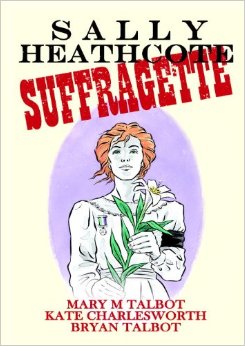
When is it right to break the law?  To defy the police?  Who decides whether an illegal act is an act of heroism rather than just a crime?  These questions are on my mind today, Election Day here in the United States.  This afternoon I shall stroll down the street to cast my ballot.  Conveniently, our district’s polling place is on the same block as our home.  Yet at other times and in other places I would have been denied the right to vote—just because I am female.  Women throughout the United States were not guaranteed suffrage (the right to vote) until 1920.  If I had insisted on voting in 1919, I would have been breaking the law!   It took the 19th Constitutional Amendment, finally passed in 1920, to change that situation.  Women in other countries struggled for and won the right to vote at other times.  Some still do not have it.  Suffrage also has been denied for other prejudiced reasons, such as bias against people’s race, ethnicity, or religion.  Two recent graphic novels eloquently depict separate battles for equal rights under the law, placing them within the context of long-held social prejudices.   Sally Heathcote, Suffragette (2014) is a brand-new British book that will suit readers already comfortable reading details of world history and tackling some adult issues.   March, Book One (2013), with its inclusion of childhood events and kid “characters,” will appeal to a broader range of readers, including some upper elementary-aged students.      
download (12)

 A talented trio created the fictional but history-based character of Sally Heathcote, through whose working-class eyes we see important, real-life events in British women’s struggle for the vote from the 1900s through the 1920s.  This trio is Mary M. Talbot, Bryan Talbot, and Kate Charlesworth.  Writer and professor Mary Talbot has collaborated once before with her acclaimed artist husband, Bryan Talbot.  Their graphic novel Dotter of her Father’s Eye (2012), part biography of James Joyce’s daughter and part memoir, won the prestigious Costa Award for biography in 2012.  For Sally Heathcote, Suffragette, Mary Talbot wrote the script, breaking it down into pages and panels, and Bryan Talbot did the page layouts, designed the panels, chose the colors, and drew the lettering.  The busy Talbots trusted veteran illustrator Kate Charlesworth to draw the detailed images which hold our attention as we read this stirring book, filled with actions which sometimes broke the law—and laws that sometimes damaged protestors’ bodies and spirits.  Charlesworth in an interview gives examples of how of how the trio worked together.      
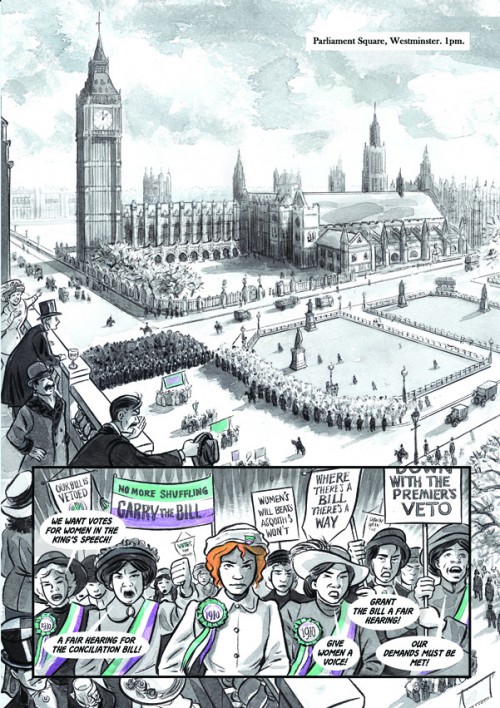
Sally Heathcote page79

In Mary Talbot’s story, housemaid Sally Heathcote is befriended and employed by real-life luminaries in the British women’s suffrage movement: wife-and-husband Emmeline and Fred Pethick-Laurence, Emmaline Pankhurst, and her daughters Sylvia and Christabel.  Sally herself becomes an activist, caught up in the violence that swirled around this movement and ultimately fractured it into two main branches—one willing to commit violent crimes to further the cause and the other not.  Regardless of this division, women and men who campaigned for suffrage themselves often experienced violence at the hands of officials. One famous instance—police wading into a crowded of peaceful demonstrators and brutally beating and arresting them on “Black Friday,” November 18, 1910—is depicted here in a dramatic two-page spread.  Its black-and-white panorama of violence, dotted with sprays of red blood, is balanced on one end by close-ups on the faces of nervous, determined police and of jeering opponents of suffrage and on the other by the dismayed faces of campaign staffers just learning about the violent arrests.  The Talbots smartly show official sanction and public downplay of such police brutality by offsetting blocked newspaper quotations on these pages: “As a rule they [the police] kept their tempers very well, but their method of shoving back the raiders lacked nothing in vigor . . . . They [the police] were at any rate kept warm by the exercise.”
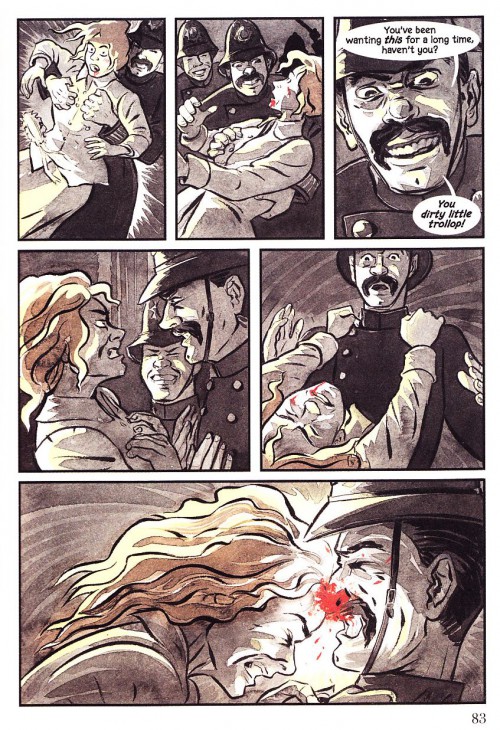
sally-heathcote-suffragette-talbot-charlesworth-cape-03

Some protestors, arrested and convicted of law breaking, suffered another form of police brutality.  After these prisoners extended their protests by going on hunger strikes, officials imposed forced feeding upon them.  In a series of pages, many wordless, where the repetition of eight small oblong frames per page achieves a powerful, percussive rhythm, Bryan Talbot and Kate Charlesworth show the effects of this feeding on terrorized Sally Heathcote.  Close-up and mid-distance views here are especially gripping due to Talbot’s selection of images and Charlesworth’s skillful drawing of facial expression and body posture.  Here, as throughout the book, the limited use of color (for instance, Sally’s red hair and blue for her moonlit prison anguish) adds effective, emotional “punch” to the storytelling.  Another memorable series of images in the novel captures how official exchanges outside of prison also dehumanized women seeking suffrage.  Shown in silhouette as they finally are granted an interview by the hostile British Prime Minister, the women as they make their case seem to turn into mice.  At the same time, the silent, silhouetted Prime Minister and his associate are visually transforming into cats!  On the next pages, when the Prime Minister verbally attacks the women’s positions, Charlesworth’s detailed drawings show these characters as full-featured, ferocious cats confronting astonished, then terrified mice.
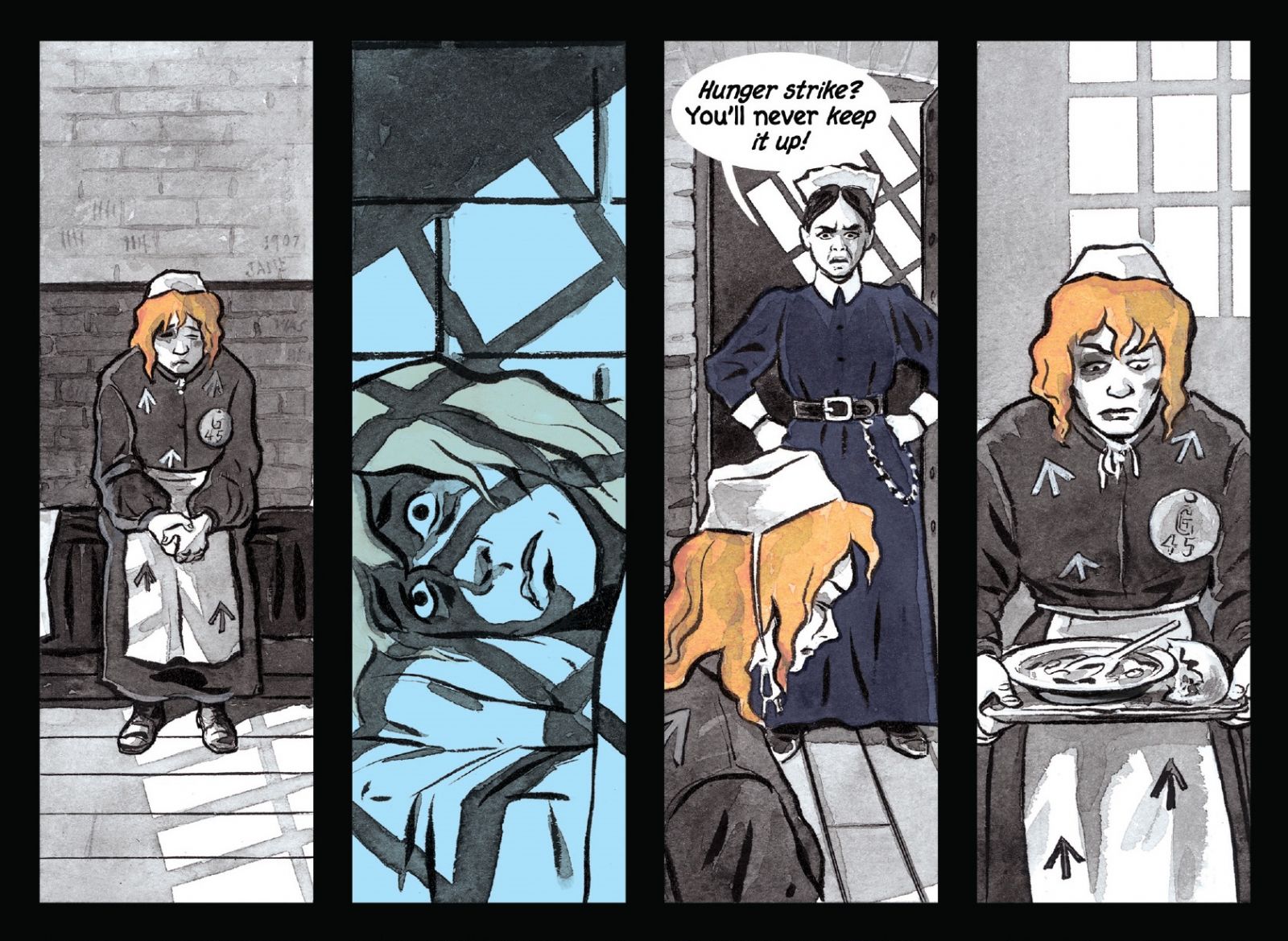
 Sally Heathcote pg 86crop

 Mary Talbot’s script further engages our interest in Sally’s story by imagining how the suffrage movement affects her personal life.  It costs her a close personal friend, another housemaid who fears losing her job if she associates with Sally, and it also temporarily halts a growing romantic relationship.  Her sweetheart Arthur, who also works for women’s suffrage, remains with its “law-abiding” branch when Sally joins in law-breaking protests.  How the two get together—and how World War I affects their lives—is movingly revealed in the novel’s framing story, set in a British nursing home in 1969.  Elderly, ailing Sally–surrounded by mementos of her youth—is visited there by her daughter and granddaughter.  Ironically, that 18 year old is not excited at the prospect of voting for the first time, not even sure she will “bother” with it.   After this bittersweet conclusion to the novel, author Talbot includes a useful suffrage timeline, beginning in 1832 and ending in 1975.  For those who wish to know more, she also includes page-by-page annotations and an extensive list of sources. 
images (2)

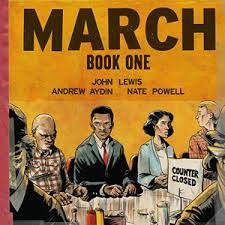
U.S. Congressman John Lewis co-authored his graphic memoir, March, Book One (2013), in large part to combat any indifference to voting—such as the complacency of Sally Heathcote’s granddaughter.  Lewis, a leader of the 1960s Civil Rights movement, has said elsewhere that “In a democracy such as ours, the vote is precious, it is almost sacred.  It is the most powerful nonviolent tool we have.”  As a young man, this Georgia representative was arrested more than 40 times in the struggle to obtain equal rights, including equal voting rights, for African-Americans.  Lewis along with others followed Dr. Martin Luther King in advocating civil disobedience, or non-violent protest.  March, Book One is the first volume in a trilogy, powerfully depicting Lewis’s boyhood through his college years.  It lists three creators, as Lewis worked with trusted congressional aide Andrew Aydin, who wrote the text, and this pair chose award-winning artist Nate Powell to illustrate Lewis’ story.  Book One looks at the segregated South of Lewis’ youth and the early struggles to integrate public spaces, such as restaurant lunch counters, and institutions  such as schools.  Book Two (available in January, 2015) and Book Three deal more directly with voting rights and laws.

march_one

Readers of March, Book One will crave those forthcoming volumes!  Lewis and Aydin zoom in on vivid, touching moments in the Congressman’s boyhood.  We see him “preaching” to chickens on his family’s farm and racing off to catch a “forbidden” school bus.  (His parents  reluctantly declared that young John was  to miss school to help with planting and harvesting.  He disobeyed.) In those scenes, as throughout the entire book, Powell’s black-and-grey wash drawings superbly convey energetic motion through their variations in line and shading. Powell also effectively ‘mixes up’ the size and shape of panels, inserting or overlapping smaller ones to punctuate key dramatic points and also omitting panels at appropriately expansive or overwhelming moments.  City or country vistas and the gatherings of protestors in squares or on streets are some of these defining moments in Lewis’s early years. march-interior-hi-res-103_custom-982722a72f0e7716eefe2ac427dbc9e5ca63adee-s40-c85
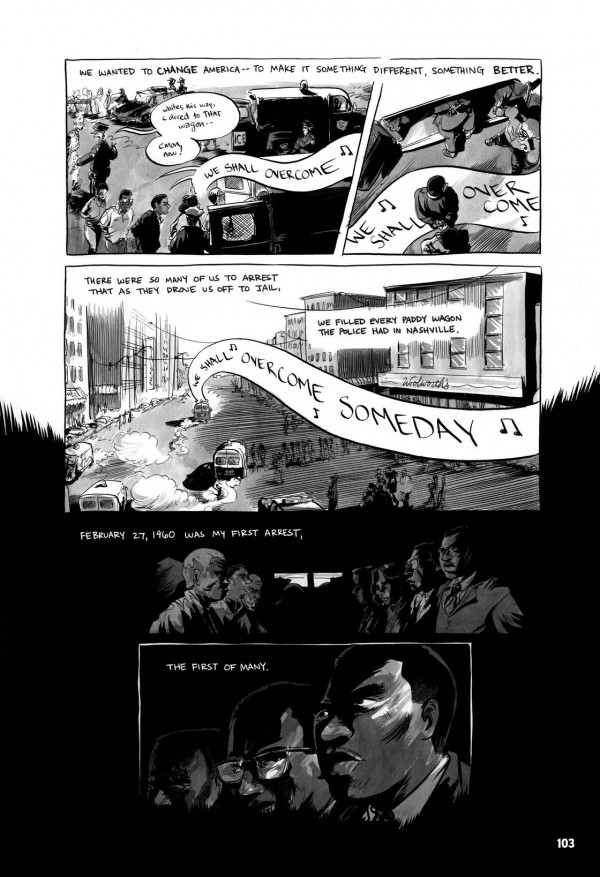
The perspective in these scenes is also telling.  March, Book One begins with a prologue set in 1965 on the Edward Pettus Bridge, where Lewis as a young man famously marched in protest for equal voting rights.  As state troopers barrel in to stop this peaceful protest, we see events finally from Lewis’s vulnerable, assaulted point of view.  On the prologue’s last page, he is still standing when in an irregularly shaped panel he views a baton-wielding trooper looming over a downed, protestor, the words “THUD,” “KRAK,” and “oof” reinforcing the assault that has just occurred.  Then, we only see Lewis’s hands in close-up, clawing at what must be the ground as he himself is hit.  This event is confirmed by the jagged-edged blackness and inserted black panel that dominate the bottom half of the page.  Illustrator Powell’s thoughtful, masterful illustrations are a fine complement to Andrew Aydin’s storytelling choices, his focus on the Pettus Bridge protest as a prologue and use of Barak Obama’s inauguration as a framing device for Lewis’s recollections.  Those events are told here to two young boys visiting the Congressman’s office on that historic day.  In speaking with these boys, genial and modest Lewis does not shy away from other acts of violence perpetrated in the segregated South, such as the murder of 14 year old Emmet Till.  Powell’s detailed illustrations depict not only people of valiant purpose and determination but the racist hatred and suspicion of people who committed or approved of such brutal crimes.   March, Book One justifiably has won numerous awards and accolades, including mention by YALSA as a Top Ten Graphic Novel for Teens.

I know I will be lining up to read March, Book Two as soon as it is available.  But first I will stand in line this afternoon, exercising my precious right to vote . . . .  

Posted in graphic novels, memoir | Tagged , , , , , , , , , , , , , , , , , , , , , , , , | Leave a comment

Tricks and Treats? Some Serious Holiday Fun

sns-halloween-jack-o-lanterns-pg-033 (1)

Today’s trick-or-treaters may not know the serious origins of this fun-filled tradition.  Their masks and costumes began as disguises for All Hallows’ Eve (now Halloween), the time when ghosts, demons, and other supernatural creatures supposedly could slip easily from their world into ours.  If such creatures could not recognize a disguised person, they could not harm that individual.  And—if someone put up a bold front, with a fierce attitude and frightening costume—perhaps supernatural ‘bad guys’ and other villains might themselves be scared away!  Today I look at two graphic novels that successfully play with our ideas about heroes and villains and also upend our notions of what is natural vs. supernatural.  I Was the Cat (2014) entertains readers by making the familiar strange, while Digger: The Complete Omnibus Edition (2013) ‘wows’ us by making the strange familiar.  Neither is specifically a Halloween read, but I think these books are as spooky as many ghost stories, with thrills and chills that rival October’s haunted houses and hayrides.  Readers tween and up will best get the verbal exchanges, interpersonal dynamics, and historical or cultural references in these graphic works.

Tobinbanner

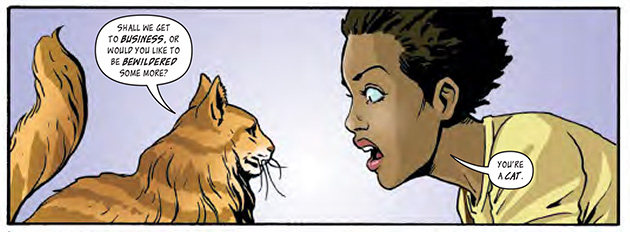
Author Paul Tobin and illustrator Benjamin Dewey confound our expectations in I Was the Cat.  Traditionally, cats (or other natural creatures such as bats, crows, or owls) are secondary characters in tales about witches and wizards.  These creatures are the so-called “familiars” whose presence helps magic-using humans supposedly achieve their goals, whether for good or evil.  Yet in I Was the Cat it is a furry feline named Burma who is the central, seemingly magical character—and an evil, criminal mastermind to boot!  If we do not accept Burma’s explanation for his ability to speak many human languages (he says merely that he is “one of a kind”) only magic remains as the explanation.

I-Was-the-Cat-ComiXology-14

Wealthy, reclusive Burma has hired web journalist Allison Breaking to write and post his life story on the web.   We learn about the almost incredible nine lives Burma has lived at the same time that blogger Allison and her woman friend Reggie do.  Burma does not tell Allison the whole truth or even the real story of his deeds, however, as readers can see through the overlapping story lines Tobin writes and Dewey illustrates.  Part of the enjoyable suspense here is waiting to discover when and how Allison and Reggie will figure out Burma’s real nature.  We wonder, too, if they will survive or fall victim to his treacherous plan to control humanity world-wide.  Bullets fly and knives slash in this graphic work, which also depicts corrupt government officials and people who live by theft and prostitution.  In an interview, author Tobin has agreed that this work is more a horror story than a fantasy one, and said that the slow, incomplete revelation of all Burma’s evil doings and plans was his deliberate decision not “to give up all the mystery of Burma the Cat right away . . . .”

534321fe7d9ff

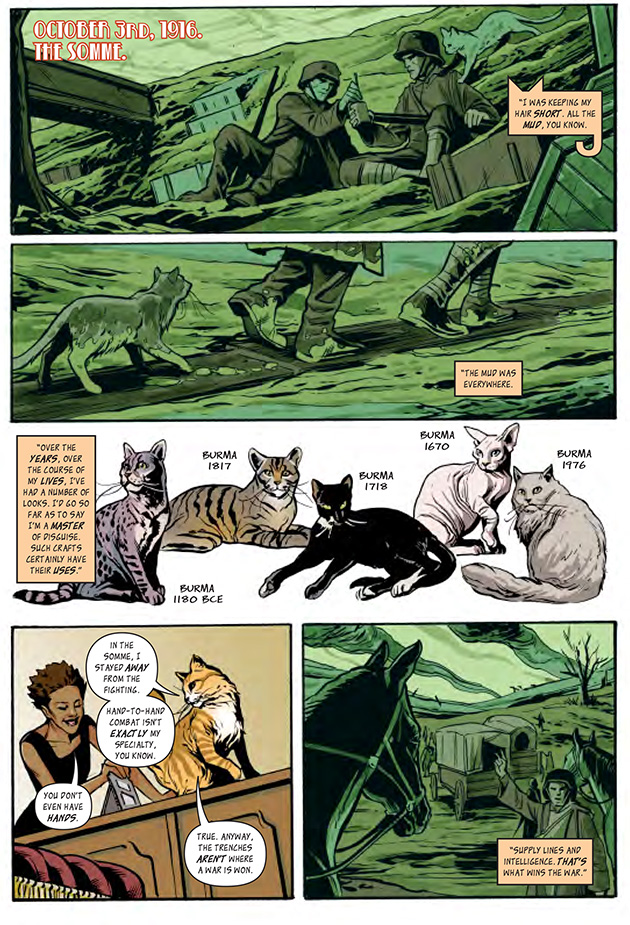
This book’s old-fashioned cover image, though, repeated as its frontispiece, contains clues for the knowledgeable reader.  Steely-eyed Burma is depicted in the style of 17th and 18th century conquerors or wealthy merchants, with one paw dominating a globe, his triumph over time indicated by an hourglass, watches, and clocks. Stray bullets, knives, and coins suggest the methods he has used to achieve his success, while a cat’s skull (typically a human one in such paintings) suggests that only death will finally conquer him—but in Burma’s case, only after an extraordinary succession of nine scheming lifetimes.  The details here bear out Tobin’s praise of illustrator Dewey’s attention to historical detail for the array of time periods covered in this book. We see Burma in ancient Egypt, in Elizabethan England, in the France of storyteller Charles Perrault and later of Napoleon, in the England of 18th century criminal Jonathan Wild, and in the European trenches of World War I.  Later, when Burma realizes that “cinema stars” are the new world rulers, we even see him on the movie set of Audrey Hepburn’s “Breakfast at Tiffany’s” and a series of James Bond thrillers.  Bond’s arch-enemy Ernst Blofeld,  often shown cradling a cat, is in this novel actually holding Burma in disguise!  Illustrator Dewey effectively uses a distinctive, unifying color palette for each different time period or setting.

I-Was-the-Cat-ComiXology-20

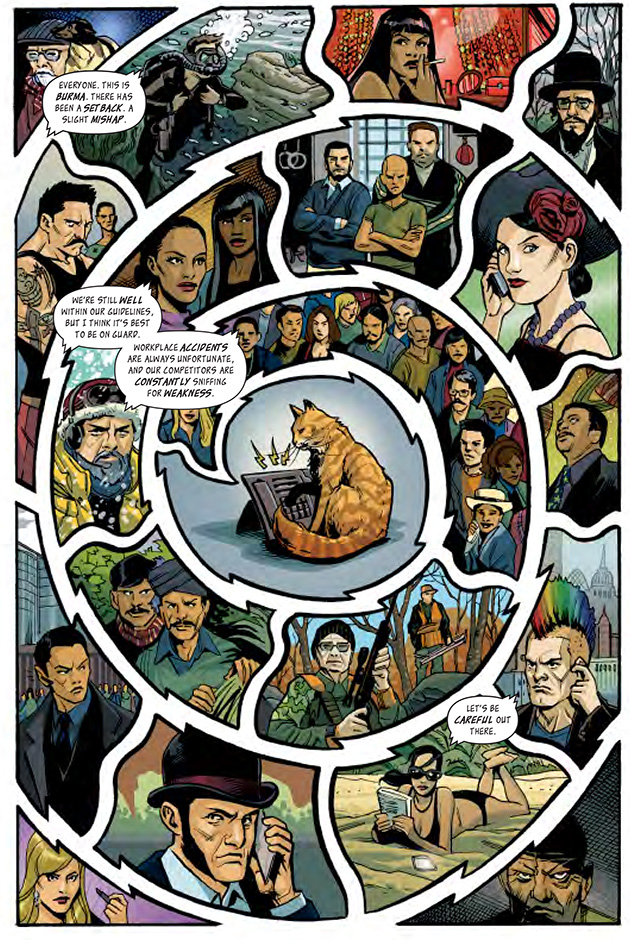
Drama in this novel is heightened by Dewey’s varying the size of framed images, with many close-ups and a few panoramic shots from a cat’s perspective on the floor or in a cushioned chair.  The reader’s attention is refreshed and refocused by some mid and long-distance shots drawn as unframed black-on-white silhouettes.  One remarkable full page image shows all the people and plots contemporary Burma now commands, as multiple images from a variety of settings swirl around the central, mastermind Burma, who is updating his minions by speakerphone.  Will this fiendish feline succeed in his plans? 

i-was-the-cat-comixology-53

As Reggie and Allison speed towards the book’s conclusion, Reggie imagines the worst: a full-page panel filled with devastating robotic cats, space-suited felines, and even cat-shaped transformers blasting everyone and everything in their path.  Yet I Was the Cat ends on a more ambiguous note:  with cats twining around the feet of unsuspecting people in a bustling downtown square.  Tobin and Dewey display devilish good humor as they toy with readers’ expectations in this novel, much as a cat might play with a mouse.  Those who enjoy the thrills-and-chills of Halloween celebrations will enjoy this game.  Others, including younger readers, may better appreciate the more traditional and tender depiction of a cat’s nine lives in Lloyd Alexander’s classic, non-graphic novel Time Cat (1963).

While cats exist world-wide, fewer readers will have first-hand knowledge of author/illustrator Ursula Vernon’s animal protagonist—a native-to-Australia wombat.  The fantastic adventures of “Digger” (short for “Digger-of-Too-Convoluted Tunnels”) were a popular, serialized webzine for more than eight years before they also began appearing as individual, in-print volumes.  Readers took this burrowing creature—depicted by Vernon as a sentient, matter-of-fact engineer, who has somehow dug her way into an even more dangerous fantasy realm—to heart.  With its recent publication in an omnibus edition, a broader audience can now see why Digger won, among other accolades , the 2012 Hugo Award for best graphic work and 2013 Mythoepoeic Award for best fantasy.  Vernon brilliantly creates a typical hero’s journey for this atypical heroine, along the way touching upon universal characters and concepts that underlie some of today’s Halloween traditions.

download (10)A           Digger

As Digger bravely moves further  underground in quest of a legendary, imprisoned god-like figure, she must conquer her own doubts as well as natural and supernatural foes.  Some of these are comic, such as the vampire squash that attach themselves to her legs, but most are not.  By the time wounded Digger surfaces with proof of having released the eons-long chained prisoner, having demonstrated her right to return home as a fully-mature individual or ‘hero,’ she has confronted issues of spousal abuse and corrupt religious institutions.  She has also come to terms with Vernon’s innovative versions of traditional Halloween figures and settings.

There is a solitary “Shadowchild,” a demon hatched out of dead bird, trying to figure out what it is, and then trying to determine what is “good” vs. “evil,” since all by itself it has decided to be “good.”  There are supernaturally gifted seers, one human and the other a slug, whose cryptic pronouncements Digger tries to follow on her uncertain path homeward. And there is a mysterious but kind social outcast (who just happens to be hyena); the fierce, matriarchal warrior clan who has outlawed him; and a brigade of self-righteous human priests determined to remove Digger, killing her if necessary, to avert sacrilege.  The gods they worship include a version of the elephant-headed Hindu deity Ganesha.  (I thought Vernon treated the embodiment of this deity with respect, depicting Ganesha as a truth-sayer and peace maker.  Yet there is always the potential for misunderstanding or misrepresenting another’s religious viewpoint, and I am not Hindu . . . .)  Gods and demons; sword-wielding, sometimes berserk warriors; masked seers and priests; haunted temples; and dangerously dark and spooky passages filled with unexpected, unknown dangers—all are frequently role-played and staged as part of today’s less-than-serious Halloween festivities.

2007-03-08-shadowimages (1)

Vernon immerses us in Digger’s worlds through artful words as well as powerful black-and-white images.  Digger is a fully-realized character not only through her stubborn actions and cantankerous dialogue but through expressions that convey her faraway home society.   Exclamations such as “Dip me in chalk and call me a limestone conglomerate,” which we are wryly told is a saying that “flows better in the original wombat,” reflect the tunneling imperative and building skills that instinctively dominate that culture.  Expressions such as “By the Great Architect!” serve a similar function.  Digger also refers to historic wombat conflicts, achievements, and heroes related to her own family.  This “humanizing” (for want of a better word) of Digger and her dilemmas is furthered by Vernon’s innovative illustrations.  Danger, anger, and sorrow are all masterfully conveyed through shifting perspectives, varied panel sizes and shapes, and overlapping, unframed images and words.  Black backgrounds, lined halftones, and multiple grey tones further extend Vernon’s emotional palette, as she also uses a variety of lettering to communicate shouts, squeals and background noises.  Some enemies become allies, and a few enemies become more understandable, if still unlikeable.

2010-08-24-wombat706-somehow

The complete omnibus edition of Digger also has interesting and fun back matter: a bonus story, published originally in volume one; short “reference works” about moles, trolls, and the cast of characters in Digger; and supposed random notes and lists “found” in the book’s supernatural realm after the events of its main story.  Vernon includes as well her “(Famous) Last Words” as an afterword to this printed volume and a “Web Commentary,” her responses over the years to readers who had questions about the serialized, online version of this world-building, epic work.  Full-color illustrations, originally the covers to the individually-printed volumes, are the final bonanza here.

Younger readers (along with the young-at-heart) will enjoy Vernon’s ongoing series of illustrated and hybrid novels (part graphic novel and part text) about a grade-school aged dragon, Danny Dragonbreath (2009 – 2015).  Its 5th volume, Dragonbreath: No Such Thing as Ghosts (2011) is set at Halloween, with a plot centered on trick-or-treating.  Yet I wholeheartedly recommend Digger: The Complete Omnibus Edition to those ready to tackle its ideas and heft.  The “trick” of leafing through its 800-plus pages is well worth the “treat” they provide!

Posted in graphic novels | Tagged , , , , , , , , , , , , , , , , , , , , , , , | Leave a comment

Selma Lagerlof’s Home and the Swedish “Tom Thumb”

ph_lagerlofI visited Selma Lagerlof’s rural home in central Sweden–an old manor house called Marbacka, close to the town of Sunne and the city of Karlstad–in May, 2008.  I had been thrilled to discover, when planning this trip with my Swedish-American husband, that his family came from the Varmland province that nurtured and inspired Lagerlof.  She was the first woman, as well as the first Swede, in 1909 to win the Nobel prize for literature.  Besides her novels and short stories for adults, Selma Lagerlof wrote a two-volume children’s classic that has been translated into more than 30 languages: The Wonderful Adventures of Nils and The Further Adventures of Nils.

This tale of a tiny boy who flies across Sweden on the back of a goose is a beloved national favorite.  A picture of Nils even adorns the back of the Swedish 20 krona note!  Lagerlof herself graces the front.  In addition to literary pilgrims of all ages, groups of schoolchildren regularly tour Marbacka each spring.  On the day that I visited, some fourth graders impressed me with their English.  Every one of them knew all about the travels of Nils Holgersson, the Swedish Tom Thumb.  Some had also seen the 10 foot-high statue of flying Nils  just a few miles down the road, next to the Rottneros Sculpture Garden.  

ph_nils

Lagerlof’s novels and tales draw upon people she knew and stories she heard growing up in the small manor house at Marbacka.  Farmers, pastors, and iron foundry owners; Biblical characters and events; gnomes, ghosts, and supernatural happenings–all appear in her works.  Marbacka itself makes an appearance in The Further Adventures of Nils, when Nils meets an author living there.  She has been asked to write a children’s book about Swedish geography and tells Nils he will be part of it!  That is indeed how these books began, commissioned by the Swedish government as educational aids. 

   Nilstate (1)bk_olden (1)

Selma Lagerlof loved her childhood home, declaring that “at Marbacka there were no sorrows.”  Her family reluctantly sold Marbacka when Lagerlof was a young woman, but in 1907 and 1910 the successful author purchased and restored the estate and began spending each summer there.  It became her permanent home until her death in 1940.  Lagerlof’s autobiographical works–collected and condensed in Memories of Marbacka–contain descriptions of life on this working farm.  As she requested in her will, Marbacka is displayed to visitors just as it appeared on the day that Lagerlof died.

Visitors pass through lush fields, some planted with oats, to reach Marbacka.  Nearby, small forest creatures scamper through stands of pine and spruce trees.  A dirt road wending upward from the highway leads to the manor itself, still surrounded by the red, wooden outbuildings that are typical in Sweden.  Nowadays, some of these still contain farm implements while others house a cafe and gift shop.  Lagerlof’s strong interest in gardening is evident right outside, in carefully arranged flower and vegetable patches, dotted with ornamental hedges and fruit trees.  Gravel paths provide an easy stroll this extensive garden, which Lagerlof herself helped design and tend.  

marbacka

The author had the current manor house rebuilt from 1921 to 1923.  It is a soft white, three-story stucco building with a dark roof–only somewhat larger than the cozy, five room, one-and-a-half story red wooden building of Lagerlof’s childhood.  The art works and furniture that fill its elegant rooms reflect Lagerlof’s love of the Swedish countryside, its folk songs, and legends, and her family.  One parlor is graced with large portraits of her companion Sophie Elkan and Elkan’s family.  Beyond these more formal rooms, it is just fun to see the many coffee sets that the author had on display in her kitchen and hairbrushes and other personal items on a vanity in her bedroom.  It is Lagerlof’s combined library and study, however, that holds the most fascination for readers and writers.

Illustrations from Lagerlof’s books decorate the walls.  Translations of all of the author’s works fill many of its bookshelves.  Others are adorned with handmade Nils items that schoolchildren sent to the author of their favorite book.  Cloth, clay, and wooden figures of Nils’ characters–along with paintings and letters from children–fill an entire, glassed-in cabinet.  A large wooden desk draws the eye onward.  It seems almost alive with creative energy, with items arranged to suit a working author of an earlier generation.  A manual typewriter sits within easy reach of a chair on one side, while an inkstand, paper, pen, and blotter face the chair opposite.  Moving closer, one sees a handwritten letter signed “Selma Lagerlof” tucked into the blotter.  Is is as though the author had just stepped away for a brief moment . . . .

bk_chnglngbk_legnd

Children and adults who have read Nils or one of Lagerlof’s folktales,  including her all-ages Christmas stories, will enjoy visiting Marbacka.  Whether exploring on one’s own or with a guided group, after a pleasant hour or so be certain to stop at the cafe for “Selma’s cake,” a spice cake served with the traditional lingonberry jam and whipped cream.  The gift shop has items aimed for both children and adults.  Check Marbacka’s website for information about visiting hours and events, and look at the National Library of Sweden’s webpage to learn about its Lagerlof collection.

Posted in articles | Tagged , , , , , , , , , , , , , , , | 4 Comments

Making the Grade

None of our family now remembers the actual grades that my adult son Daniel earned in fourth grade, but we all remember his early student activism.  When the school principal decided that lunchroom noise was getting out of hand, she banned talking during lunchtime.  Daniel then drew up a petition protesting that action but offering alternative ways to maintain order and allow talking.  He got other students to sign the petition, leading the principal to lift her ban.  That petition was also the beginning of Daniel’s ongoing involvement with communication and civic commitment, in his professional and personal life.  As September begins a new school year here in Minnesota, our family’s experience reminds me that kids and teens learn a lot more in school than is ever measured on tests.  There are multiple ways to “make the grade” in life, but sometimes formal education does not recognize this.  Sometimes schools even hinder student progress or success.  Today, I look at three graphic novels that deal with different types of “education” and miseducation, each with its own distinctive emotional register.  One focuses on elementary school, while the others follow their protagonists into adulthood. 

bk_comicssquad

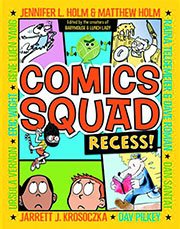
Comics Squad Recess (2014) is a compilation of eight rollicking “riffs” on elementary school life, each by a different comics author-illustrator or writer-and-artist pair.  Its three editors—the sister and brother team of Jennifer L. Holm and Matthew Holm, along with Jarrett J. Kroscoczka—are themselves acclaimed graphic novelists.  Their best-known characters—the Holms’ Babymouse and Kroscoczka’s Lunch Lady—are stars in their own separate series of popular, fun-filled graphic novels.  In Comics Squad Recess, Baby Mouse and Lunch Lady not only anchor two of the eight stories but also appear as zestful narrators between the stories, urging the reader to turn the page, try out do-it-yourself projects, or buy zany imaginary products.  These page-long “promos” are like the old-fashioned transitions that used to appear in comic books.  Babymouse and Lunch Lady’s gleeful, pop-up appearances add to the fun as they connect the stories.  The vivid two-color presentation here, alternating shades of orange with black and its gradations, is similarly attention-grabbing and cheerful. 

bk_comicssquad_interior

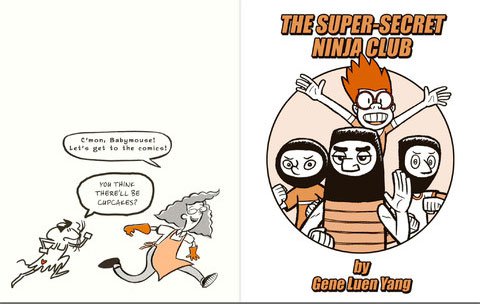
As its title suggests, most of the stories in Comics Squad Recess focus on the non-academic parts of school life: recess, winter vacation, lunch time, and hallway hijinks outside of class.  How to interact with one another, be one’s own person, and discover the vast realms of the imagination are some of the serious topics explored in these funny tales of typical elementary school life.  (There are also a couple of creative fantasy versions of school, with squirrels, cupcakes, and healthier snacks as characters.)  I am hard-pressed to name a favorite story, but Gene Luen Yang’s “The Super-Secret Ninja Club” is lots of fun.  Author-illustrator Yang often smartly lets readers piece together for ourselves how image and text fit together, as when someone outside the frame asks, “Anyone seen the star that’s supposed to go on top of the Christmas tree?” and we see a young, would-be ninja practicing “Throwing Weapons Techniques“ with the star as a make-shift shurikan.  Providing the Japanese names for ninja practices is one way Yang, himself a teacher, slips still more knowledge into this tale—something that young-at-heart readers as well as kids will appreciate.   (That active learning can take place outside of school—during winter break, or while holding a comics anthology in one’s hands—is just a given here.)

The one story that deals most directly with in-class, traditional ‘book learning’ will similarly appeal to a broad audience.  Dav Pilkey’s “Book ‘Em, Dog Man,” purportedly a comic created by two elementary-school age students named George B. and Harold H., is prefaced by Pilkey’s clever letter from these boys’   first-grade teacher to their parents.  She sternly recommends that they try to cure their sons of their “creative streak,” shown by the wild characters of the comic book they were told would not be acceptable homework.  She cannot see past the spelling and grammar mistakes or the fantastic story line there to the imaginative, affectionate respect for reading in this kids’-eye view of a world bereft of readable books.

dav_pikey.png__550x186_q85_crop_upscale

If your first thought, like mine, is that such a teacher’s response seems outdated, that most adults today recognize and respect how graphic literature reaches and moves kids, I will highlight this ironic fact:  the most challenged book in schools and libraries in 2013 was Dav Pilkey’s popular comic book series Captain Underpants.  This series featuring George B. and Harold H. as fourth graders was deemed offensive more often last year than E.L. James’ erotic bestseller Fifty Shades of Grey!   Captain Underpants also topped the American Library Association’s 2012 list of ten most challenged books.  Despite these bizarre facts, I am certain that readers of all ages will enjoy the verve and humor its creators bring to this Comics Squad Recess’ short book trailer . https://www.youtube.com/watch?v=UiTRmUGRAeA  

bk_primates

A different kind of school “failure” based on fact is revealed in Primates: The Fearless Science of Jane Goodall, Dian Fossey, and Birute Galdikas (2013).  This fictionalized biography, written by Jim Ottaviani and illustrated by Maris Wicks,  shows how little relevance traditional education had to the scientific passions and success of these three groundbreaking naturalists.  Their discoveries about  surprising ways humans and other primates are alike and how primates act in the wild were self-motivated.  We meet Jane Goodall as a preteen absorbed by Edgar Rice Burrough’s tales about Tarzan of the Apes.  Watching farm animals had also piqued her curiosity about the natural world.  Unable to afford college, clerical worker Goodall began her life’s study of chimpanzees after travelling to Africa and meeting paleontologist Louis Leakey, who supported her efforts. Dian Fossey, whose education and career as an occupational therapist did not satisfy her passionate interest in the great apes of Africa, was also aided by Leakey when the 31-year-old woman took a longed-for African vacation.  On the other hand, Birute Galdikas was already an academic success in anthropology, when a lecture by Leakey and follow-up meeting with him changed her career path.  With his help, she switched to the study of orangutans and their behavior.   While Galdikas had to switch her academic focus, Goodall and Fossey had to “backtrack” and complete advanced college degrees in ethology in order, ironically, to receive official support and recognition of their considerable achievements.  All three of these scientific pioneers had to combat the prevailing, mid-twentieth century prejudice that women were not intellectually suited to be scientists.  In one more ironic twist, Louis Leakey’s own views on women’s innate differences from men—his belief that women are more patient and dedicated—spurred his support of these researchers.

bk_primates_pg46

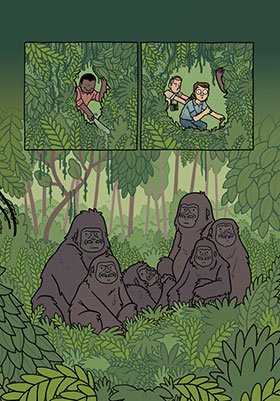
Maris Wicks’ illustrations provide much of the gentle, sometimes rueful humor that dominates Primates. Against the vivid green hues of African and Malaysian jungles, she depicts human researchers stumbling awake; humans and apes attempting to outstare and out-sniff each other; and the awkward, sometimes physically irritating lessons humans have to learn about living in the wild.  Wicks use of different typeface sizes, shapes, and colors to reflect wild sounds and noises is very effective, as are the frequent wordless panels which convey the stillness of these researchers observing primate life.  Wicks even manages gently to underscore the unsuccessful ways in which Louis Leakey attempted to be more than “fatherly” with these female protégées.  Every time he thinks about this, we see he has removed his spectacles, perhaps unconsciously, to appear more dashing.  In one such scene, his wife and research partner Mary Leakey mutters to herself in the background, “Huh. Here we go again.”  She is also happy to discover that Birute Galdikas is married, though readers later see the toll that a research career has on that relationship.  The light ways in which these ‘adult’ matters are touched upon support author Ottaviani’s view that Primates is “designed to work well for [younger readers] but . . .  it’s a book that appeals to anyone interested in primatology and the scientists who work in that field.”  Treading that middle ground in readership may explain why Ottaviani omitted mention of Fossey’s unsolved murder, most likely by the animal poachers she opposed.  Certainly, Ottaviani was more forthright about adult foibles and habits in his award-winning graphic biography, Feynman (2011), about physicist Richard Feynman, who had his own battles as a student and teacher with formal education.  However, the more serious information about Fossey is readily discoverable in many resources, one being the Bibliography that Ottaviani provides in Primates.

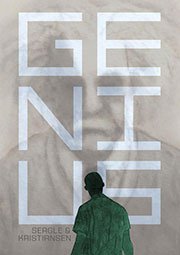
The ways in which educational institutions fail to help and even harm such brilliant students is the subject of the graphic novel Genius (2013), written by Steven T. Seagle and illustrated by Teddy Kristiansen.  These frequent collaborators here use muted pastels and sepia tones in a sincere, sometimes bleak, but ultimately hopeful story that twines the life of a fictional physicist with the experiences of 20th century luminary Albert Einstein.  Seagle has said that he was inspired in part by the real-life experiences of his wife’s grandfather, a soldier during World War II who had met Einstein. 

bk_genius


The book’s protagonist, Ted Halker, a pre-teen who ‘skips’ several grades in school, learns the hard way that there is a “chasm between knowledge . . . and knowing.”  He is too physically different from other high school students to be readily accepted, and he lacks the social skills to change this.  Ironically, his intellectual and social isolation in school, represented in a full page image that blocks him off centrally from other seated classmates, reoccurs when Halkner nears forty, having failed in the last decade to make the scientific leaps that characterized his early 20s.  Once again, illustrator Kristiansen shows Halker center page, this time in a think tank’s block of cubicles, peopled now by younger scientists who are ahead of him intellectually.  Einstein too achieved his greatest breakthroughs in theoretical physics in his 20s.  But Einstein did not face losing his job, as Halker does, unless . . . just possibly, his aged father-in-law really did learn one of Einstein’s secrets while he served as one of the genius’ most trusted army guards.  If so, perhaps Halker can use this information to help himself and his family.  His wife, just diagnosed with cancer, needs expensive medical care, and his smart-aleck teenage son and gifted daughter are facing their own social and academic challenges. 

Einstein’s supposed thoughts float through this book, as Halkner hears something from his father-in-law, represented in several wordless pages of dramatically more vivid, abstract patterns, overwhelmed finally by one dark color mysteriously covering an entire page.  Is the old man’s whispered message a discovery about the theoretical anomaly Einstein himself seemed never able to resolve?  Perhaps.  But these pages may also represent the life-altering shift in viewpoint that Halkner soon makes, placing his family first and discovering a new, satisfying career as a high school physics teacher.  He now knows he will be happy to be there for “that kid—or kids” who as geniuses need the kinds of help he did not receive in school.   Grading student homework, including a notebook containing a doodled Einstein figure, Halkner is in this novel’s final panels content in new, hopeful ways.  He no longer judges himself by the artificial standards and numbers that dominated his school-centric childhood and adolescence.

bk_genius_interior

At the start of a new academic year, many students and schools face problems not addressed in this post: poverty, racism, physical and emotional deficits . . . overcrowding, understaffing and underfunding, government restrictions or requirements.  I do realize the family anecdote which began this post shows just how fortunate and privileged we have been in our dealings with professional educators and schools.  But what then of my adult son?  I think he has finally forgiven us for not permitting him to skip grades in school.  And I know he continues to “make the grade” in interesting, unusual ways.  His former principal, now a family friend, was smiling as she recently told me she had received another written communication from Daniel—this time an e-mail  suggesting sights to see when she toured Istanbul, his former home for several years.  He had also mentioned places where one might enjoyably dine.  I do not believe any of them were particularly quiet, even at lunch time.

Posted in graphic novels | Tagged , , , , , , , , , , , , , , | Leave a comment

Jack the Ripper: The Story Behind the Book


Jack the RipperThey had names but not faces. Their dismembered body parts were identified but not their dreams and hopes. Even a century later, the world seemed to care more about their mysterious killer, Jack the Ripper, than it did about his known victims. It was that injustice, those five women, who kept me slogging through the bloody, confusing annals of his crimes. In 2003, the assignment I had taken on as a whim—to write a book about these notorious serial killings in 1888 London—acquired personal meaning for me. I wanted to acknowledge the humanity of prostitutes Mary Ann (Polly) Nichols, Annie Chapman, Elizabeth Stride, Catherine Eddowes, and Mary Jane Kelly. I wanted their lives and deaths to have as much and more meaning for strangers than that of their murderer, whatever his twisted motives or real identity.

And so, in 2004, my Jack the Ripper became only the second book then in print to contain this letter written by Polly Nichols to her father in May, 1888. The 44 year-old woman, just four months sober, was so happy in her new job as a housecleaner. She wanted to share news with her family, and wrote:

You will be glad to know that I am settled in my new place, and going all right up to now . . . . It is a grand place inside, with trees and gardens back and front . . . . They are very nice people, and I have not got too much to do. I hope you are all right, and the boy [her son] has got work. So good bye for the present. From yours truly, Polly.

Answer soon, please, and let me know how you are.

Polly Nichols did not hold onto this job, though. On August 31, 1888, she became the Ripper’s first known victim. Middle-aged Annie Chapman, who had tried and failed to earn a living by selling flowers and crocheting, became his second. Forty-five year old Elizabeth Stride, a Swedish immigrant born Elisabeth Gustafsdotter, was the third woman he butchered.

Catherine Eddowes, who at age 44 still cried when she met her respectably married sister and said, “I wish I was like you,” became the Ripper’s fourth victim. Mary Jane Kelly, still light-hearted enough at age 25 to sing and smile as she walked through her neighborhood, was the fifth woman he slaughtered. These are some of the details I was able to include in the book, after working hard to convince my editor that such information did not “ruin its suspense or mystery” focus! Unfortunately, the editorial budget did not extend far enough to include the only pre-mortuary photo we have of any of these women. That formal studio portrait of Annie Chapman and her husband is, though, now accessible online. Just google “Annie Chapman images.” The portrait’s sepia tones set it apart from the black-and-white mortuary photos and newspaper sketches surrounding it.

In a violence-filled world, we remain fascinated by what motivates crime. One new book I blogged about in the May, 2013 Gone Graphic is Derf Backderf’s memoir, My Friend Dahmer. Backderf went to high school with Jeffrey Dahmer, who became a notorious 20th century serial killer. He murdered for the first time around their high school graduation, which concludes the memoir. I was relieved and reassured to see that Backderf’s End Notes contain a detailed, respectful account of Steven Hicks, the 19 year-old concert-goer who became Dahmer’s first victim. Readers hear from the Hicks family, too. This emphasis is appropriate and long overdue. As many survivors of recent acts of terror have remarked, theirs are the stories to memorialize, not just those of their attackers. This viewpoint inspired my writing of Jack the Ripper.

Posted in articles | Tagged , , , , , , , , , , | Leave a comment

To End All Wars

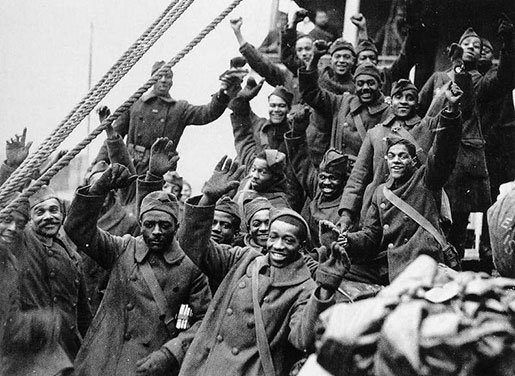
ph_harlemhellfighters (1)

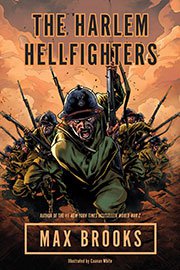
It was called the “war to end all wars.”   Yet this month—marking the 100th anniversary of the first battles of World War I (1914 to 1918)—brings new headlines and sound bites about wars and battles.  Images of wounded children, weary soldiers, and dead bodies haunt newscasts—on TV, computer screen, and smart phone.  Our phones may have grown smarter, but it seems that we have not.  We still wage war.  In this centennial of what was once also called the “Great War,” an upsurge in graphic literature about World War I reminds us just how little is great about any war.  Instances of heroism, acts of loyalty and compassion—all are eclipsed finally by the horrors of warfare.  Some new graphic works about World War I point this out, as does the reissue in book format of a classic weekly comics series about that conflict.  Still, the creators of one new graphic work were inspired by the overlooked heroism and patriotism of African American soldiers.  This reclaimed history of the United States’ shorter, later involvement in World War I (1917 to 1918) is the focus of Max Brooks and Canaan White’s The Harlem Hellfighters (2014), which I will discuss closer to the end of my post.  First, I look at books concentrating on the entirety of World War I or its earlier years. 

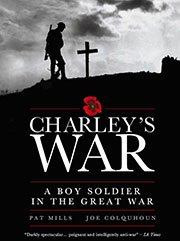
“Charley’s War,” written by Pat Mills and illustrated by Joe Colquhoun, first appeared as a weekly series in the British comic book Battle.  The likeability and vividly terrible experiences of its central character, 16 year-old Charley Bourne, soon made this series the most popular part of Battle.  Between its first appearance in 1977 and its conclusion in 1986, each 3 to 4 page long episode of “Charley’s War” was eagerly awaited by readers young and old.  The talented team of Mills and Colquhoun (that’s pronounced “Col-hoon”) made it painfully easy to identify with naïve, patriotic Charley, a British working-class kid who lies about his age to enlist in the middle of World War I.  Unlike the typical comic book soldier, Charley was shown with his family in daily life, and letters and post cards from and to his London family became a movingly ironic part of the series, as Charley struggles to stay in touch yet also spare his family from the warfare horrors he is experiencing.   This series—with the addition of illuminating essays and interviews by its creators and historians—was reprinted in 10 volumes between 2004 and 2013.  Those volumes follow Charley, along with his family and acquaintances, from 1916 through and past the end of the war, concluding ominously with Hitler’s 1933 election as Germany’s chancellor.  They are still in print.  Yet I am pleased to tell you that the first three books are being reprinted as one compendium volume later this centennial month.  Retitled Charley’s War: A Boy Soldier in the Great War (2014), this compendium gets my strong recommendation, particularly since its publisher’s description indicates it will include many of the first volumes’ fascinating background essays.    

Charleys-War-Omnibus-Cover

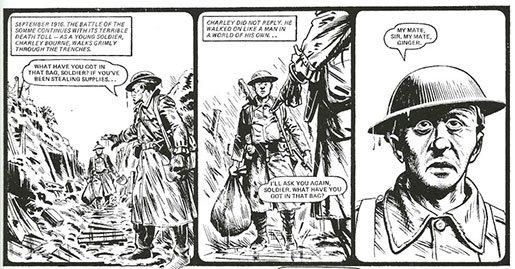
Charley’s War: A Boy Soldier in the Great War (2014) follows Charley’s arrival in the battleground trenches of France, his experience of the horrific battle of the Somme, and his wartime leave back home, during which London is bombed by German zeppelins.  A Boy Soldier will be a great introduction to the entire series and a very satisfying read on its own.  Readers will see how Mills’ strong storytelling and dialogue skills subvert the very idea of “righteous” warfare, while never belittling Charley’s initial patriotism, and how Colquhoun’s powerful images merge with the text.  Sometimes these insightful black-and-white drawings achieve greater impact by ironically contrasting with Mills’ words. For instance, when Charley writes, “Tell Auntey Mabel her scarf was very useful,” this seemingly cheerful, innocuous remark is juxtaposed with the image of Charley’s using the scarf to cover a trapped, wounded war horse’s eyes before he mercifully shoots it.  Sometimes, Colquhoun’s black-and-white drawings are powerful simply because of the smart visual choices the artist has made and the level of detail he includes.  Panel size and shape vary, with frames sometimes being omitted, to emphasize the storyline.  For example, the soldiers’ prolonged stays in the long, narrow trenches of France are at one point shown by a page-long, narrow vertical panel down the side of one page, depicting trench life in great detail.  Later, after Charley is wounded, a close-up of his unconscious, bandaged face, framed in a billowing round panel, is juxtaposed with a panoramic, overhead view of his location, a French train station.  We see a departing Red Cross train, filled with wounded soldiers, at the same time we see a battalion of newly arriving soldiers, not yet aware of what awaits them.  Tellingly, Colquhuon places a body-bagged corpse between the two moving columns, each headed in the opposite direction.  Pat Mills has written of this artist that “Joe’s [work] is at least fifty-percent of Charley’s War, and without his contribution it would have been an entirely different story.”  

charleys-war-mills-colquhoun-04

Certainly, Colquhuon’s ability to draw soldiers as recognizable, distinct individuals reinforces writer Mills’ now-common view that World War I was really one of class warfare, with an elite officer class (on both sides) willing to sacrifice ordinary soldiers as so much “cannon fodder.”  It is a view Charley himself comes to share by the end of the months-long battle of the Somme, one of the bloodiest in human history, with more than one million soldiers killed.  Its horrors—including the foolish insistence of British generals on 19th tactics against 20th century weapons—were so great that the first day alone of that battle is the focus of another, new graphic work.  Award-winning American author/illustrator and war reporter Joe Sacco    has created a wordless, 24 panel panorama of that day, when within just the first hour 10,000 British soldiers were killed.  Images of The Great War—July 1, 2016: The First Day of the Battle of the Somme: An Illustrated Panorama (2013), along with a seven minute narration by Sacco, are online here: http://boingboing.net/2013/11/07/exclusive-joe-saccos-the-gr.html  and here.  http://vimeo.com/76336385   This graphic work is an absorbing, gripping achievement.  Readers will pore over its “miniaturized” drawings of the vast numbers of soldiers as their situations change over the course of that terrible day, unfolding almost hourly with each panel.  (The slipcase-enclosed book also comes accompanied by a pamphlet containing an author’s note, a panel-by-panel annotation, and an essay by journalist Adam Hochschild.  All are useful.) 

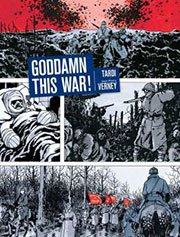
The experiences of French as well British soldiers have also been recognized.  Just the other week French author/illustrator Jacques Tardi deservedly won another Eisner award for his most recent work about World War I, Goddamn This War!  (2013).  This award joins the two Tardi won in 2011 for his scathingly brutal It Was the War of the Trenches  (2010; 1993).  Unlike that earlier book, Goddam This War! is a year-by-year account of World War I, from the point of view of one ordinary French soldier, beginning in 1914 with full color used in each early page’s three horizontal panels.  As that year progresses, however, and the horrors begin to pile up, those colors fade into monotone washes of grey or sepia.  The only splashes of color come as red gouts of blood or exploding flesh, along with—in a bitter irony—the fully colorful swirls of national flags. This telling use of color continues throughout Goddam This War!, which concludes with an extended, highly informative essay about World War I by  Tardi’s credited co-author, historian Jean-Pierre Verney.  Verney’s essay is illustrated with photographs, many of which inspired Tardi’s drawings.  The most devastating of these—several pages of soldiers with gruesome facial wounds—are difficult viewing for readers of any age.  Tweens and some teen readers might need to talk about their reactions to these images and how such wounded veterans actually fared after the war.  Less emotionally grueling would be discussions about how official wartime ‘press releases,’ which begin each year in this book, differ from what soldiers actually experienced and said—such as “Goddamn this War!” 

bk_goddamnthiswar

Tardi’s earlier It Was the War of the Trenches is dedicated to his grandfather, whose experiences in World War I inspired the book.  In his Foreword, Tardi writes that his book is not meant to be history, nor does it try to follow one protagonist or show “heroes” or a “collective adventure.”  For Tardi, as for the ten or so soldiers whose experiences he depicts, war is “Nothing but a gigantic, anonymous scream of agony.”  This graphic novel’s words and black-and-white images are strongly moving, but its phantasmagoric shifts from one character’s experiences to the next do not provide the typical linear narrative.  That may disconcert readers who want or expect that sort of clear-cut story line.  As Tardi’s final, devastating panels show, though, even what should be a clear-cut ending to warfare is death-dealing horror.  Battle continued on November 11, 1918, the day that the Armistice was signed at 5:00 A.M., as its ceasefire was not scheduled to take effect until six hours later, at 11:00 A.M.  Under a timestamp of 10:45 A.M., Tardi’s final, grim panel depicts entrenched soldiers still being blown to bits. 

tardi5

Despite Tardi’s denying being a historian here, both of his WW I works note with historical accuracy how France conscripted its colonial subjects as soldiers.  Black troops from Senegal, Morocco, and Algeria are among the soldiers Tardi shows fighting and dying for France, even as some French officers treat these men with racist disdain.  Joe Sacco’s The Great War similarly depicts turbaned troops from India marshalling as part of Britain’s armed forces.  Charley’s War also shows how the British and French military commands sometimes sacrificed Black or Brown colonial troops with even less thought than they gave to Caucasian soldiers.  Furthermore, in a background essay, Pat Mills reveals that one of the few times editors censored Charley’s War was when he wrote scenes depicting U.S. Army officers denigrating their segregated African American battalions, typically relegated to service roles.  http://exhibitions.nypl.org/africanaage/essay-world-war-i.html  Mills’ editors removed these supposedly “inflammatory” panels.  It is the little-known battle history of one of these battalions—the 369th Regiment, known as the “Harlem Hellfighters”—that inspired writer Max Brooks to reclaim this bit of African American history.

bk_harlem-hellfighters

Author Brooks and illustrator Caanan White do not shy away from the horrors of trench warfare.  Yet their brilliantly executed The Harlem Hellfighters (2014) has a different focus.  This fictionalized history (some protagonists are historical figures while others are fictionalized composites of real individuals) emphasizes how institutionalized racism in the U.S. at first denied Black soldiers even the right to participate actively in warfare. They could be army cooks and laborers or dockyard stevedores, but not combat troops.  The Caucasian social and military elite did want Blacks to be empowered to challenge their inferior status in a then segregated nation.  Early scenes set in the U.S. show how pervasive and violent this segregation was, particularly in the South.  Readers see its brutal impact on groups of people as well as the individual characters we come to know here.  The bravery, unity, and self-sacrifice the all-Black 369th Battalion was finally permitted to demonstrate in France proved yet again how wrongheaded such racism was.  Yet it would be many years (and many civil rights “battles”) later before legal equality—the “Democracy” that all U.S. soldiers supposedly fought for in World War I—was achieved for Black U.S. citizens.  It has taken even  longer for the history of the ‘Harlem Hellfighters,’ a name coined by their awestruck German enemies, to become known.  (Brooks gives an overview of this general history along with his novel’s evolution in the Author and Historical Notes.  He also includes a helpful Bibliography and Filmography.)

The-Harlem-Hellfighters-06_612x380

Caanan White’s dramatic black and white illustrations are virtuoso-level, both in themselves and as they interact with Brooks’ fast-paced, vibrantly worded and well-chosen text.  Panels of different sizes and shapes, sometimes outlined in jagged bold lines to reinforce emotional content, alternate with full-page images that spotlight crucial moments.  White frequently makes effective use of figures in silhouette and creates several pages of telling, wordless scenes—one aptly showing the different reactions of Black and Caucasian movie audiences to the 1915 racist silent film, “Birth of a Nation.”  White and Brooks also achieve genuine drama when they incorporate the words of a popular song and a war poem into the novel.  One other moment—when words and image unite in dramatic counterpoint—stands out for me: a scene where a discouraged Hellfighter rejoins the Battalion.  Just before his hard-won Croix de Guerre (France’s highest military honor) is returned to him, an officer says simply, “You’re out of uniform.”

As this centennial year progresses,  readers will see more graphic works published about “the Great War.”   I am particularly curious about Line of Fire: Diary of an Unknown Soldier—September, 1914 (2014) illustrated by French artist Barroux because its publisher claims this edition of a found, real-life diary is suitable for 8 to 11 year olds.  I also have in my library “queue” a graphic anthology of World War 1 war poetry, illustrated by various artists: Above the Dreamless Dead: World War I in Poetry and Comics (2014).  But I have to admit that the barrage of war-torn evening newscasts is making me more eager to turn next to lighter graphic fare—rest and recreation that, right now, is beyond even the dreams of those people whose lives, tragically, are the evening news. 


Posted in graphic novels | Tagged , , , , , , , , , , , , , , | Leave a comment

Summertime Lessons

It’s summer and school vacation time here in the Northern Hemisphere.  In Australian author/illustrator Shaun Tan’s ‘neighborhood,’ though, December through February are the warmest months, bringing students their long school vacation.  Regardless of this geographical difference, both Tan and the Canadian duo of author Mariko Tamaki and illustrator Jillian Tamaki have just published immensely satisfying books that focus on important life lessons young people learn during their school-free months.  Some lessons seem obvious and immediate, while the meaning and ramifications of others will unfold more slowly . . . perhaps over years or even the course of a lifetime.  Tan’s picture book Rules of Summer  (2013; 2014) and the Tamaki cousins’ graphic novel This One Summer (2014) are also similar in successfully appealing to a specific, identifiable age group while simultaneously providing older readers our own joys in these vibrant works.

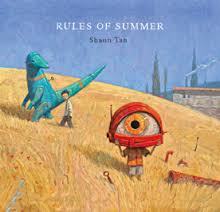
bk_rulesofsummer

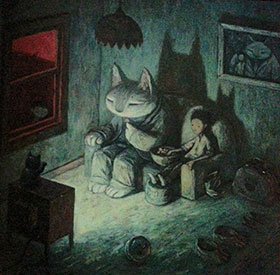
Rules of Summer, produced in Tan’s favorite medium of oil paints, is awash in color.  Its mysteriously unspecified settings veer from the hot, bright colors of sun-drenched days on Australia’s lush shores to the cool blues of twilight.  Some twilight and even daytime scenes are set not outdoors in nature but in frequently ominous cityscapes, muted pastels revealing looming buildings; mechanical, robot-like figures; and impossibly gigantic rabbits, crows, and cats—some nattily attired in suits. These imaginary landscapes, as Tan explains on the book’s website     http://www.rulesofsummer.com.au/#!home and his comprehensive author site http://www.shauntan.net/ , draw upon both his own childhood in the suburbs of coastal Perth, Australia and the industrial cityscapes of Melbourne, where he now lives and works.  All are put into play to depict the “rules” deduced by a young boy, seemingly seven to nine years old, as he plays with another, larger boy, possibly ten to twelve years old. 

They may be brothers or neighbors, but readers are free to interpret the characters’ evolving relationship—from tagalong closeness to ‘abandonment’ for another companion to possible imprisonment and then release or rescue, followed by reconciliation—as we wish.  This freedom is deliberately fostered by Tan, making his picture book satisfying for readers of all ages as well as the five to ten year-olds who are its apparent first audience.  Tan notes that “these very open ended kind of stories . . . don’t have necessarily the kind of structure or dynamic direction that you’ll find in novels or films or plays . . . art forms that have more of a linear or kinetic structure.”  Of Rules of Summer, Tan observes that “you can open it on any page and spend five minutes or an hour pondering the image, close the book and that would be a sufficient experience.”

gr_rules_cat_shoes (1)

Tan’s picture book text is minimal, one centered sentence per page, phrased as adages that could apply to multiple situations, not just the mysterious image on the facing or subsequent pages.  Thus, after the first, ‘plot-setting’ sentence—“This is what I learned last summer:”—the author has his character figure out that it is better to “Never leave the back door open overnight” and “Never give your keys to a stranger.”  How exactly these rules apply to the fantastic garden and creatures that have overnight engulfed the narrator’s living room or, on another page,  the enormous, clothed cat that is now watching TV with the older boy, with the narrator peering sadly into the room, is not explained.  Close examination of that page reveals further ‘causes’ for the narrator’s sadness.  The cat seems right at home with the older boy, his gigantic shoes placed neatly alongside the boy’s and a photo or painting of the two hung on the wall.  Readers young and old will be relieved that, by “the last day of summer,” the boys are happily playing and watching TV together again, with crayoned drawings of their adventures decking out that living room wall.  Their relationship—complex, evolving and never truly articulated, is a model for many human relationships, at all stages of life.

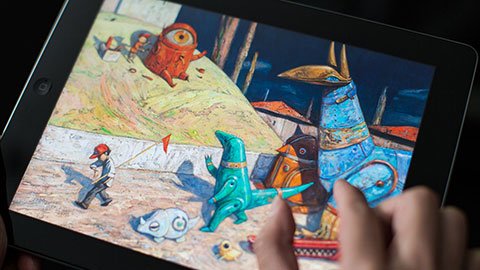
Shaun Tan has won multiple awards for earlier works, including the 2011 prestigious Astrid Lindgren Memorial Award for contributions to international children’s literature, and an Oscar awarded in 2011 for the animated version of The Lost Thing, originally an honored picture book.  (Attending the Oscar awards ceremony, as Tan reveals on his book’s website, is even related to one of the eerier pages in Rules of Summer!) Forward-thinking, Tan continues to engage with his audience in multiple ways.  There is now an “app” version of Rules of Summer, http://www.shauntan.net/books.html complete with musical score, available for purchased download for readers who want to experience or re-experience Tan’s work in this format.  The author/illustrator describes this app as “more than just an e-book . . . a unique work which took months of development.”

gr_tan_app

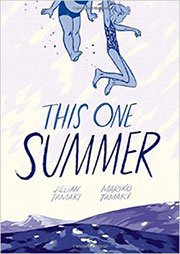
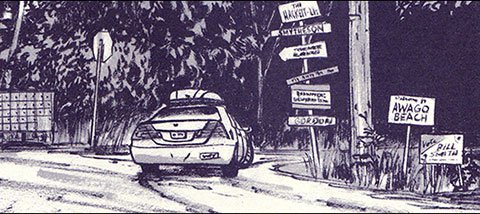
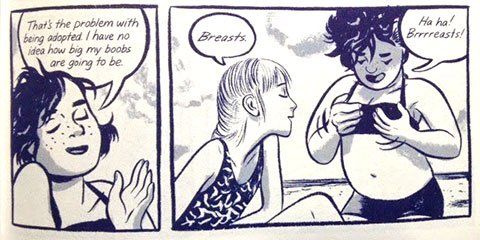
Unlike Rules of Summer, Jillian Tamaki and Mariko Tamaki’s This One Summer has a specific, realistic setting—one integral to its story of preadolescent girls’ slow, complicated growth towards adulthood.  The isolation of its wooded, lakeside cottage community has fostered the years-long summertime friendship of Rose, now about 12, and Windy, who Rose remarks is “one and one half years younger than I am.”  This difference in age is evident not only physically but emotionally: Rose develops an unvoiced crush on a teenaged convenience store clerk nicknamed “Dud” that younger Windy cannot comprehend, even as both girls are still childlike enough to share giggling, jiggling remarks about the possible future size of their undeveloped breasts. Jillian Tamaki’s illustrations here and elsewhere in the book are wonderfully paced and precise in evoking the rhythms of the pair’s interactions, both in speech and action.  She also deftly draws facial expressions that speak without words.  In interviews, the cousins have explained that it is Mariko who spent summers in an Ontario lakeshore community similar to the book’s fictional “Aswago Beach.”  Jillian, growing up in the more arid Canadian West, had to visit and photograph such communities as research before tackling this project.  The 300 page book took a year of full-time work to illustrate.  (It is also the Tamakis’ second project together; their first graphic novel Skim (2008) won multiple awards, including a 2009 YALSA accolade as a Great Graphic Novel for Teens.)            

bk_thisonesummer                                                                                         

Aswago Beach is also home to adults and older teens whose lives Rose and Windy only half-apprehend.  The cause of the temporary rift between Rose’s parents—richly-conceived individuals whose voices and expressions are vividly portrayed by the Tamakis—is only revealed at the end of the novel.  The personality and depth of Jenny, the older teen girlfriend of Rose’s ‘crush’ Dud, also unfolds dramatically then.  Readers, depending on their maturity, will observe and understand some of the tensions experienced by background characters, including Rose’s visiting aunt and uncle and Windy’s adoptive mother, in ways that Rose and Windy do not.  Adult problems such as infertility, depression, and unwanted pregnancy swirl around the young protagonists, who also witness and successfully cope with an attempted suicide.  

bk_thisonesummer_interior

I do not want, though, to give a misleadingly grim picture of This One Summer, with its central focus on preadolescence, when some days seem to tick by incredibly slowly and boringly while other moments seem to last forever because of heightened emotions, such as Rose’s crush.  These rather uneventful situations—along with other, good-humored interactions, including dealing with the impact of sneakily-bought horror film DVDs —form the bulk of the book.  Conversations between Rose and Windy focus as much on their daily lives, often filled with jokes and high spirits, as they do on problems that affect them or those around them.  Mariko Tamaki’s story and dialogue are spot-on in capturing both sorts of emotions and casual interactions; Jillian Tamaki’s illustrations, including many wordless panels and others featuring only background sounds—are riveting often in enjoyable rather than disturbing ways.  And, of course, some preadolescent as well as adolescent experiences (such as beginning to hold different views than one’s friends) messily overlap such clear-cut categories.  Despite their differences, Rose and Windy’s end-of-summer meeting concludes on an upbeat note, with the two planning to get together again, and Rose together again, and Rose, playing with as well as munching on her licorice whip, deciding with great seriousness that “Boobs would be cool.”                      

gr_onesummer_interior                                                                                 

This One Summer—illustrated in ‘teen diary’ colors of shaded purple and cream—is a wonderful read, tender as well as tough, a pleasure to look at as well as to ponder.  It is also proof positive that life lessons are ongoing, acquired by adults as well as teens and kids, and that the rules of any one summer may need to be relearned or changed.


Posted in graphic novels, picture books | Tagged , , , , , , , | Leave a comment

Esther Abrahams: From Convict to ‘First Lady’

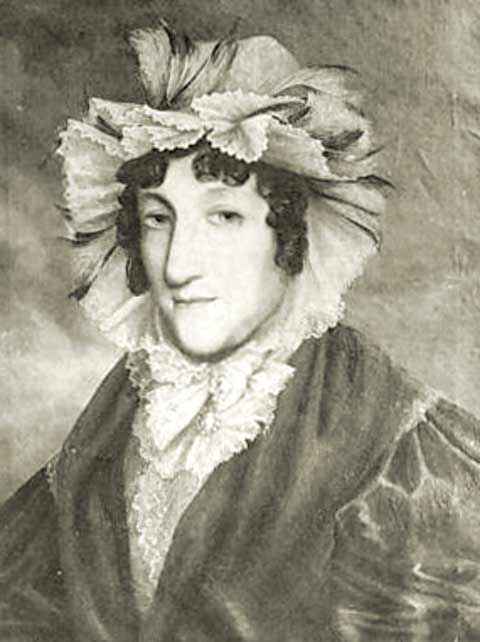
Last February in Australia, an 1823 portrait in Sydney’s Jewish Museum riveted my attention.  Just a few tantalizing facts identified its dark-eyed society matron.  I had to know more . . . .
Australia-Abrahams

Her Newgate Prison jailors never imagined how far Esther Abrahams would travel.  In 1786 London, pregnant prisoners like this young Jewish woman often died before or soon after giving birth.  Yet fifteen year-old Esther and her infant daughter Roseanna survived and  made an astounding journey—one that spanned thousands of miles and a vast social gulf.    Esther Abrahams arrived in colonial Australia as a convict but became for a time its ‘First Lady’!  With determination and sharp sense, she founded a dynasty that included illustrious military and political leaders.   Ironically, she also fought—and lost—a bitter legal struggle with one of her own sons.
Esther’s amazing story began officially in the courtroom of London’s “Old Bailey.”  On August 26, 1786, shopkeeper Hannah Crockett testified that she had seen the unemployed milliner steal 24 yards of black silk lace.   Three character witnesses spoke for law-abiding Esther, but could not sway the jury.  She was convicted of shoplifting, punishable then by hanging.     

The British government, though, had plans to transport some convicts to its newest, most distant colony—Australia.  This would empty Britain’s disease-ridden prisons while establishing its claim to Australia with a permanent settlement.  Esther Abrahams—unmarried and recently pregnant—would not hang.  Instead, she received the standard sentence: seven years “transportation.”  Once this First Fleet of convicts with its military guards reached Australia, she and others would work as prisoners.   In May, 1787, Esther and two month old Roseanna boarded one of the fleet’s six convict-bearing ships, the Lady Penryhn, moving from one harsh prison to another.

The fleet’s 193 women prisoners were kept apart from the 582 convicted men.  Aboard the Lady Penryhn, female convicts were housed far below the waterline, in a low-ceilinged area with boarded-up portholes.  The guards, fearing possible fires, forbade candles.  The lice-ridden, feverish women could smell but not always see dead rats nearby.  Dirty bilge water added to the stench.  Rations were skimpy.   When sailors offered extra food in exchange for sex, older prisoners advised the younger women to accept.  Some desperate women stole from each other and fought.                              

In these bleak conditions, Esther Abrahams met Lt. George Johnson, a well-born, 23 year-old Marine officer.  Johnson, battle-hardened in North America, was responsible for keeping order among the Lady Penryhn’s prisoners.  Guards might have called him below deck to help settle a fight.   Perhaps he first saw Esther then.  Possibly Esther went out of her way to catch his eye.  The account in Johnson’s diary of their first meeting is lost to us, destroyed by an embarrassed descendent.  But ship records show that in October, 1787, when the Lady Penrhyn docked in Cape Town, South Africa for supplies, Lt. Johnson purchased a nanny goat.  It provided Esther and her baby with fresh milk.  They no longer had to “make do” with convict rations of salt pork, dried biscuit, and pea gruel.   Johnson’s protection also saved Esther from the horrors undergone by women convicts during the colony’s first months in Sydney Harbor, after the fleet arrived in January, 1788.  Rape, lack of shelter, and near-starvation were common.  This alliance benefitted George Johnson too, since Esther brought brains as well as beauty to what became a lifelong relationship. 

During the next years, Esther (or “Hetty,” as Johnson affectionately called her) gave birth to two sons and miscarried another child.  Johnson was then promoted, receiving a land grant of 600 acres that he named “Annandale.”   Esther supervised the construction of their home when Johnson was away.   Annandale House, one of the first large brick buildings in Australia, became the center of its own village.  Johnson and Esther raised wheat, maize, and livestock that they sold to the government.   Another son and four daughters expanded the still-unmarried couple’s family.  When Johnson was promoted again and spent even more time away, Esther managed their land holdings and thriving cattle business.  Disgruntled traders complained to officials about bargains struck by “Johnson’s woman, a Jewess.”  One of Esther’s supporters testified, however, that she “accumulated her property by hard struggling, that it was not [Johnson] who got the money” for Annandale’s household.   As one grandson later said, Esther was “a strong industrious woman.”

In 1808, Johnson supported a mutiny by other wealthy settlers and officers against the  colony’s new governor, William Bligh, infamous as captain of H.M S. Bounty.  Johnson arrested Bligh and for the next six months was the acting Lieutenant-Governor of Australia.  Esther Abrahams by association became its ‘First Lady.’   Yet Esther cannily avoided public attention, knowing that her convict past would weigh against her.  Johnson did not move into Sydney’s Government House.   Even while Annandale served as the governor’s residence, Esther remained in the background.  This shrewdness kept Johnson’s business going and earned Esther a land holding in her own name while Johnson was in Britain, recalled to defend his part in the mutiny.  Johnson was cashiered from the army, but was cleared of the worst charges.  He returned to Australia a free man four years later.                  

In 1814, after twenty-five years and seven children, Esther and Johnson officially married.    Australia’s governor had insisted that the couple become socially “respectable.”  Esther probably gave little thought to marrying outside her faith, since colony officials considered children legitimate only if their parents had wed in a Christian ceremony, and the 30 to 40 Jews in Australia had no rabbi.    Esther’s daughter Roseanna also had a Protestant marriage, to emancipated convict Isaac Nichols, who became Sydney’s first Postmaster.   Esther had identified herself willingly as a Jew for First Fleet records, unlike some of the 14 other Jews transported then.  Their religion is officially known only because they took oaths in court on the Hebrew Bible.   Yet when Sydney’s first synagogue was built in 1844, none of Esther’s children or grandchildren were members.  They had assimilated into Christian society.

Ironically, Esther’s “respectable” position as Mrs. Johnson brought grief to her last years.  Her wealth divided her family after her husband’s 1823 death.  Johnson had left the Annandale estate to Esther for ‘the term of her natural life,’ after which son Robert would inherit it.  Robert was not willing to wait.  In 1829, he took his mother to court, seeking to have her declared senile.   Aging, sometimes eccentric Esther did have short term memory problems, but was shocked when a jury declared her “insane with lucid moments.”  Dismaying both Esther and Robert, the court appointed a trustee to manage her property.  Mrs. Johnson retreated to the country home of youngest son David, where she lived quietly until her death in 1846.   

Yet the amazing saga of convict Esther Abrahams did not end there.  Some of her descendants became renowned, influential leaders in Australia.  Grandson George Nichols, born to daughter Roseanna, was elected to the New South Wales legislature.   He successfully argued for the right of rabbis to receive the same public funding as Christian ministers.   When the Sydney Synagogue officially thanked him, it described Nichols as the “grandson of Esther Abrahams.”  Nichols also donated 100 pounds to Sydney’s proposed Hebrew Grammar School.  He served as the colony’s Auditor-General before his death in 1857.

In 1988, Admiral Sir David Martin, chief of Australia’s navy, was appointed Governor of New South Wales.   Before he died in 1990, this great-great-great grandson of Esther Abrahams and George Johnson established a foundation to help needy, homeless young people.  Perhaps Sir Martin, a proud member of the Fellowship of First Fleeters, thought of teenaged Esther Abrahams’ plight as he began this charity.  How that young Jewish woman, whose portrait is now displayed in Sydney’s Jewish Museum, would have marveled at this turn of events! 


Posted in articles | Tagged , , , , , , , , , , | Leave a comment

Graphic Content! The Culture of Comic Books (Compass Point Books, 2010)

bk_graphic_140

Donald Duck in Sweden? Teenage superheroes with everyday problems?  People imprisoned or executed for creating comic books?  The life of Buddha honored in a graphic novel?  Get ready to be astonished by the pop culture blaze kept alive today by comic books.

From short strips printed on cheap paper to award-winning novels, comic books have come a long way.  Their evolution mirrors the way our world has become more complicated and connected in the last 100 years.  The great news?  These exciting changes are not over yet.

Awards & Recognition

Pennsylvania School Librarians 2011 “Book of Note” for young adults

Posted in Books | Leave a comment

Japan–47 Ronin and 50,000 Manga

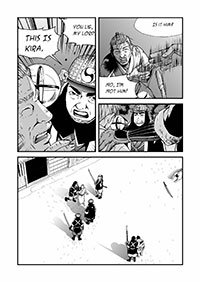
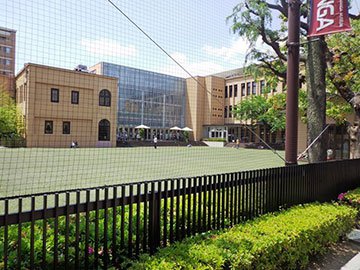
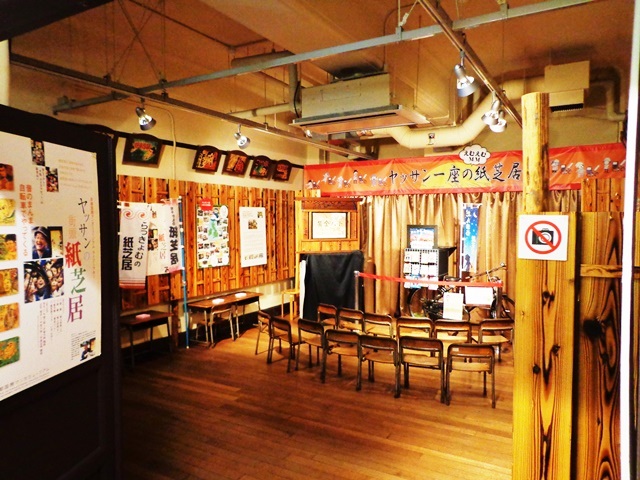
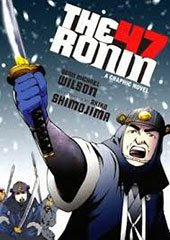
47 Ronin and 50,000 manga highlighted my trip to Japan last month.  Our week in Tokyo began with a professional gathering featuring writer Sean Michael Wilson.  His recent The 47 Ronin: A Graphic Novel (2013), illustrated by Akiko Shimojima, recounts a series of  important, iconic events in Japanese history.  Our next week in Kyoto began with a tour of the splendid Kyoto International Manga Museum, which makes 50,000 manga (out of its 300,000 archived materials) available to on-site readers.  I am all smiles as I think about these experiences, and am very happy to ‘relive’ them with you here.

bk_47Ronin1

My husband Don Larsson and I joined members of the Society of Children’s Book Writers and Illustrators/Japan Chapter (SCBWI/Japan) in an evening of hands-on fun, working under Sean Wilson’s affable direction to produce our own, spontaneous two-page graphic mini-stories.  But first we heard a bit about graphic novels in general, how Sean’s interest in the field began in his Scots boyhood, and how he works with illustrators to create a variety of graphic novels and manga.  The conversation continued over a post-workshop meal, during which I was pleased to have my own copy of The 47 Ronin (brought all the way from the U.S.) personally inscribed by its author.  As I toured historical sites and museums during the next weeks, I came to realize how central to Japanese culture the events and issues in this fine book are.

Honor and loyalty—valued above individual life—are at the heart of the 1701 C.E. events that for centuries have sparked Japanese plays, wood block prints, opera, movies, and television shows, as well as graphic novels.  (In fact, Hollywood even recently produced its own glitzy, fantastic version of 47 Ronin, starring Keanu Reeves as a fictional action-adventure hero inserted into these historical events.)  Simply put, in 1701 young Lord Asano Takumi-no-Kami Naganori stomached higher–ranked Lord Kira Kozuke-no-Sue Yoshinaka’s many insults until Asano felt his honor required him to strike Kira.  Asano did this, even though he knew that this attack, committed in the imperial palace, was illegal and would require his own death.  It would leave his family in peril and his loyal followers leaderless—no longer honored samurai warriors but wandering ronin (swordsmen).  Kira survived Asano’s blow, but Asano suffered the expected consequences.    

bk_47Roning_interior_200

After Asano was arrested and committed seppuku (ritual suicide), 47 of his  ronin followed the samurai code of honor, carefully planning an attack two years later on Kira to avenge their dead lord.  They did this even though the loyal men knew that they too would forfeit their lives for this deed.  Each year, the Buddhist Sengaku-ji Temple where Asano and his ronin are buried hosts a ceremony in honor of their righteous, self-sacrificing bravery.  In fact, the day my husband and I visited their tombs and the small museum dedicated to them, we saw an elderly couple placing lit incense sticks in front of each of the 48 gravesites.  This “national legend” still is vividly alive for some Japanese—and Wilson and Shimojima’s graphic novel is a fine tribute to its iconic status.

The book’s ten chapters, each introduced on a page featuring a samurai’s hand grasping his all-important sword, make effective use of many wordless pages in its crisply-paced retelling of historical events.  Beginning panels range from long and mid-distance perspectives to close-ups on marching feet and a face to convey Lord Asano’s lengthy journey to the capital city of Edo (now Tokyo).  Then, a double-page spread reveals the impressive size of his destination, identified as “Edo Castle!”  Throughout the novel, illustrator Shimojima continues her deft touch with subtle but telling details: in one panel, a seated Asano, simmering with rage, clenches his fists with unspoken anger.  Another extended, nearly-wordless sequence conveys the steps involved in Asano’s  blood-drenched ritual suicide, completed by the “SwiiiShhh. .” and “FLIIISH” of a helper’s sword that then traditionally beheads the self-gutted, dying man. 

gr_edocastle_360

Other wordless sections in which Wilson’s planning and Shimojima’s execution shine include a montage page depicting five different groups at one point in the ronins’ lengthy plotting of their revenge.  We see ronin who have inserted themselves as workers and merchants near their target Kira’s home; Kira  himself with two servants; the departing family of chief ronin Oishi Kuranosuke Yoshio, whom he has spurned to protect them; and—at the center—Oishi with his son, a teen who has seen through his father’s pretense and remained to join the avenging ronin.  That planned attack, on a snowy winter night, also contains several very effective wordless sequences, examining the event from multiple perspectives.  These include the blood spatter and spray as Kira’s guards are killed; an attacking archer’s overhead view of the guard he is about to shoot; and a close-up of Kira’s worried face when he hears the first suspicious noises.   

Writer Wilson’s dialogue seamlessly intertwines with these images, propelling the action smoothly and clearly.  From Kira’s first sarcastic, biting remarks to Asano to Kira’s frantic screeches when he realizes he is under attack, their tone reinforced by the angular word balloons in which they appear, Wilson effectively communicates Kira’s personality and character.  We are not surprised when Kira, captured by the ronin, is too cowardly to accept their offer of an honorable death by suicide.  The avenging ronin slay him.  This graphic novel, unlike others about this iconic series of events, is the first to tell them with historical accuracy and balance.  Wilson depicts the ronins’ disagreements about whether and when to slay Kira.  To this day, there are still questions about whether it would have been more honorable to have immediately avenged Asano rather than wait as long as the 47 did.  Yet Japanese admiration of their loyalty and honor remains paramount: the novel ends with a young family paying their respects at the Sengaku-ji tombsite—the one I saw being solemnly honored by that elderly couple during my own, more casual visit.

0524-Kyoto20-Manga-Museum_320

 Kyoto’s delightful International Manga Museum may also be visited by the curious and the committed.  Scholars and teachers may make serious use of its research library or ask to see some of the 250,000 manga stored underground, preserved in climate-controlled archives.  (Kyota Seika University  and the city of Kyoto sponsor the museum.)  Casual visitors and manga fans may just take pleasure in the museum’s exhibits and its touchable “Wall of Manga”—shelves full of mostly paperback manga (from 1945 onward) that range across the three floors of this former junior high school.  My own visit was a wonderful combination, as it began with a personal, professional  tour generously provided by the museum’s public relations officer Hiroko Nakamura and also included a brief talk with university researcher Sookyung Yoo.  I learned about the Genga’ (Dash) project, designed to digitally reproduce and thus preserve some important manga from the 1920s onward.  I also learned how local school children and families as well as fans from around the globe make this museum a place humming with excitement and fun!  I spent the next hour or two being one of those happy fans.

0524 Kyoto06 Manga Museum (1)

Rotating special exhibits may be the draw, or you may find readers heading straight for the separate floors devoted to boys, girls, and young adult manga.  There are also shelves highlighting manga and graphic novels from around the world and a “best of the year” collection.  If you stop in at the right times, you may be lucky enough to see and hear some ‘old-fashioned’ kamishibai (picture-story) storytelling, see manga artists at work, or have your own portrait drawn ‘manga-style.’   The “What is manga?” display in the main exhibition area is an excellent, thoughtfully detailed introduction (in both Japanese and English) to the subject.

0524 Kyoto11 Manga Museum


Besides zooming in on the manga produced during important years in our lives, my husband and I particularly enjoyed two other features of Kyoto’s International Manga Museum.  Its hallway walls are lined with pictures of maiko (apprentice geishas wearing traditional kimonos) drawn by 174 different manga artists.  It was great fun to see how they had interpreted this ‘assignment,’ with results ranging  from grumpy to silly to scary figures in kimonos.  There was even a cat geisha there!  Professional manga makers who visit the museum are also asked to have a plaster cast made of their dominant hand holding a pen or brush.  Seeing these replicas showcased in waist-high glass cabinets was another sort of thrill.  These small-scale delights were offset by another, gigantic one: a huge sculpture of a phoenix hanging in the museum’s atrium.  The Phoenix is both a traditional symbol of Kyoto and a central character in a manga series by influential Japanese artist/author Tezuka Osamu.  When we stood under that giant carved Phoenix, we were smiling hugely—as our photo shows!

0524 Kyoto13 Manga Museum (1)

Visiting Kyoto was a rare opportunity, but I have bookmarked the Kyoto Manga Museum’s website to keep track of its rotating exhibits.  That information is itself a resource I intend to use, and one I can heartily recommend to you as well.


Posted in graphic novels, manga, Uncategorized | Tagged , , , , , , , , , , , | Leave a comment