
“Weathering the storm” can mean surviving all sorts of difficulties—emotional as well as physical. Since last month’s Typhoon Haiyan seized the Philippines and tornadoes blasted through the U.S. Midwest, though, waves of wind and water have been uppermost on my mind. I tracked Haiyan particularly closely as my adult son was in the Philippine capital, Manila, while Haiyan raged through the island nation. Manila (and my son) were spared, but so many people were not… It is difficult to make sense of such tragedies and their aftermath. As a result, today I am writing about four graphic novels that feature monumental storms. These gripping books range from non-fiction to a fictional crime caper, both impelled by Hurricane Katrina, to the myths and tall tales people have created to explain drenching floods and deadly, dust-filled droughts. The Katrina books contain details and language that readers tween and up will absorb, while the other books will resonate with readers of all ages.
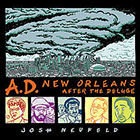 Artist/illustrator Josh Neufeld began A.D.: New Orleans After the Deluge (2009) after serving as a Red Cross volunteer with victims of 2005’s Hurricane Katrina. In his Introduction and Afterword to this non-fiction book, Neufeld provides statistics about the impact of the devastating storm. He explains how he chose to “tell the story from the perspective of a range of real people…” as well as describing “certain key experiences” about “evacuating the city, facing the flooding, being trapped in the Superdome or Convention Center, and losing all your possessions.” Neufeld interviewed and kept in touch with seven adults who had lived through Katrina, vividly recreating their different personalities and experiences before, during, and after the storm. An underemployed Black counselor living with her extended, female family; a White, ‘Yuppie’ husband and wife; an Iranian-born shopkeeper and his Black, working-class buddy; a middle-class Black teenager, son of a pastor; an upper-class, gay White doctor: these are the real people whose lives Neufeld dramatically captures, the “beating hearts and souls of A.D.,” to whom he dedicates this book.
We come to know and care about these people through Neufeld’s sharp, skillful renditions of their words, deeds, and emotions. A.D. opens with a section about “The Storm” itself, zooming in from outer space with boldly-drawn, then finely-detailed views of New Orleans. We see Katrina’s dramatic impact on the cityscape, sometimes in powerful double spread images, before we ever meet its citizens. But how quickly we come to know them! Abbas and Darnell’s initial, cheerful determination that they can ‘wait out’ the storm is captured in their sparkling fist-bump, Darnell saying “Bro, we are all set. It’s gonna be just like ‘Survivor’!” Yet too soon we see in dramatic double spread images how shaken they and others are by Katrina’s incredible devastation. In the center of one dark-grounded double page, Darnell and Abbas are shown in chest-high muddy water, imagining lighter-colored snakes and alligators swirling around them. A few pages on, the real danger of mosquitos to them is suggested by another, atypically humorous double spread, with one page’s tiny “G’night” ironically facing the other’s image of a giant, buzzing mosquito. The next morning, the men are covered in bites.

Neufeld uses double spreads more often to convey painful realizations and realities. He depicts from an overhead, distant perspective the horde of homeless victims waiting to shelter in the city’s Convention Center. In close-up, Neufeld later shows the anguished faces of these people, with their escalating, rumor-fueled fears captured in three word balloons widely-separated across the pages: “There ain’t gonna be no buses comin’!” “They gonna open the floodgates and drown us!” “THEY BROUGHT US HERE TO DIE!” The two-tone contrast used throughout A.D. heightens the impact of such scenes. (The reason for shifting from one color combo to another, though, is not clear.) In smaller panels, color contrast also conveys Denise’s silent, bleak anger as her extended family is turned away from its promised shelter. Her articulate bitterness bursts out later, during Katrina’s immediate aftermath, in a word balloon superimposed over a desolated neighborhood, when she remarks, “This isn’t my life. This is the life of someone I wouldn’t even want to shake hands with.” Neufeld then shows us Denise herself, her hand covering a probably tear-filled face, as she goes on to say, “I think a big part of me was swept away in that hurricane.”
A.D.’s concluding section, titled “The Return,” updates readers about its protagonists and New Orleans’ efforts at recovery through 2008. That remains a mixed success. As Denise, now employed successfully full-time notes, “I am home. But it’s not over.” A large panel depicting the FEMA trailers that were supposed to be temporary shelters contains Denise’s final remark: “We’re not all home yet.” That is the last, powerful image in Neufeld’s book. Yet he and his seven protagonists have remained in touch; A.D’s Afterward describes some of their activities through 2010. There are even more recent updates. In blog posts, New Yorker Neufeld describes how—after 2012’s Hurricane Sandy blasted the Northeast—some of the seven contacted him to see how he had weathered that storm. Neufeld himself is active in Hurricane Sandy relief efforts, some focused on book collections, with projects as current as last month.
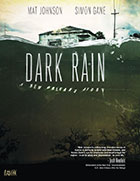 Another graphic work springing from Hurricane Katrina further shows how monumental storms bring out both the best and worst in people. Dark Rain: A New Orleans Story (2010), written by Mat Johnson and drawn by Simon Gane, with Lee Loughbridge providing grey tones and color and Pat Brosseau the lettering, is a well-done fictional crime caper. Its central plot is a bank heist made possible by the chaos Katrina causes. The book’s events include episodes of violence—with dramatically lettered sound effects such as “BANG,” CREEACK,” “BRAKA BRAKA,” and “BOOM”—typical in action-packed comic books. Similarly, its ex-con hero and its villains—a brutal mercenary soldier named Colonel Driggs and a self-satisfied, snobbish bank manager—are familiar types we have met before. (Ex-con Dabny, the book’s hero, has only broken the law once before, to raise money for his young daughter. This former customs inspector gets involved in the heist when an old cellmate asks for a ride.) Yet the fast-paced action, expressive drawing, shifts between wide and close-shot images, and dramatic use of a limited, dark color palette elevate Dark Rain beyond a typical crime comic. It tells its tale so very well. Sophisticated readers may anticipate much of its outcome, including Dabny’s romance with a strong-willed woman he rescues and his reunion with his daughter, but seeing how the story lines develop and how characters cope with Katrina’s dangers and difficulties hold our attention enjoyably.
Nearly half of Dark Rain’s focus is on the hurricane’s impact on its protagonists and the ordinary citizens of New Orleans and neighboring communities. Some of these communities welcome refugees, while others turn them away. Poor, Black citizens of New Orleans, already an underclass in ‘the Big Easy,’ fare worst in the days following the storm. Yet Johnson and Gane also show how some characters defy stereotypes and expectations. Young gang members help the ill and elderly suffering outside the Superdome, even as their gang clothing and rough appearance cause more conventional citizens to fear them. Katrina’s ‘dark rain’ is brightened by the goodness of some people, even while it foils some of the worst aims of Colonel Driggs and his mercenary force, itself ironically named “Dark Rain Security.”
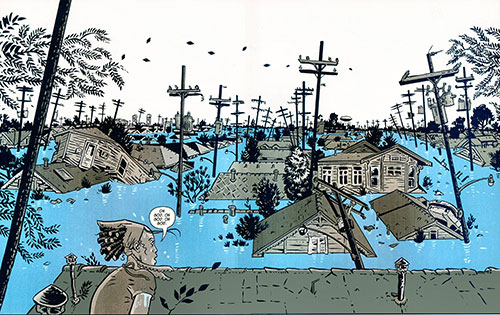
One character in Dark Rain remarks about a wrecked neighborhood, “It ain’t right.” Dabny replies, “Not a matter of right or wrong. It’s a hurricane. It’s a flood. It’s not a question of right or wrong, it just is.” Yet Dabny’s view of natural disasters—a view many nowadays, including most scientists, share—has not always been the dominant one. Cultures world-wide have created myths or used religion to explain the occurrence of torrential rains and floods. Three of these ancient explanations are highlighted, others more briefly mentioned, in a recent, beautiful graphic collection of myths. The only ugly thing about this book is its awkwardly long title: Some New Kind of Slaughter—or—Lost in the Flood (and How We Found Home Again) Diluvian Myths from Around the World (2007).
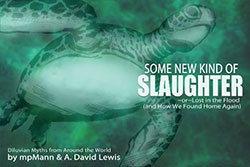 Illustrator MP Mann and author A. David Lewis focus on Zizundra, the ark builder in the ancient Sumerian Epic of Gilgamesh; Noah in the Judeo-Christian tradition; and Da Yu, who controlled floods in Chinese legend. Mann and Lewis weave these stories along with their own creation of a modern “eco-warrior,” a scientist racing to save her U.S. coast family from an approaching Force Four hurricane, into a blended quartet of tales. Organized by a timeframe of “Warnings,” “Preparations,” “Deluge,” and then “Aftermath,” these four main flood stories sometimes converge on pages with four, rectangular panels, each panel illustrating a different flood. At other times, the majestic words of an ancient epic or Bible appear inside modern flood panels. Sometimes, images from different time periods appear within the same large panel.
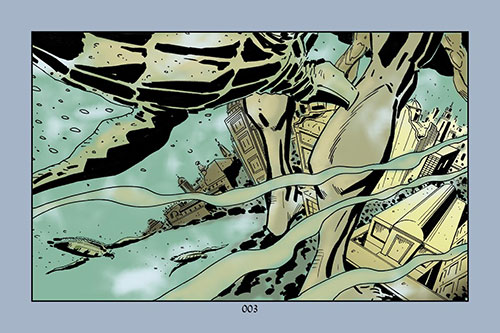
I particularly enjoyed such a full page spread early in the “Warnings” section. It depicts underwater the bare legs of an ancient prophet alongside the swimming sea turtle of many legends as these foregrounded figures approach the sunken ruins of four different cultures. A full-color palette is used to great effect throughout this book. Older readers will appreciate the overlap and blending of stories here, including the dreams and adventures of the modern, heroic scientist/mother, while younger readers may take more pleasure in the ancient stories, including the brief accounts of Native American, African, and Australasian flood legends.
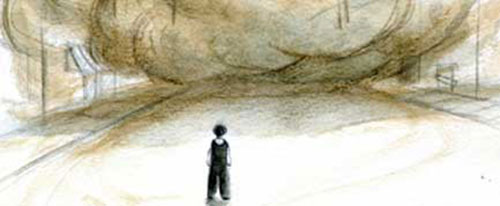
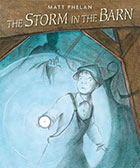 Readers of all ages will enjoy author/illustrator Matt Phelan’s The Storm in the Barn (2009), centered about a different kind of disastrous “rain”—ongoing dust storms. These caused “dust pneumonia” and even “dust dementia” during the prolonged 1930s drought that turned parts of the U.S. and Canada into a savagely poor, barren “Dust Bowl.” Phelan’s swirling lines and muted water color tones, along with a multilayered storyline, have earned this book many kudos, including the 2010 Scott O’Dell Award for historical fiction, the American Library Association’s designation as a Notable Children’s Book, and a YALSA accolade as a Great Graphic Novel for Teens.
We quickly come to care about Jack Clark, Phelan’s 11-year-old protagonist, as he copes with bullies, harsh events such as the mass clubbing of rabbits, and the frightening mystery of a looming figure in the barn. Is Jack himself suffering “dust dementia” when he sees this eerily rain-drenched figure—or is this a supernatural creature, one who has been keeping needed rain away from the area? Maybe a friendly shopkeeper’s tall tales about heroic “Jacks” who defeat gigantic Kings of Blizzards and Northeast Winds have led a sick Jack to imagine a terrible “Storm King” who is malevolently holding rain hostage. Or perhaps this really is an encounter with the supernatural, akin to the world-wide myths about floods described in Some Kind of Slaughter. Phelan begins the novel with an epigraph (from a scientific manual, no less) which supports that possible interpretation: “Every theory of the course of events in nature is necessarily based on some process of simplification of the phenomena and is to some extent therefore a fairy tale.” The many wordless panels support both possibilities—a supernatural encounter as well as illness. The varying size of the panels also make readers aware of how time seems to slow down for people awaiting a terrible event and speeds up for those trying to flee it. The Storm in the Barn concludes with Jack Clark’s father acknowledging the way his son has faced down his fear, whatever its cause, and giving Jack the increased responsibility and respect he has earned.
Just as Japan’s 2011 earthquake and tsunami, combined with the resulting nuclear power plant accident, have inspired some manga about those disasters, I expect that Hurricane Haiyan, the inspiration for this blog post, may feature in future graphic works. As for me, I am anticipating a late December visit from my son. I can only hope that, having avoided Haiyan, he is not delayed by any of the blizzards or ice storms winter brings us here in Minnesota! I would rather weather those storms after his safe, timely arrival.
 Unlike the parents who objected to Rowell’s novel, taking its use of obscenity and profanity wrongheadedly out of context (from my point-of view), I found Rowell’s dialogue fresh and natural, her insights into teens and adults sharp and nuanced. I thought it ironic that while her character Eleanor finds safety with an uncle in St. Paul, author Rowell had been ‘uninvited’ to speak with students in St. Paul’s neighboring Anoka-Hennepin School District. Now, nearly two months later, I am pleased to learn that the St. Paul Library itself has invited Rowell to visit and has selected Eleanor & Park for its community-wide
 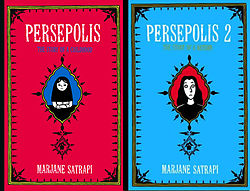 Yet challenges of individual books—including graphic novels—continue to be made by concerned parents and community groups, occasionally even educators, for a variety of often well-intentioned reasons. And sometimes (from my point-of-view) their objections have some merit, although I would argue that censorship is not the solution to the problems, real or potential, they identify. One case of this is the Spring, 2013 challenges brought in Chicago to Marjane Satrapi’s acclaimed Persepolis: The Story of a Childhood. (Nowadays this memoir is also published together with Persepolis 2: The Story of a Return in one volume titled The Complete Persepolis.)
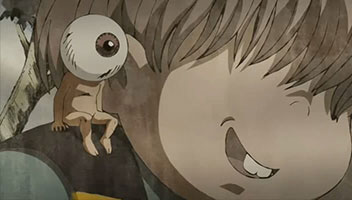 Perplexed by that drawing of a shaggy-headed, one-eyed boy, with an eyeball-shaped critter perched on top of his head? You may be amazed to discover that Japanese storyteller Shigeru Mizuki has spun hundreds of tales about this cartoon creation of his—a supernatural hero named “Kitaro.”
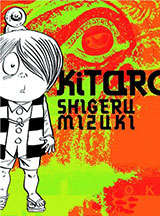 October 31 means spooky fun for kids in North America and parts of western Europe. The thrills and chills of Halloween ‘haunted houses,’ eerie hayrides, and ghastly costumes also appeal to many tweens and teens. Now, thanks to a brand-new translation into English, we readers of Japanese manga (comic books and graphic novels, typeset back-to-front) have a special Halloween treat. With Kitaro (2013), we can finally enjoy the popular cartoon character who, for more than fifty years, has brought supernatural adventures year-round to Japanese readers young and old. In Japan, the character of Kitaro is as popular and well-known as Charlie Brown and Garfield are in the United States. Like those characters and their cartoon pals, Kitaro and his associates have also starred in successful TV series, specials, and movies. Kitaro’s creator, Shigeru Mizuki, is as famous in Japan as Charlie Brown’s creator, Charles Shulz, is here in North America. His hometown of Sakaiminato hosts
 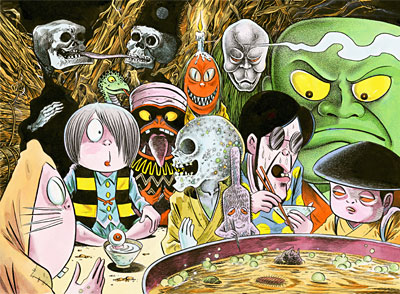 Like Kitaro himself, these creatures are “yokai”—a Japanese word that includes the wide range of supernatural creatures described in Japanese folktales first told hundreds of years ago. Often shape shifters, these spirits, ghosts, and demons may do good or evil. One part of Shigeru Mizuki’s achievements is his compilation of the many different local stories about yokai told all across Japan, bringing these to life through his drawn tales. When we meet these supernatural beings alongside Kitaro, the yokai character developed by Mizuki, the fun begins! Kitaro only (mostly) looks like an ordinary boy; this kind-hearted, brave figure is really the child of two ghosts, born in a graveyard, whose dead father has resurrected himself into an eye-ball sized helper who now lives inside Kitaro’s empty eyesocket! After popping up and out to aid Kitaro with tough problems, this creature likes to relax in a teacup bath. That kind of “yucky” detail is sure to entertain young readers, especially ones who appreciate the fake goo, gore, and grim elements of Halloween.
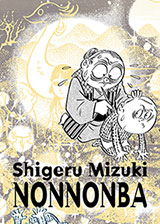 Readers who enjoy Kitaro may take further delight in Mizuki’s autobiographical NonNonBa (2012), a graphic novel depicting his boyhood in 1920s and 1930s Japan. NonNonBa is the nickname of the elderly neighbor who first taught young Shigeru about the spirits called called yokai. She also helped him cope with the harsh realities of disease and poverty in that place and time. Along with sadness and loss, this quiet novel of daily life contains moments of boyish fun and mayhem, parental wisdom and foolishness, and an awareness of mystical beliefs and connections that has remained important to Mizuki throughout his long life. (He is now a remarkable 92 years old!) NonNonBa, which contains helpful end notes similar to Kitaro’s, won an Angouleme award, an honor conferred by European graphic artists. Before these recent English translations, Mizuki’s books had been translated into French and Italian.
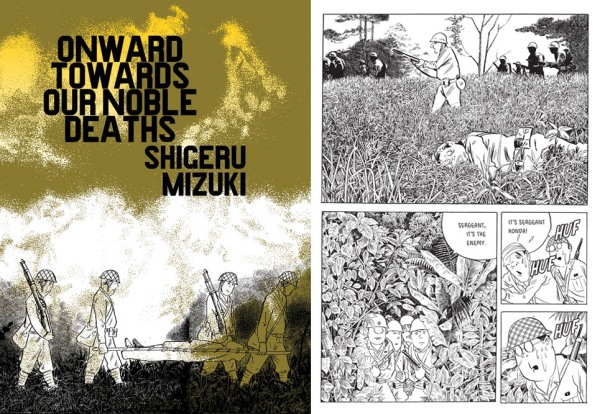 Having savored both Kitaro and NonNonBa, I now look forward to reading Shigeru Mizuki’s semi-autobiographical Onward Towards Our Noble Deaths (2011; published in Japan in 1973), an account of being a soldier in Papua New Guinea during World War II. Mizuki lost his left arm during that conflict. This loss, along with other wartime experiences, has led him to criticize war in interviews as well as his graphic works. The ironically-titled Onward Toward Our Noble Deaths won an Eisner Award after its English publication. This work as well as another recent Mizuki translation into English is far removed from the light-hearted, fake violence and thrilling chills of Halloween and the happy endings of Kitaro tales.
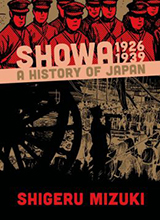 Mizuki’s Showa: 1926 – 1939: A History of Japan (2013) is the first volume of two covering the reign of Japan’s Emperor Hirohito, which lasted until 1989. Showa—looking at the situations and events, often brutal themselves, that led up to the official start of World War II—will be published on October 22, 2013. Its Canadian publisher,
 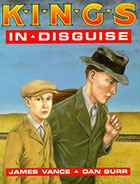 So, in tribute to my mother and others who weathered the Depression, finding some fellowship and reward in labor unions, I am blogging this month about two phenomenally powerful graphic novels set in 1930s America. The youthful protagonist in Kings in Disguise (1988; 2006) and its brand-new sequel, On the Ropes (2013), written by James Vance and illustrated by Dan E. Burr, is about the same age my mother was during the years they cover—1932 to 1937. Fictional Fred Bloch also has his education cut short by the Depression and his life affected by union activities. Fortunately, though, my mother never experienced the violent, real-life strikes and union-busting activities that are the factual basis for these historical novels. These events and similar ones are explained further in the nonfiction graphic works about labor leaders and history that I briefly describe at the end of this entry. While Vance and Burr’s novels are best appreciated by older readers (tween and up), three of the nonfiction works are suited to younger readers too.
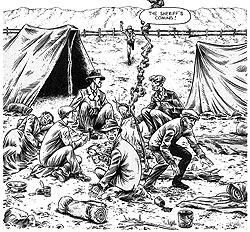 For most of this time, Fred rides the rails as a homeless hobo, seeing both the worst and best in human nature. He is befriended by older, tubercular Sam, who jokingly makes light of their straits by calling himself “the King of Spain” and Fred “the King of France.” Sam selflessly protects Fred from sexual predators, but he cannot protect him from the nightmares Fred has about those predators, or railroad guards who bludgeon hobos, or townspeople who destroy the ragtag, packing crate communities sometimes built by otherwise homeless wanderers. Burr’s black-and-white illustrations wonderfully communicate the hallucinatory, overwhelming nature of these nightmares, with images shown from different, at times distorted angles; faces sometimes drawn as gloating, cartoonish masks; and styles that vary from sharp, bold lines to swirling, lighter ones. Swathes of darkness, cross-hatched backgrounds, and frameless panels that alternate with or bleed into framed ones are also used to great effect. In these scenes and elsewhere, Burr’s visual narrative is so strong that entire pages are frequently wordless, yet they eloquently communicate both action-packed scenes and thought-filled revelations. Vance’s dialogue winding through other pages keeps readers in the moment with slang and expressions suited to the era—as Sam admiringly tells Fred at one point, “Boy, you said a mouthful!” Yet what he experiences in Detroit and nearby Dearborn, Michigan leaves even Fred speechless.
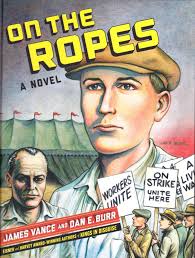 On the Ropes (2013) begins in 1937, with 17 to 18 year old Fred at work in the travelling WPA Circus. (This real-life organization was one of the more unusual groups sponsored by President Roosevelt’s Works Progress Administration to employ performers and artists.) Fred is the assistant to Gordon, the circus’s featured “Escape Artist,” who each performance defies death while hanging from a noose knotted around his neck. Hard-drinking, cynical Gordon—a disillusioned WW I veteran—early in the novel tells his impoverished, entertainment-hungry audience that “We’re all scared these days, my friends . . . on the ropes, like a nation of punch-drunk fighters.” This bleak view echoes the novel’s narrator, an older Fred who warns us right away that his adventure-filled tale is a grim one. As we see a young boy smiling up at the show and then see assistant Fred offstage, this narrator reflects that “So few understand that even though most of us escaped with our lives—that doesn’t mean that any of us survived.”
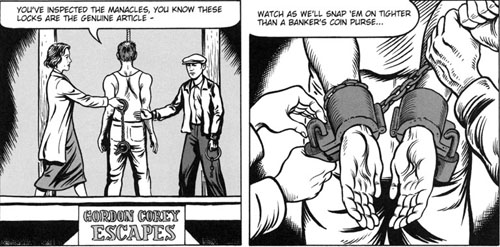 In flashbacks to the years between 1933 and 1937, Vance and Burr show us the physical as well as emotional costs Fred has paid for his life on the rails. Burr’s spot-on illustrations of period clothing, hairstyles, and settings transform into a surreal, photographic “negative” and then fade to black as Fred is maimed while trying to hop a ride . . . and briefly escapes into unconsciousness. Fred re-finds purpose for his life by becoming a travelling mail ‘drop’ for union activists; in the circus, he even finds his first, true love with manager’s assistant Eileen, herself not yet twenty. A journalist writing about the circus encourages Fred to rework his own writing into a book. Yet harsh realities—part of real labor history—crash into these dreams. Visiting that journalist, Fred witnesses the Republic Steel Strike, also known as the Memorial Day Massacre. In May 1937, Chicago police shot into and then beat a crowd of 1500 people outside the gates of the Republic Steel Factory. The police killed and injured not only laid-off workers but wives and children who had accompanied them on that holiday. While Fred is away from the circus, two thugs hired as union-busters—another labor history fact—come in search of him. Their brutal activities have been a subplot throughout the novel. Sexual violence, plus one thug’s past relationship with Gordon, tinges their actions. Not finding Fred, the union-busters ‘question’ Eileen. While this crime is not shown, Gordon and returning Fred’s final encounter with these murderers is depicted in a crescendo of violence. Close-ups, shifting points-of-view, and dramatic swathes of inky black and dark grey, along with pages of fast-paced, wordless action, sweep readers along at a breathless pace. Is what happens then justice, a “vigilante bloodbath,” or both? Regardless of the answer, what follows—in two nearly wordless pages in which Fred reaches towards a dying Gordon—is a remarkably wrenching visual coda.
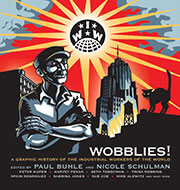 For more about labor history, leaders, and the conflicts between and within unions, older readers can turn to the non-fiction anthology Wobblies! A Graphic History of the Industrial Workers of the World (2005). Its editors Paul Buhle and Nicole Schulman provide clearly-written comments explaining and linking the entries they have chosen, created by 35 graphic authors and illustrators. These pieces display a wide range of graphic techniques and storytelling, many extremely effective, and cover less well-known events and figures as well as prominent ones. This is fascinating, sometimes disturbing reading.
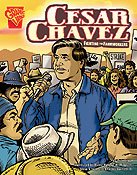 Younger readers interested in labor history and leaders will benefit from these non-fiction graphic works: Cesar Chavez: Fighting for Farmworkers (2006); Mother Jones: Labor Leader (2007); and The Triangle Shirtwaist Factory Fire (2006). The fast-paced storytelling of these books, part of Capstone Press’s Graphic Library series, and their distinction between original quotations (shown against a yellow background) and “made-up” dialogue are pluses that respect the abilities of all readers, regardless of age. Second language learners will also find these books worthwhile.
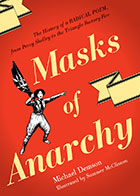 Finally—since I began this entry with “Who knew?” bit of family labor history—I think it appropriate that I end it with a “Who knew?” item of global labor history. I discovered this in a book with a mouthful of a title—Masks of Anarchy: The History of a Radical Poem, from Percy Shelley to the Triangle Factory Fire (2013), written by Michael Demson and illustrated by Summer McClinton. This non-fiction graphic work focuses on the impact one poem written by British Shelley had nearly a century later on the life and work of American labor organizer Pauline Newman. His inspirational words to suffering workers—“Ye are many, they are few.”—became her lifelong motto. I did not know that!
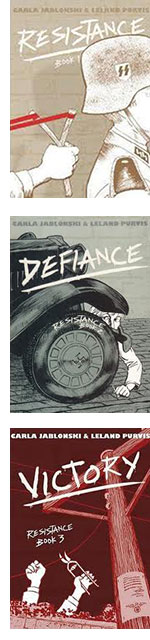 One possible answer is “resist the enemy.” French life after defeat by Nazi Germany is the focus of the Resistance trilogy (2010; 2011; 2012), written by Carla Jablonski, with art by Leland Purvis and color by Hilary Sycamore. The wrap-around covers of its volumes, viewed in sequence, show central character Paul’s growing towards adulthood as, between 1942 and 1945, he defies the Nazi regime. Resistance: Book 1, beginning three years into France’s occupation, depicts 13 year old Paul aiming a slingshot at a Nazi soldier. On the cover of Defiance: Resistance Book 2, 14 year old Paul has moved on to acts of sabotage, puncturing the tire of a car guarded by an armed Vichy policeman. The cover of Victory: Resistance Book 3, shows 15 to 16 year old Paul committing more physically-dangerous sabotage, destroying an overhead telephone line with a wire cutter. Yet braving physical danger is only one of the challenges facing Paul, his younger and older sisters Marie and Sophie, and his Jewish friend Henri.
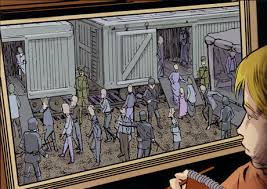 These second and third books depict Marie’s growing disillusionment with the Vichy government as well as further acts of sabotage, rescues of downed Allied pilots, and confrontations with Nazi troops. There is action aplenty for readers here! All the while, though, the Tessier family continues to deal with the brother-and-sister, parent-and-child, and schoolmate, sweetheart, and neighbor interactions that, in peacetime, would have been the focus of their lives. These relationships add luster to the trilogy’s concluding pages, as Paul watches the sparkling lights of Paris, now liberated from the Nazis. We have come to know Paul and his community, to understand why in an Author’s Note Jablonski distinguishes written history, with its “definite winners and losers, friends and enemies, loyalities and betrayals” from “History as lived [which] is anything but clear … filled with missteps, confusion, mistakes, and choices
 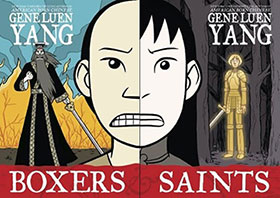 I wish author/illustrator Gene Luen Yang had included comparable introductions or notes for his stunning new graphic duology, Boxers & Saints (2013). In these volumes colored by Lark Pien, Yang—creator of the award-winning American Born Chinese (2006)—does an unforgettably good job of depicting teenagers who choose warfare, unlike Jablonski’s characters, whose resistance is a reaction to war imposed upon them. Boxers & Saints is set in 1900 China, a period in which some Chinese revolted against foreign influence, especially Christian missionaries, in their country. These Chinese “Boxers” fought for their own ways and religion and considered Chinese converts to Christianity, Yang’s “Saints,” to be their enemies, too. I think Yang’s powerful narrative and compelling images will keep readers engrossed in the story, but “at-hand” background information about this distant time and place and about traditional Chinese culture would have been useful. For instance, it is just assumed that the reader knows about women’s inferior position in that culture and our association with supposedly weakening “yin” energy as opposed to male “yang.” So is some knowledge about acupuncture, the history of the Chinese empire of the time, and Chinese religion and literature. Yet the internet and libraries are available and Yang does provide a “Further Reading” list. I believe intrigued readers both young and old will find any information they need, wanting to understand more about Yang’s compelling characters and the disturbing, sometimes mystifying events in their lives.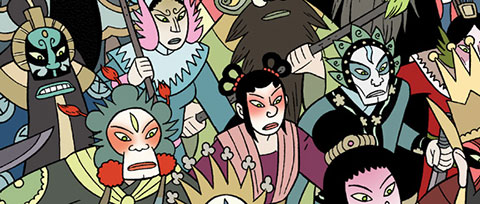
 The Captain America who first appeared in a 1941 Marvel comic book, created by Joe Simon and Jack Kirby, has undergone many transformations. At first, patriotic but frail Steve Rogers—given super strength and healing through an untested “super serum”—became costumed Captain America and helped win World War II. Later, Marvel employees depicted blonde Rogers fighting in other wars, sometimes with a sidekick. Some storylines even had Rogers travelling back in time, entering alternate universes, becoming the president, or turning into a zombie! Yet it is a different origin story of Captain America, at first not meant to tie into the Marvel universe(s) of tales, that is my focus. In 2003, writer Robert Morales, with illustrator Kyle Baker, tackled racism in America in a seven issue “mini-series” about
 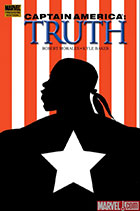 Morales was surprised that Marvel Publications accepted his concept for its copyrighted superhero, since his Truth drew upon some “staggeringly depressing” history. Yet the project was championed by Marvel editor Axel Alonso, who found it “especially meaningful…” to “edit a story that functions as a little more than pure entertainment.” As each issue appeared, Alonso recalls, reviewers initially opposed to the series’ basic premise began to see that it was about “building bridges between people, not burning them…” That premise is apparent in the very first image of Captain America: Truth—an African American man in a Captain America costume! Over the course of the novel, we learn how this character, Isaiah Bradley, wears that suit with valor, even though he and other Black soldiers are treated shamefully by the U.S. government, enduring much more than the segregation of their era.
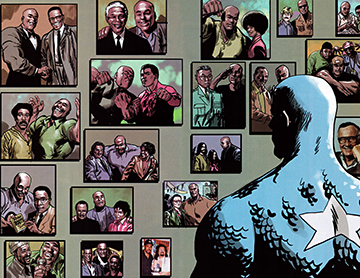 Captain America: Truth, though, does not end on a downbeat note. In “Chapter Six, The Whitewash,” Isaiah Bradley is captured but resists the attempts of Nazi officials (including Hitler himself!) to win him to their side. And, when Steve Rogers later learns how Bradley’s valor was concealed and his bravery actually punished by the U.S. Army, Rogers sets out to correct this terrible whitewashing of the truth. In the final, seventh chapter, tellingly titled “The Blackvine,” Rogers and we readers learn that Isaiah Bradley—while permanently damaged by official U.S. injustice—had never been forgotten by his wife Faith. Bradley has also achieved word-of-mouth fame and respect in the Black community and its supporters. On a double page spread, we see a costumed Steve Rogers examining a wall of photographs of world-renowned celebrities posing with smiling Isaiah Bradley. These are drawn realistically for easy identification. Everyone from South African leader Nelson Mandela to boxer Mohammed Ali and film maker Spike Lee, it seems, has known the truth about the first Captain America long before Steve Rogers and us readers! The book’s final narrative page shows a photo of both costumed Captain Americas, shoulder- to-shoulder and smiling. An inserted, smaller snapshot of joyful young Isaiah and Faith Bradley suggests that injured Isaiah is genuinely as happy now. He has made his own peace with the brutal “truths” just revealed to us so brilliantly by Robert Morales and Kyle Baker. Their tale suggests it is possible to move past our country’s shared hurtful past, once it is acknowledged.
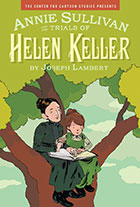 This “hidden” story of fictional Captain America is mirrored by the hidden (or at least overlooked) stories of real-life hero Helen Keller. Anyone who has seen William Gibson’s play The Miracle Worker, or the 1962 Oscar winning film version, might think a book could not rival that portrayal of young, blind-deaf Helen first comprehending language. Yet Lambert’s Annie Sullivan and the Trials of Helen Keller (2012) depicts this stunning moment at least as well as Gibson does.
 Lambert conveys the “trial” of blind-deafness through color and line. Before Helen understands language, Lambert casts her as a roughly outlined pale grey shadow against a black background. The touch of others is drawn as swooping, roughly outlined blue swatches. The finger signs Sullivan tries to teach Helen are also depicted in blue. Lambert creatively uses vertical and horizontal blue lines and swirls, separately and in combination, to show how Helen learns to connect water pouring out of a pump, her hand plunging into a pitcher of water, and falling droplets with the word “water.” As Helen acquires more language, filling the void that was her mind, Lambert fills the black background of panels with more and more labeled, outlined images of objects, in assorted muted hues.
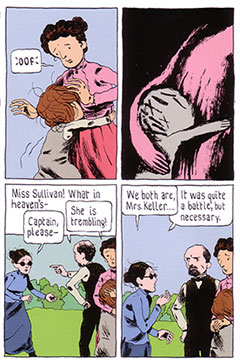 In contrast, the daily life of Annie Sullivan, Helen’s teacher, is depicted in a schematic style, devoid of shadows, both before she meets Helen and once Helen acquires language. This hyper-realistic style changes only when Lambert reveals their other “trials.” These centered upon Sullivan’s complex relationship with the Perkins School for the Blind in Boston, where vision-impaired Sullivan received her own education and where the Kellers found help for Helen. As Helen’s achievements receive public attention, Sullivan resents publicity that emphasizes Perkins School rather than her own efforts. This attitude leads to the book’s two other “trials.”
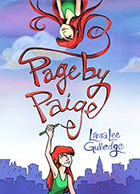 The focal character in author/illustrator Laura Lee Gulledge’s Page by Paige (2011) is 16-year-old Paige Turner. (She thinks her punning name is too cute, too.) Her family’s recent move from Virginia to New York City has left Paige feeling lost and insecure. Trying to figure out what to do about this, the young artist realizes, “I know I need to draw about it.” Gulledge’s work is, in fact, structured as a month-by-month sketch book kept by Paige, with each section also subtitled with one of her grandmother’s adages about art and life. One is “Figure out what scares you and DO IT.” Paige also thinks and feels in images. So, when she imagines ridding herself of negative thoughts, we see Paige’s head shaped like an upside-down salt shaker, with all those negative “shoulds,” “perhaps,” and “maybes” literally being shaken right out of her head! When she feels heartened by a hug from her father, we see her sheltered in the center of a large, intertwined skein of many loving arms.
 The tone and look of author/illustrator I. Merey’s gripping a + e 4EVER is much different than Gulledge’s novels. Merey uses visual elements typical in Japanese manga to depict the sometimes bleak and painful experiences of her teenage protagonists. High school juniors
 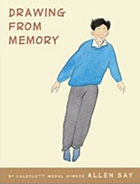 An illustrator of Caldecott-winning picture books for young readers, Allan Say in his memoir Drawing from Memory (2011) shows as well as tells about his fierce desire to be an artist. As a boy in 1930s and 1940s Japan, he had to overcome his family’s disdain for this ambition. His father, Say recalls, even said, “I expect you to be a respectable citizen, not an artist …” Kids will be fascinated by the determination with which young Say took every chance to seize his dream. Readers of all ages will be tickled to learn that teenaged Say and his fellow art apprentices actually appeared as characters in early manga comics penned by their sensei (master teacher), Norei Shinpei! Delightful panels from those strips, along with Say’s own softly-colored, more realistically styled drawings and black and white photographs illustrate this upbeat hybrid work, half-graphic novel and half-picture book. Beginning with his earliest years, it concludes with 17-year-old Say immigrating to the United States. A final, illustrated Author’s Note summarizes Say’s adult career and last meeting, in 2002, with his revered sensei. Their mutual respect and affection is touching. Drawing from Memory was commended as an Honor Book in the 2012 Robert F. Sibert Informational Book Award competition.
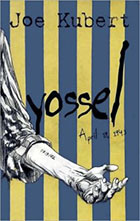 What might have happened to Allen Say, though, had he not immigrated? We may speculate, but we cannot know for sure. Jewish Joe Kubert, however, is certain that his family’s 1926 immigration from Poland, when he was an infant, saved his life. Unlike I. Meray’s Asher and Eulalie, who view their being Jewish as an almost irrelevant “difference,” by far the least of their concerns, in Poland Joe Kubert would almost surely have become a victim of the Nazi Holocaust. He would have been among the millions of people slaughtered just for being a Jew, along with millions of others declared criminally “different.” That alternate—and tragically truncated—lifetime, in a kind of alternate universe, is the basis of Kubert’s stunning graphic novel, Yossel: April 19, 1943: A Story of the Warsaw Ghetto Uprising. (2003; 2011). Yossel is the Yiddish name usually translated as Joe. The book Yossel depicts the life Kubert imagines he would have led in Poland.
 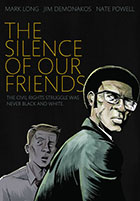 The Silence of Our Friends (2012), written by Mark Long and Jim Demanokos and illustrated by Nate Powell, is based on Long’s 1960s boyhood in Houston, Texas. Racist white people and institutions there often clashed with black individuals and groups seeking equal civil rights. A 1967 sit-down protest at Texas Southern University, the subsequent police riot, and the arrest of wrongly accused students, followed the next year by Dr. Martin Luther King’s assassination, had a powerful impact on young Mark. As an 8- or 9-year-old white boy, though, his understanding of these headline-making events was limited. This memoir moves among three viewpoints: Mark’s naïve impressions; those of his father, a TV news reporter committed to telling truths, despite opposition; and the experiences of Larry Thomas, a black community activist who with his young family broke conventions by becoming friends with the Longs. In the concluding Author’s Note to this memoir, Mark Long explains that some of its “details … have been changed for storytelling purposes.” The self-aware writer adds, “Creating a book like this one requires finding a balance between factual accuracy and emotional authenticity. What we have striven to create is a story that offers access to a particular moment in time ….” I believe that Long and his co-authors—through their skillful graphic storytelling—reach this goal, placing us on the scene in moving, dramatic ways. Even readers unfamiliar with this era and its conflicts will be drawn quickly into the memoir through its creators’ storytelling choices.
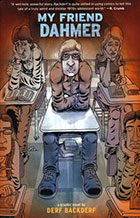 Author/illustrator Derf Backderf (pseudonym of John Backderf) also chose black and white for his provocative, gripping graphic novel My Friend Dahmer (2012). In the 1970s Backderf attended high school with Jeffrey Dahmer, the disturbed teenager who later became one of the United States’ most notorious serial killers. For this reason, even the title here is eye-catching! Backderf describes this book as a novel because he researched the story, interviewing many former classmates and teachers, reading related FBI and police files, and reviewing print and TV interviews with Dahmer and his family in ways Backderf did not in 2002. That year he published a much shorter version of this story—the incomplete version Backderf now calls “a straight memoir … culled entirely from [his] memory and from stories [his friends and he] … shared over the years.” This author is well-aware of memory’s possible flaws. The stark colors here suggest 1970s TV, newspapers, and school yearbooks, as well as the palette of 1930s through 50s horror movies. As Backderf draws rectangular-jawed Dahmer—and as the few snapshots of Dahmer included here suggest—the large, bulky teen somewhat resembled the Frankenstein monster of those films.
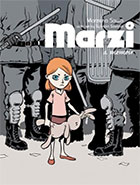 Marzi: A Memoir (2011) and Little White Duck: A Childhood in China (2012) are both excellent, satisfying reads and are similar in other ways, too. Each tells about the early life of its female writer in a Communist country, while each artist is either the author’s life partner or husband. Marzi’s author Marzena Sowa grew up in 1980s Poland, but now lives in France with her French partner, graphic artist Sylvain Savoia. Little White Duck’s author Na Liu immigrated from China in 1999 to work in the United States, where she met and now lives with her husband, artist Andres Vera Martinez. Each memoir—while including several extraordinary, history-making events—is most focused on what everyday life was like for young kids and their families under Communism. And each of these acclaimed, episodic books is accessible to a much broader range of readers than either its marketed audience or the age of its protagonists might suggest. Marzi was published as a book for adults, but the vivid, wryly insightful experiences of preschool through 10 year-old Marzi are, I believe, accessible and captivating for all ages. Similarly, while Little White Duck was published for kid readers, its content and presentation will also appeal to older ones, readers whose greater knowledge will add further resonance to the history there.
 In her Afterward to Little White Duck, Na Liu writes that the “China I grew up in is disappearing. The China my parents knew is almost gone.” She and her husband created this book to preserve these experiences for future generations. Little White Duck focuses most on its author’s early school years of 1976 through 1980. Whenever it describes the experiences of Na Liu’s parents, those more distant years are colored in one soft, single shade. Na Liu’s own childhood is more colorful, with techniques typical of different Chinese styles of painting—some featuring widespread landscapes, others having boldly-outlined figures—used in panels of varying sizes and arrangements. These pages alternate with single and double-spread pages without any panel borders, and at times—whenever Na Liu is reading or thinking about Chinese legends, for instance—mythological figures hover behind panels or even fly high above the landscape. This visual richness enhances the combination of family experience and Chinese history shared here.
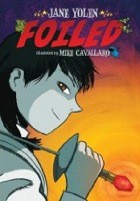 Aliera Carstairs does not fit in at her New York City high school. In Foiled (2010) and its sequel Curses! Foiled Again (2013), we see how important the sport of fencing is to her. Through hours of hard practice, she may have the chance to compete nationally. If only the practice fencing foil her mother bought at a garage sale were not an enchanted one, revealing that Aliera is the destined Defender of Faerie. If only the handsomest guy in school, her lab partner Avery, were not really a troll. When things and people are not as they seem, what’s a 10th grader to do? What rules should be broken … what promises kept? Aliera’s cousin Caroline, wheel-chair bound with rheumatoid arthritis, is a major character in both books, helping Aliera with strategy.
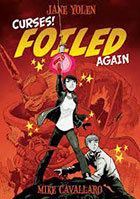 This variety of panel sizes, shapes, and perspectives is just one instance of Mike Cavallaro’s versatility and flair. The books’ action is also kept brisk with full page and double page spreads, and with pages where the absence of all words heightens tension and suspense. There is smart use of color to distinguish between the everyday world and Fairie, and to show Aliera’s growing ability to see the Fairie creatures infiltrating New York City. Sometimes Cavallero also uses different drawing styles to indicate velocity as creatures zoom, a magical storm rages, or Aliera charges into battle. I can see why Foiled was acclaimed as a YALSA Great Graphic Novel, A Texas Maverick Graphic Novel, and an Amelia Bloomer Recommended Title. I expect Curses! Foiled Again may win awards, too. I wonder if this second book contains the same clue that the first one did—a t-shirt Aliera wears there displays a quotation that became the next title. I think that careful readers may be able to spot and figure out the title of Aliera, Avery, and Caroline’s third, yet-to-be-written adventure.
 Author/illustrator
 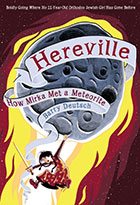 In Mirka Meets a Meteorite, green enters Deutsch’s palette, as both Earth and then Mirka are threatened by the space rock that, due to her latest dealings with the troll, has crashed to Earth. Mirka’s amazing race to reach a powerful, helpful witch before this crash occurs is shown in vivid detail, with her large, running figure overlaying many small thought panels. We then see close-ups of Mirka’s anguished face as she struggles to find strength, interspersed with close-ups of other body parts as she tries to rise from her knees or raise a foot just one more time. We turn the page right after seeing Mirka collapse only to see a wordless, double-page spread of the large blue meterorite just above the treetops! The next two pages keep us in further suspense, with images of blinding light, glimpses of a dazed Mirka, and the only words her bewildered, “What happened?” The fantastic answer to this question fuels the rest of the plot.
 Natalie Rosinsky